
Vladstradamus Part 1

Boss, IT Business, Microsoft
2 Comments

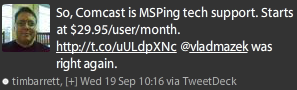
Comments like these have been coming in fast and furious over the past year or so:

Capture

… and to be honest they kind of piss me off because it makes me seem like some kind of a prophet. Like I foretold the demise of SBS, the end of SBSC, the Office 365 as the grim reaper of MSPs and that whole movement kind of going to crap.

I would like to remind you for a moment that I do not work for Microsoft.

It might be something I’ve said… but they don’t come to me for advice either. Just the check.

And while I’m being honest, you don’t need a crystal ball to tell that one man a business does not make.

The gurus, the experts, the masterminds and their universities? If they are even employed, they are in roles far from power or decision making responsibilities… because you don’t put a failed VAR in charge of business they have proven they can’t run, you put them up as a puppet to make it seem like you care. Which leads me to the most important point we can learn from the debacle of would-be SMB-IT:

It ain’t dead..

There is this myth out there that small business IT providers are struggling. We work with thousands of partners and I can tell you they are doing better than ever.

There is another myth that Microsof is somehow on a downward spiral in SMB without the partners.. quite the contrary: They are now charging what they used to give away for free, they have finally converted their products into annuities and they are converting all that inefficiency of inept computer repairmen into their reoccuring revenue.

Microsoft won. Partners won. The guys that lost out were idiots that argued with common sense – that’s not a prophecy, that’s just calling it like it is.

If I am guilty of anything.. it’s pointing out the trends, Microsoft CEO quotes, Microsoft product development, consumerization and other stuff any decent business owner and even middle level manager with 4 hours of community college economics would have told you: marketplace does not reward inefficiency.

Now for the really ugly truth

The death spiral of the SMB IT is just in it’s beginning. Don’t get me wrong, I don’t disagree with you about technology, implementation, best practices, your resume or how savvy you happen to be. You’re not wrong. It’s just that it doesn’t matter. Sorry.

The companies that are thriving right now are not necessarily great at IT.

But how can it be? How can something inferior beat out something that is so much better?

Because purchasing decisions in SMB, midmarket and even enterprise aren’t made on 100% rational arguments and the academic correctness of your thesis. They are made on limited information, great service, flexibility and the faith that you’re getting something more than you’re paying for (aka “getting a great deal”).

This is something that has been driving ExchangeDefender and it’s partners since 2007. Recently Shockey Monkey has also gone in that direction, with nearly 10,000 companies building their business on it.

These folks are thriving.

We’re not the easiest to work with. We’re not the cheapest. We’re far from the biggest. Kind of like our partners – but guess what: we’re doing better than we ever have.

Why?

Because we’re constantly adding to what we do and we’re constantly talking about it. Not at the next release, not at the next event or party, not at the next quarter. When it’s done, it’s out there.

So while others are busy with partnerships and strategic alliances and trying to sell as much stuff before the time on the clock runs out and VC money dries up… we’re extending the time on the clock.

This is ultimately what made the difference for IT Solution Providers out there. If you were a VAR and you bet the entire house on Y2K you died in the boom. Or MSP. Or web design. Or social media marketing. Or whatever next cycle happens to be. I don’t care if your business makes tens of thousands of dollars a year or tens of millions of dollars, we are in business of selling technology that changes daily and you cannot stop evolution by peer grouping it up with the same bastards that are stuck heading down the same tunnel, trying to perfect the efficiency at which you’re heading towards the light. You have to constantly pay attention to what is going on and constantly evolve.

IT is not a very forgiving industry – and it’s not kind to it’s fortunetellers either – but you don’t have to predict the future nor do you have to be right: You just have to be agile and you have to stay informed.

And you have to react. Information is worthless if you don’t take advantage of it.

It kills me that so many of you are sitting around waiting, hoping, wishing.. day dreaming about blue oceans and what Windows 8 is going to do for you.. Snap the fuck out of it and start talking to your clients. Get more clients. Make sure they know what is going on and make sure they have the advantage.

I do the same for my partners. Not because I’m a prophet, but because I’m a CEO of a company they rely on. There is no $ in being right, but you will always get paid for a job well done. So get back to work and stop whining about what others are doing.

Love,

-Vlad

P.S. If you didn’t like this, now would be a great time to unsubscribe. Because what I got coming for you tomorrow is really going to make you livid.

iPhone 5: Week Later

Apple
3 Comments

There is no shortage when it comes to opinions and reviews of Apple’s latest iPhone. To sum it up, it’s the greatest thing to ever descend from heaven unless you use maps in which case you’re doomed. More realistically, it’s an iteration or two behind what Samsung S3 is putting out. I’m a big fan of the iPhone for no particular reason so I figured I’d offer my impression of it to anyone thinking about the upgrade.

Apple Is Annoying

First off, the device is great. Not one regret in getting it. I’ve upgraded from iPhone 4 so with all the discounts it was less than $300.

The biggest annoyance is with the new charger – in order to fit more gadgets inside the phone Apple shrunk it’s power connector and rendered all the existing toys I have obsolete. Fair enough, with every new technology you get some forced changes (Windows Metro ring a bell) and I can understand that I’ll have to shell out a few bucks for the adapter for my existing gadgets – except there are no adapters to be found! Apple mall store is sold out and the one I purchased online at the same time I got my phone won’t be here for another two weeks. So much for the “screen supply shortage”..

Keyboard takes some adjusting to. The phone itself is slimmer but taller so hitting some of the keys correctly every single time takes practice. My typing out of the box was pretty horrible but it has gotten back to normal now.

The Good Stuff

Battery: Even though I only have one place I can charge my iPhone, it lasts 2 days on a single charge. Not something I could say about my iPhone 4 and definitely not something I can say about the Samsung Galaxy android phone I use for work.

Siri: It’s kind of stupid but I’ve been able to use it for quick stuff while driving (setting appointments, alarms, sending emails).

Speed: It’s fast. It’s really, really, really fast.

The Flameworthy Stuff

Now some of you will say that this is all just a part of the reality distortion field (and you’re partially right) and that there are better phones out there (still right) and that I should check out Windows Phone 8! It’s the best damn phone with the most amazing faked camera ever! Put down your Zune phone and get back to work M$ drones.

I do own an Android phone that I use for business. I actually really like the new Galaxy S3. My problem with Android is about 30% technical – I have never met one that didn’t have terrible battery life. Look, it’s a phone, it’s not a PC – I don’t want to load it with battery optimization software, manage which applications are going rogue, worry about whether it will be fixed by a legit ROM released by Samsung or one I’d have to cook myself. It’s something that a phone should do on it’s own and I have no interest in “managing it”.

The other reason why otherwise reasonable people go with Apple, even though it’s clearly not the most advanced thing on the marketplace – has to do with comfort. I had to make absolutely 0 adjustments with the new phone. All the data, all the settings, all the look and feel made it from my iPhone 4 to my iPhone 5. I just unplugged one, plugged in another and I was back to my phone experience uninterrupted.

This is something that I think bares relevance for IT Solution Providers as well. Even though there are “better” phones on the marketplace, the pain of switching to something else is just too big. I don’t want to move all of my pictures, all of my music, worry about backups and battery management software – even if it brings me NFC and a bigger screen. There is also no real cost advantage, $100 here or there is not going to make me completely redesign my mobile life.

If I didn’t have an iPhone already, I’d probably buy the S3. But with my tablet also running iOS and being able to use the same apps I bought on it on my iPhone would probably play a part in it too. This gets me to Windows 8 – if it’s a major departure from Windows 7 that’s been relatively the same UI-wise since XP days (for over a decade)… interesting Smile

The best SMB IT conference you can attend this year..

IT Business
2 Comments

Aeron2Is right in your Aeron.

I talk to IT Solution Providers all day every day and there has definitely been a shift in attitude when it comes to social stuff over the past year as our use of social media picks up and the days out of the office become more and more expensive.

Let me just say it out loud: You should go to conferences. Period.

But as someone who sponsors a bunch of them, I am always asking you which ones you go to. And why. Because there is a right answer (to make connections, to find out about product X) and a wrong answer (to get out of the office, to catch up with my buddies, etc).

Time out of the office, for successful IT solution providers, has gotten really expensive because it’s harder than ever to make significant profits with the compressed margins.

The Best Conference This Year

Most conferences last about a day or two.

Add another day on each side for travel and you’re looking at about 3 days out of the office for a conference.

Allow me to indulge you: Our most successful partners aren’t just selling ExchangeDefender. They are selling multiple tiers of ExchangeDefender, from the $0.50 / mbox replacement for Postini all the way up to double digit per mailbox revenue with encryption, compliance archiving and LocalCloud. They are selling hosted Exchange, SharePoint, etc.. all from us. I’d be willing to bet that half of you reading this blog post don’t know that we do all this – and I bet you don’t know half of what all your key suppliers can do for you.

Make a virtual conference where you flip the tables.

Make the vendors come to you instead of you going around to talk to us.

Get as much attention as you want and wait for the complete answer, not the “let’s catch up when I get back to the office” answer.

Here is how

First, put it on the calendar. Schedule a day or two where you’re only going to be dealing with the vendor stuff that’s going to move your business forward.

Second, if you really have to burn cash and you don’t think you can focus in the office or at home, pack a suitcase and go to the free Wifi hotel at a hotel an hour away from home.. It will give you the combo of burning money and time away so you can focus and think clearly.

Finally, break out your schedule. Book some time to watch webinars or sales or tech training. Book the rest to actually interact with the person on the phone.

Ultimately, book some time to sketch the implementation of what you’ve learned. Time to beta test something new, cost compare with what you already may have, etc.

Everyone Is Busy

We’re always busy.

Yet I see everyone on Facebook nearly all the time. Maybe you’re like me and you Facebook in the meetings when you should be faking interest in a proposal that you know is doomed to a certain failure.

The rest of the time we just don’t manage the clock as well as we should because we’re dealing with fires and distractions.

The real obstacle to success, unfortunately, is that we do not make the time to make things any better. Instead of organizing and consolidating, we just patch stuff with yet another miracle solution which in the end sucks up even more time and produces further inefficiencies.

Aim for simplicity. Slow down to speed up.

ExchangeDefender PSA Integrations

Programming
Comments Off on ExchangeDefender PSA Integrations

If you happen to be using something other than Shockey Monkey to manage your business, I would appreciate some ideas on what we need to add to our ExchangeDefender integration set. The deadline for all ideas is October 15th as we have to have the roadmap put the requests in place by November 1st and transition the development.

Autotask – This is our most complete integration out there, as far as I know everything works. (if it doesn’t, please email me a screenshot of what’s broken to vlad@vladville.com)

ConnectWise – Reporting of some stats data is broken and will be straightened out by CW event. We’re kind of open to suggestions on how to help you out on this one given the reputation that CW reports have – but to be honest I am not familiar with the 3rd party report companies.

API – Everything here works as well, all data available to 3rd party PSA as well as Shockey Monkey portals is functional. If there is something you’d like us to open up please email me at vlad@vladville.com

Anything else? Let me know.

Before the conspiracy theories start and I hear from others that I’ve said something I haven’t actually said… here is the deal: We’re growing very rapidly and we have a very aggressive roadmap ahead of us for 2013-2014 – meanwhile the talent pool out there is extremely shallow.

This is something I’ve been discussing with my partners for a while now. For obvious reasons I can’t have the same personnel on Shockey Monkey and AT/CW.. and with 3rd party mobility integrations becoming more demanded by the partner base, what would you like me to spend my development resources on: Something that makes managing your job easier or something that you can sell / get $ for? Universally, everyone has asked for more features and things they could sell (Unicorn, LocalCloud, etc) but we can’t have broken integrations either so… if you know php/.net or have some brilliant way of digging out of this hole, let me know Smile

Dealing With Bad Days

Boss, GTD
1 Comment

I have three kinds of days: Good day, bad day and #$!%.

I have blogged previously about #$!%, the reverse midas touch, days when everything I touch turns to shit and the best and most reasonable course of action is to end that day and try not to touch anything else.

Good days and bad days come and go, some people choose to quit while they are ahead on good days and take off on a positive note and do something they enjoy, others like to turn bad days into good days, I just kind of go with the flow.

Only exception

On bad days when I’m tired.. stressed out.. I should quit.

I don’t. I work on mundane crap – go over my to do list, review reports, send emails that I’ve had in the queue, follow up with people, update software.. basically deal with stuff that doesn’t require brain, concentration, skill.

First, it’s nearly a form of meditation. You don’t have to move much, you won’t get any good or bad news out of the process, it’s just time * effort equation.

Second, things can only get better. Bad day can only get worse if you try something ambitious and then have that blow up in your face. But if I work on stuff that needs to get done that isn’t going to cause further problems.. I can at least say that it was a bad day but I got a lot of stuff done so hopefully I’ll be less stressed tomorrow.

Third, I’m already stressed out and tired. If it’s 4PM and bed time is hours and hours away, there is no point going to sleep, or wasting the day by drinking. If I have nothing better to do and it’s already a bad day, I’d rather not have my bitchy mood rub off on anyone else.

Fourth… and perhaps most important, there is a reason I defer certain things. Mostly, it’s because I just don’t like doing them. That’s why I write them down and am disciplined to get them done… eventually.

My motto has always been, if something needs to get done I’ll get it done. Sooner or later. While I wish I was more disciplined, less emotionally affected by certain tasks, wish I could defer more things and a ton of other coulda/shoulda/woulda.. thing to remember about building a business is that it’s a process and that there are constraints (financial, time, common sense) and so long as you just see those constraints and work within your capabilities… it’s just a matter of choice to do the work or not do the work.

Distrusted Cloud Processor Agreement

Uncategorized
1 Comment

We’re all familiar with the nirvana of the Trusted IT Advisor.

In an effort to leap over the Grand Canyon that is the legal liability of a solution MSPs don’t manage, many are trying to find ways around it.. Terms like “Cloud Broker” or “Cloud Integrator” seem to enter discussion from time to time so I wanted to offer you both an opinion and the way we handle this at ExchangeDefender (we offer Hosted Exchange, SharePoint, Lync, hosted encryption, compliance archiving, etc through a worldwide network of partners and even directly through the agent model).

Whose Fault Is It Anyhow?

It’s the fault of the person that makes the transaction.

The end.

But suppose you don’t have a very sophisticated services contract, suppose you’re just copying someone else’s copied template that doesn’t fit your business, your offering and your local laws. Suppose you’re just a good guy. How is the cloud sold?

#1 Cloud is about efficiency. If your pitch for the cloud solution says that the client should consider it because it reduces overall management costs, reduces hardware investment, reduces eventual migration costs.. but then turn around to sell a whole bunch of stuff on top of it and bundle it in with your stuff.. you’ve just bundled in a ton of liability.

#2 Cloud is a building block. If your pitch for the cloud solution says that the client should consider it because it makes technical sense and you’re recommending a technical solution that is prone to some failure and your option is the only one you’re willing to support.. you’re doing this right!

Option #1 often fails not because it’s a bad idea but because you’re leading down a path that naturally has the client choose the cheapest possible solution. When you are pressed to make a compromise on the price (because they shopped around and found a solution without antispam, without mobile access, without SharePoint, without backups, without a phone number, etc) you too might follow them down to the gutter of choosing something horribly inadequate to their risk portfolio.

When Option #1 backfires, they will blame you. You know how people don’t want to pay for a real server, real RAID controller or even spend $200 more for another hard drive.. but when the said single point of failure blows up they are suddenly finding $ in the budget to send it for a $2,000 Hard Drive Data Recovery Lottery, Inc? Option #1 is that, except with the 100% guarantee of complete data loss.

At ExchangeDefender we offer 2 factor password authentication for the hosted Exchange. The number we’ve sold? 0.

We also have an off-brand solution at CloudBlock for a $2.99 Hosted Exchange that doesn’t even have a phone number for support. It sells around the clock like the last call for at the 4-for-1 bar. Appropriate too, because you’d have to be friggin drunk to put your business on it but I know, budgets are tight and email is not that critical and..

Note the difference.

Two solutions. Two very different experiences.

When it comes to cloud.. you have to make them choose: Do you want a solution we stand behind and support or do you want to roll the dice?

I always tell my partners to present both. No matter if this is the first or last sit with the lead, if you lead with the ultimatum (“This is what we recommend and this is the best offering and the only one we will ever offer”.”) they have no choice but to consider an alternative that may be prettier to look at than you (physically|financially|cosmetically) you will not just lose that subscription business but any other solutions they may need from you down the road. If they invited you into their office do not leave until you’ve taken some money or at least some office supplies – even if you have to take the extra roll of toilet paper from the bathroom.

But do not.. never ever never.. cross-pollinate your recommendation with ill-conceived risk tolerance of technology they do not understand that you do not control.

So what do you do?

When you go through your sales process your prospect is buying the dream of everything you are selling them… at the price that they have in the mind (which is naturally always lower than the one you’re proposing). So when they attempt to reconcile it, they still think they are getting everything and just paying less.

Never make that compromise.

Price is the price, recommendation is recommendation, pick and choose. No, you can’t have a Big Mac meal for the cost of a happy meal because the McDonalds register doesn’t do discounts – but I’ll throw in an extra few fries and let’s make a deal! Your compromise is on additional services, not at the core – because you don’t control the core.

Partners ALWAYS come to me looking to get Hosted Exchange for less than $10 or less than $8.. and tell me they’ll have to consider building it in house if we can’t work something out.

If they are nice, I pull out Excel and do the math for them – this is what it would cost you to build a comparable solution and this is the number of seats you’d need before you stopped losing money (assuming your Exchange and support worked around the clock for free)

It’s much easier for you to knock off a $1 or $2 off your $125/hr labor rate than it is to shave off the cost of a complete solution.

Now, note the consistency here.

There is a strict separation of service and solution. The liabilities must always stick with the service provider, never with the overall solution. You cannot, in all good conscience and common sense, assume the liability of a third party service or entangle yourself in it any more than you would put your business on the line of a Made in Taiwan hard drive.

So remember – as an advisor, you warranty your advice and they pay for it. Beyond that (and I don’t care what you call it) you’re pretty much processing a third party transaction. Break it up, get plenty of signatures and continue to remind them that you know better.

P.S. This is one thing that most MSPs seem to miss out on but our most successful partners constantly do – just because they bought something that got your foot in the door doesn’t mean the sale ends there. Continue to remind them what they should be using and what the risk happens to be. Every time yet another service provider blows up and downs their cloud, tell them that ExchangeDefender Hosted Exchange is the only major player with infrastructure spread across multiple data centers that doesn’t suffer from a single-point-of-failure issue. Every time a major cloud provider has their authentication compromised, data stolen, data lost – remind them of more stuff they need to take into account. So many people focus on selling to the blue ocean of leads they haven’t sold a damn thing to – and don’t invest in their own existing client education (read: upsale).. and I will never understand why.

Limit Stupidity in Business Decision Making

Boss, GTD
1 Comment

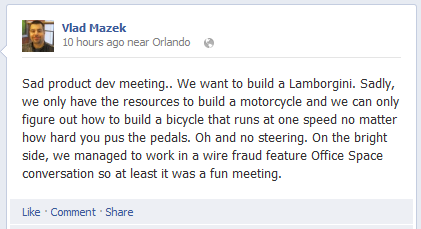
Earlier today I posted this on my Facebook wall (follow me, I’m hilarious):

limitstupidity

Allow me to offer you some background.

We were sitting around discussing changes and additions to a new software product. We’re primarily a server and web services software company and in the past haven’t spent too much time dealing with this type of a product so clearly it was a scene straight out of 2001 Space Odyssey.

Here were our issues in no particular order of importance:

1. We don’t know the best way to solve the problem.
2. We don’t know the typical user case scenario: Who will install this, what will they want to do with it?
3. We don’t know if to aim for simplicity or for flexibility (next few points explain this)
4. Option A: Do we rovide a simple interface with flexibility underneath?
5. Option B: Do we rovide a flexible interface that manages simple actions?
6. Either option requires redesign of the solution (from DB schema to software)
7. The way options are loaded into the system and then distributed to the client could either be expensive now or require reengineering later.

Business As Usual

This type of a problem is encountered in every business of nearly every type every day.

You have too many questions, too few resources and far too much uncertainty. There are two paths:

Path 1: Do something quick and dirty, get the solution out there and perfect it when you have sufficient reason to do so (lots of sales, lots of users)

Path 2: Only do something basic that you can do well and push off the complex stuff until you have a sufficient amount of reason (sales, $) to develop it.

Of course, the correct answer is: Pause. Breathe. Do more research and only act when you have sufficient information to make the correct call. While this answer is the only correct one, it’s not really a valid one because in business you either do shit and get paid or you get a job as the professor (or try to share your wisdom from a broken chair in your basement in between job applications).

I typically take Path 1 or Path 2 (and sometimes just say we’re not going to do anything at all). This makes my team furious. For a long period of time there was actually an interoffice joke that I made decisions based on which way my @#^$ leaned when I got up in the morning. Considering that’s the one they shared with me I’m sure their private opinions are far worse. So for their benefit (or for yours, in case you work for someone like me) here is a point of reference.

Terrible Business Decision Making Illustrated

If I don’t know about the demand but need to have a solution, we’re taking Path 1 (Quick and Dirty). If there is enough demand, we’ll perfect it.

If we know there is a lot of demand but do not know how quickly it will gain traction, we’re taking Path 2 (Basic, if they sell it we’ll write Complex 2.0)

If I know there is a ton of demand and that everyone will sell it, we’ll take Path 1 (Quick and Dirty) and we’ll put all the resources towards perfecting it as we release it. If someone needs a product and you don’t have it, they go elsewhere. It’s your job to earn it so even if it’s not perfect, effort compensates for quality.

If I know there is a ton of demand but no money in it, we’ll take Path 2 at first (Basic) and see if it brings in new clients we otherwise haven’t worked with. Sometimes solutions are simply a part of the whole picture and if we can get them to take a look at the picture maybe they’ll buy the frame, the hanging nail, the paint protection, the insurance and the commemorative personalized brick on our Hall of Fame Walkway outside our office. But I can’t sell them a brick until I get them to look at it.

The only truly random part of decision making is when Path 1 has a nearly equivalent cost to Path 2 and happens in the same amount of time. For example, let’s assume that the cost of getting something done quick and dirty is just slightly less than doing it right and can be done right in just a little bit of time. At that point I have to guess how busy you are (and you’re not busy at all; if you were busy you wouldn’t be talking to me you’d be pulling your hair out at your desk) and if I want to make you delay all the other stuff now or if I can wait to do it later.

The Fourth Path

People who don’t do your job have no respect for how difficult it is and will always expect it to take far less than it really should.

People who actually do the work are terrible at understanding the business strategy and how the product will be positioned.

The job of decision makers is to make a decision that maximizes the dollar amount and minimizes the time to get paid. The job of the person doing the work is to make sure any shortcuts taken in order to meet an unrealistic goal do not explode immediately. At this point the two play the software architect Russian roulette.

{ This part gets ugly and we’re trying to trademark it right now so I can’t blog it }

Needless to say, there is a better way that doesn’t involve crime scene cleanup showing up to mop up the shells from the conference room floor.

Shortcut to Possible: Compromise on completing things that are easy, attainable and will not result in a lot of change regardless which path is taken.

This gives you the time to think of a better way to solve the problem or to eliminate the problem entirely.

Sometimes we get preoccupied at solving the problem by staring at it from the top “It needs to do this!” as opposed to looking at all the components that lead to it being a problem in the first place. The amount of guess work and assumptions is also broad – yet what matters most is not the solution but the strategy of getting to that solution. Before you can solve a problem you must make people aware of it, concerned enough that they understand it’s impact, substantiate it with some actual data points, sell, schedule – and only then try to implement a solution. By taking problems apart and understanding who does what, when and how things do get simpler.

Today we decided to take care of what we know how to do, solve the chunks of the problem that won’t need to be reengineered and we decided to revisit the elephant on the table in a few days and weeks when we’ve had some time to think about the best way to lift it. Because no matter which path we took in lifting the elephant off the table today, we’d still have to figure out how to get him through the door, onto the elevator, down the street and so on and so forth. Don’t attack your problems from the top.

Vlad: Accept Death

IT Business
Comments Off on Vlad: Accept Death

Note: This is the third in the series of blog posts about stuff that has served me well in the world of business. The success of Own Web Now, ExchangeDefender and Shockey Monkey has been well chronicled, these posts are more about me – some stuff I was born with, some I learned after hitting the wall with the head too hard and often. Take it for what it’s worth, forward it to your friends if you like and if you’re interested in these please feel free to join my private list by clicking here.

So far I’ve covered the importance of tolerating failure. I’ve also explained how I know when to quit and when to be patient. I even explained how to manage failure and make the best of it. Finally, the single biggest reason I’ve been successful has to do with accepting death as a natural progression of business.

deathEver heard of the book “Good to Great”? It’s what most middle managers hail as the greatest study of transforming mediocre companies into outstanding ones. The only (slight) problem with that is that most of the companies discussed in Good to Great are by today’s standards either immoral or dead. Whether they sell stuff that gives people cancer, whether they went bankrupt or got rescued by TARP or even if they are among the greatest polluters in the world – we focus on the good stuff. There is a lot you can learn from failures too:

The single fundamental truth to business (taxes aside) is that everything comes to an end.

I wish I had learned this early on. Smile

I’ve made plenty of mistakes early on in business.

I even had two really ugly setbacks, financially, that brought me to an inch of just going on to do something else.

With each bad day coming to an end (at seemingly later and later hour).. I would wake up the next day.

I would go back to work.

Why? Because I liked what I did, because it mattered to me and those that counted on me.

I could have just sat there and watched TV but not doing anything at all is still a choice to do nothing and you’re doing something about the problem even by ignoring it. Sadly, you’re only making it bigger.

At some point your business will end. At some point, you too will come to an end. That’s business and that’s life. Could you be angry about your mortality (if you are why are you reading this blog?) – of course not, so you can’t treat each business idea or each business as life that you’re angry at. Businesses come and go, your preoccupation shouldn’t be with the exact time and way the business ends but with what it does along the way. More importantly, because you have resources to run and build multiple companies, don’t waste time trying to prevent the death of one – spend more time trying to build something great

For example, email security of on-premise servers is a dying business. ExchangeDefender’s competitors that protect on-premise Exchange servers are either dying or trying to partner up with everyone in the world in hopes of preventing the inevitable conclusion that people will no longer build office-based email servers. Wouldn’t it be a better use of time, money and energy to actually focus on building products and innovating instead of trying to maximize the short-term revenue that has only one trajectory? Down.

I don’t say this to criticize them, I understand. If I feared death, that would be my course of action as well. Why spend money developing and innovating – let the service slip but sell sell sell sell. But the inevitable truth here is that it will come to an end and while my businesses may have indefinite lives, I know I don’t and I don’t want to waste my energy on riding a dead horse.

This is where most people mess it up

People equate death of a business or business line or product or service or line as a failure.

People look at relationships that end, agreements that don’t work out, contracts that end up in fire as a negative thing.

If I cried over every business fuckup I’ve personally made I would have drowned in my tears by now. So I don’t cry much – I tear up contracts, I end relationships, I fail and.. I’m still alive to go on and do something good tomorrow.

Yet, most people get so caught up in not making a mistake, not failing, not offending anyone, not taking the wrong turn and not potentially making a fatal business mistake that they end up paralyzed in something that’s already dead. Person that is stuck in a dying company that avoids making a change or moving on is losing more every single day compared to the person that went to try something better.

People fall in love with their ideas, companies, the norm… that as I mentioned in the previous post: they sell themselves the dream. Don’t do that  to yourself!

Refuse to live your business life in a constant fear of that business dying

Today is September 3rd, 2012.

Picture September 3rd, 2013. Exactly a year from now.

What do you want your business to look like then? Can you financially afford to make it happen? If yes, do it. Motivate yourself by looking at what your business could be and how you could be a part of making it there.

Do not sit in fear of making a decision that could end your business. If you lived your own life like that you’d never cross the street in fear of getting hit by a bus.

Once you’re no longer in business of preventing a business from going under… there is a second part to this equation.

We’re in business of transitioning the business

For the past 15 years, ExchangeDefender has been transitioning from ISDN to Y2K to web design to colocation and data center solutions to the cloud to the communication.. and to whatever is next.

I always get to play with the latest toys, work with the latest technologies and what I get to take home (aside from ridiculous amount of money) is the satisfaction of being able to make people realize their own satisfaction – both my employees and my clients.

So once you have a business that makes money… don’t sit there waiting for a venture capital or rich people bad at math to scoop you up. If you’re in that seat you’re already dead but you’re too stupid/ignorant to realize it… instead focus on what more you can do.

One thing unique to successful entrepreneurs is that we are always looking for that next thing. It’s about solving problems, not avoiding them. It’s about embracing and introducing change, not trying to avoid it.

Some day I will die. Pretty sure about that.

However my ideas, concepts, drawings and mistakes will die much sooner. I’m OK with that. Because I’m not in love with what I used to do for a living, I’m in love with what I’m about to do. That’s why I’m in the office on Labor day.

Vlad: Managing Failure

Boss, GTD, IT Business
1 Comment

Note: This is the third in the series of blog posts about stuff that has served me well in the world of business. The success of Own Web Now, ExchangeDefender and Shockey Monkey has been well chronicled, these posts are more about me – some stuff I was born with, some I learned after hitting the wall with the head too hard and often. Take it for what it’s worth, forward it to your friends if you like and if you’re interested in these please feel free to join my private list by clicking here.

So far I’ve covered the importance of tolerating failure. I’ve also explained how I know when to quit and when to be patient. The only thing left is to be disciplined about managing failure.

Managing Failure

Most of the mistakes and failures in business are manageable. Everything short of totally failing your business can be taken care of. Well, except one:

Recklessness: There is no workaround for the lack of discipline.

If you like to procrastinate, don’t like dealing with the forms or computers or government or people in general, if you spend more time on Facebook instead of your line of business app, if you detest the people you work with or work for.. well, maybe business ownership isn’t for you. But suppose that’s not an option, how do you deal with it?

Best way to manage failure is by being disciplined and sticking to your plan. Write down your plan. Review your plan. If your results do not reflect your expectations, change or quit. Just don’t let it slide.

Almost all of the catastrophic business failures I’ve witnessed have been a result of direct recklessness by the owners or management. When people take their eyes off the ball it’s easy for things to slip between the cracks until it’s too late. When you care more about things other than your business then that business is only heading in one direction. Pure and simple: straight down.

How To Manage

First, write things down. Study your competition, evaluate your opportunities, consider exit strategies, project stages, workarounds, best case scenario, worst case scenario, funding estimates, profit requirements, timelines (quarterly, annual objectives, 5 year plan) and write them down.

I like to write.

I like to doodle.

It gives me a feeling that I am for a moment disconnected from the very tool that I use to do most of my work and it helps me remember things.

photo1

I’ve discussed this in detail here.

The $400 something Louis Vutton notebook contains all of my sketches, all of my projections, notes, research and to-dos.

Every week I sit down and write down my weekly agenda. Every day I go through the weekly agenda and the daily list of tasks and check them off one at a time. Sometimes it’s just as easy as [ X ] Filed form 2925, done. Sometimes a single line spawns a product line, but it’s there.

Sometimes I take notes and write out possible action items. They nearly never get done that week. But I put a big circle at the top of the page and when I feel bored I flip through the book and look for empty circles in the supper left hand corner – if they are there, I revisit them. If I figure it out, I check them off and I move on.

The picture you see there represents 99% of my productivity and discipline enforcement. I don’t use Outlook tasks, I barely use the calendars. Everything is written down with ink on paper.

You know the expression… until it’s in black and white on paper… do likewise. Start writing down what you’re doing and pretty soon you’ll be writing out what you do each quarter, month, week, day and even intraday.

The problem with the lack of discipline isn’t in carelessness which leads to mistakes: It’s that we’re so overworked, preoccupied and overstimulated that obtaining the proper focus is impossible.

If that’s not the case for you then you’re a better man than I am and kudos to you! Start a blog Smile 

Otherwise, get a notepad.

Discipline Howto

Dedicate the first two pages to your annual goals.

Dedicate the next 8 pages, two per quarter, and write out how you’ll accomplish your annual goals.

Dedicate the next 104 pages to it, 2 for each week. You’ll fill these out as you go along. Sometimes you’ll get things done faster, sometimes it will take more time.

Then just keep yourself in the check.

Discipline is impossible when you don’t know that you’re not being disciplined. You can’t really call it procrastination if there is no due date and you can leave it for tomorrow. Unless you’re willing to hold yourself accountable, nobody else will – but your results will show that and you will not like them.

Managing failure is simply an act of being disciplined about qualifying it, quantifying it and making sure that mistakes and failures don’t become paralyzing, catastrophic disasters. You’re not going to avoid making mistakes – but you’ll at least give yourself a chance to minimize them. Once you can improve your odds of success everything else will follow.

Vlad: Quitting and Patience

Boss, IT Business
Comments Off on Vlad: Quitting and Patience

Note: This is the second in the series of blog posts about stuff that has served me well in the world of business. The success of Own Web Now, ExchangeDefender and Shockey Monkey has been well chronicled, these posts are more about me – some stuff I was born with, some I learned after hitting the wall with the head too hard and often. Take it for what it’s worth, forward it to your friends if you like and if you’re interested in these please feel free to join my private list by clicking here.

Last time I wrote about the importance of tolerating failure. In business and life setbacks are natural and they come and go. There is really one failure you won’t be able to overcome – death – so as long as you can accept that with each day you get another chance you will put yourself in the right frame of mind to be successful. You can always change things up, try something new, learn to let go of things and not let stuff bother you. It’s a process.

Failure is a part of it.

But what if it’s a really epic colossal failure?

So long as you’re still alive, things will be alright.

In short, you do not want to let things get so far that a mistake ruins you. With these three simple steps:

You can and will be wrong about things.

Some decisions will be bad and you will make mistakes.

It’s easier to change your mind and admit defeat than to die trying to be right.

For example, let’s say you’re about to add a new line of business. Or hire a new employee. Or take up a new marketing campaign. Or lease a car.

Establish a timeline.

Establish a review period.

Establish conditions: success or failure.

The new business you start might generate millions of dollars of profits. New employee could lead your company to the new heights and become someone to run the whole place while you move to a tropical island. Marketing campaign could transform your organization and win loyal clients for life. You can race the leased car in the underground drag racing circuit and make a six figure income after work. Awesome.

Or the new line of business could bankrupt your whole company. The new employee would steal money until you confront them and they show up in the office with a gun. The really clever marketing campaign might turn out to be horribly offensive to the general public and people would throw stale vegetables at you everywhere you go. The day after you lease the car you get fired and your new job is 60 miles away from home. Shit happens.

The key to success is knowing when to quit, knowing what is at risk ahead of time and being able to make business decisions based on facts and data not feelings and mood when you’re stressed and not thinking clearly.

To make it work, follow these three simple Vlad rules:

Rule 1: Set your risk

Before you undertake something, know what you are willing to risk.

All business decisions come with a $ value attached. Before making a decision, whether a purchase or investment, I like to know what it’s going to cost me. I also like to guess how much it’s going to make me. So if I’m going to have to spend $100,000 to earn $120,000 and I stand to potentially lose $70,000… I’m going to pass. I know what my loss tolerance is: $50,000. I know by when I expect to see the return on my investment and I know that I will need to keep an eye on it leading me to..

Rule 2: Be a disciplined failure

Stick to your schedule and make decisions based on data and your own plan, not your gut instinct. In business you almost always fail hard when you’re not paying attention.

Business deals happen without you in the room. Technology changes the landscape of the industry. Operational efficiencies render things useless from time to time. Things change. This is why it is so important to evaluate your decisions on a preset timeline and realize when you are just wrong and heading in the wrong direction.

This is where half of the people lose it. They cannot tolerate failure. Their ego will not let them admit to themselves that they were wrong. Perhaps I’m just a jerk but I could care less about what you think of me when it comes to business – that’s why I run a business instead of a political campaign or Ms. Congeniality contest. Let. It. Go. If your plan ahead of time called for certain results to be in place by a certain date and those results aren’t there – you’ve failed. Game over. The more you try explain to yourself how you were right and everyone else you’re wrong the more wrong you become with each passing day.

Rule 3: Don’t buy your own BS

Never lie to yourself. Extend that as a service to others and stick to your own definition of success/failure.

About a decade ago I coined this phrase “I just sold you a dream” that most business owners and managers can probably relate to. As a leader you have to convince people that you know what you’re doing and that they should follow you. If the only one following your dream is you then it’s pretty much the same thing as digging a hole to try to get out of one. It’s futile.

This is where the other half of the folks I know fail miserably: they have a good idea that just keeps on getting better and better the harder it fails and the worse it performs. It just needs another tweak, a little more money, a little more effort and.. yeah. Endless cycle of failure upon failure. If you’re constantly going from one business model to another, from one job to another, barely making ends meet – it’s time to reassess your core expectations and get back to the drawing board.

Balancing Quitting & Patience

How do you know when to quit and when to be patient? The answer is: you don’t. But if you establish your tolerance, risk and failure levels ahead of time and continue to review them along the way.. you stand much better odds.

This is something that has lead me to phenomenal level of success in business: My odds of success have been better because I knew the outcome I wanted and when I wanted it by before I begun. So if at the due date things didn’t look right – I changed things or scrapped them altogether.

Not everything is a winner. I’ve learned to take business one year at a time (you know, like real companies) and extend my expectations to all areas of the business not just typical annual stuff like finances. I started to look at employment, goals and incentives on an annual basis too. I’ve hired people that for one reason or another did not immediately work out. Had I cut people that failed me quickly I probably wouldn’t have had one of the most valuable employees I’ve ever had. But by the same token, I’ve allowed worthless toxic people to sit around and ruin the company atmosphere day after day, one HR policy after another.

Ever notice that there is a sense of relief when something is over? Let’s say you had a terrible employee and eventually you just had enough and fired them. Not only did they fail as an employee but you failed as the  manager – to lead them, mentor them, communicate to them how to become valuable to you. As you sit there and make that long, deep exhale you feel a sense of relief – and you wonder why you didn’t make this decision sooner? Or you just quit that crappy job and wonder why you didn’t do it the first time your boss was mean to you or the clients didn’t respect you or you didn’t get what you wanted?

The balance of knowing when to quit and when to be patient is a myth. There is no such thing as balance – you’re always either quitting too soon or being patient with a failure for too long. So forget the notion that you will be able to get it done just right (again, don’t be afraid to admit failure)

In absence of balance there is always sound judgment: Establish your expectations ahead of time. One year from now I want _____. Within the next 3 months I expect ____ and if it doesn’t look like that will happen in 6 moths I will do _______. If within 9 months neither stage is set, I am better off doing _______.

Then it becomes pretty simple. You look at your annual plan every 3 months, look back at what you expected, compare it to the way the world may have changed since then and decide if you were just wrong or if the underlying facts have changed.

If you were wrong – quit.

If the facts changed – draw up a new plan and set up new expectations.

Just don’t wing it. Do not sell yourself a dream – pinch yourself every now and then. Do not dig yourself into a hole you can’t climb out of – look up every now and then and see what is around you. Planning and awareness will trump balance and instincts every single time.