
Reloaded: Shockey Monkey unRMM–What is managed?

Boss, Cloud, IT Business, IT Culture, Shockey Monkey
1 Comment

Yesterday I wrote the first in the Reloaded Shockey Monkey articles covering the grand scheme of consumerization of IT and how the business models need to evolve as we transition from the world of IT to the world of the cloud to what’s coming next. The argument I’m making is not that IT will become irrelevant, that the cloud will obsolete things or that you need to abruptly change your business model today:

All I am pointing out is that technology purchase cycles in business are long and there is an immense advantage to being first. To read about the rest consider these articles:

1. No future without the past
2. unRMM – What’s managed?
3. unPSA – Whose business is it anyway?
4. Derrivatives – Who does the IT work?
5. Ultimately, who pays the bill?

What is an RMM?

RMM is quite simply a tool that has made unskilled IT staff obsolete. Prior to IT task automation, a human being of questionable hygiene and even more questionable IT certificate trail would walk to a computer / server and perform maintenance, repair, helpdesk functionality and so on. As businesses started using more technology the IT departments grew in size and influence within organizations because things were far from perfect.

RMM software – the likes of nAble, Level Platforms, Kaseya, Scriptlogic, Labtech and so on allowed IT departments and MSPs to centralize and “remote” a lot of the functionality. One person could now roll out software to thousands of workstations across multiple companies. They could keep an eye on all the software and act on problems before significant damage occurred – are backups running, are we using the latest antivirus definitions, are we running out of storage and do we have the latest security updates applied? If the answer to any of those is no, we could address it remotely.

This in fact is how ExchangeDefender manages to run a global network without ever setting foot on some of the continents that we have infrastructure on. This technology has been behind the outsourcing of IT management and massive reduction of IT force needed to manage this immense growth in IT infrastructure.

What’s next?

RMMs are here to stay. No argument there.

However, if you believe that the consumerization of IT is real and that end users and business owners are capable of managing their own phones, tablets and gadgets then you seriously need to look at the opportunity you have here. The current and future workforce isn’t out of Mad Men, it’s not your grandma with the flashing 12:00 on the VCR or an old guy who can’t see his smartphone much less use a keyboard. People showing up in workplaces today have been on Facebook, MySpace and Twitter for years and they may even know some HTML. Yet none of them will be impressed by SNMP traps or VPN advantages over SSL.. because the low level geek stuff we’ve built our companies on is largely too geeky to be relevant.

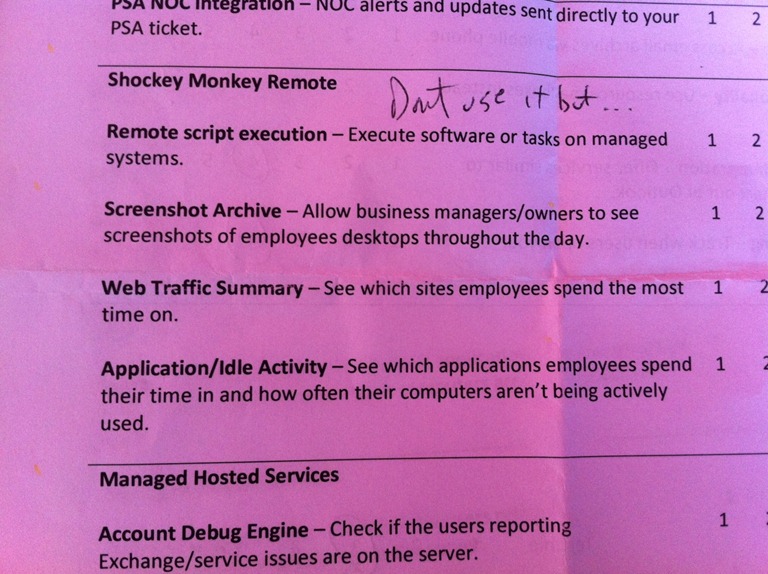
Last week we caused a minor controversy when an NDA survey made it’s way into the public with the title “Is Vlad building an RMM?” – for those of you that haven’t seen it yet, here is what we asked:

unrmm

Love the writein comment.. Smile Click on the image for magnification.

If we can all agree that virtualization, cloud and mobility are the future..

If we can all agree that the IT decision power and management is going from the IT department to business leaders and managers..

If we can all agree that devices like smartphones, tablets and netbooks are replacing traditional workstations and offices..

.. Is it really that much of a stretch to say that the monitoring of those resources changes radically as does the importance of the data being monitored?

In the long, long ago when I started Own Web Now, everyone had a PC. The select few important people got laptops. When those computers went down, people stopped working. It was not the end of the world because most business was still conducted over the phone, fax and mail.

Over time people got cell phones, laptops, netbooks, tables. We’re living in the Star Trek world talking to our computers about where we’d like to eat and asking them to remind us to do something tomorrow. With the exception of asking Siri to make you a coffee we’re only short of a replicator.

Once upon a time it really mattered if a hard drive was filling up and the client couldn’t send mail. Now if their computer literally explodes they have several devices that can do the same thing.

So let’s think about where we are, not where we were..

Reality of Today

If you talk to a business owner today his IT concerns are significantly different than those of an IT department. It costs me $300 per month to have an employee park in the highrise office that ExchangeDefender is in. That is the cost of renting the spot, not buying it by the way. The overhead of the office space is even higher as is virtually everything else associated with a real business.

Your “real businesses” of the future will have better ways to spend money than overpriced office space and parking spots. Most of the work will be done remotely. You may not have 100% say which device that work gets done on – if the VoIP server is down they will pick up the cell phone, if their computer is down and they need to send a quick email they might have to wrestle an iPad from their kid. Your future workers come with built in Internet redundancy and several business disaster continuity sites (Starbucks, McDonalds, Moes).

With a workforce so mobile what is the key monitoring objective? Making sure their infrastructure is working or that their employees are working?

Business owner in charge of an unRMM

As a business owner that manages people working from home, out of the country, or at 2AM there are different metrics I care about that transcend infrastructure. Your laptop got a Gatorade bath because your kid celebrated while watching a football game on it? It happens. $350 later, you’ll get a new one by tomorrow. It happens.

What I really want to monitor as a business owner and manager is performance. I want to know that 480 minutes of the workday I pay you for go towards something that makes my business move forward. I know, I know big brother, all employees already put in way too much overtime and work to the bone every minute of the day. But when you look at the data you see they catch up with their friends and family at work, have discussions with folks on the forums and endless chats about stuff over IM. In between banking sites, youtube or my favorite Office Space moment: “Sometimes I like to just sit here for 15 minutes and zone out.” 

As a business owner, you have no insight into what your employees are doing with the technology and as much as they feel you’re not paying them enough you know they aren’t spending all of their time working. So you do this little dance of trying to pin down one another – you make them produce endless timesheets and reports, ask for status updates and try to document every inappropriate non-business site they go to. What all this amounts to is more useless meetings, more time wasted on analytics and the staff is now even more pissed off that you don’t trust them that it adds even more work to the scarce time they have between managing their sports fantasy league, uploading and commenting on Facebook pictures and staying on top of tmz.com

Sounds pretty bitchy, right? What if you could just trust each other?

OK, joke aside, here is what I want. I want something that would help me both trust everyone, keep them more accountable and let them experience at least some workplace liberty that the technology we have guarantees us: I don’t mind if you work from home but keep in mind that I have a tool that will tell me when you started working, when you went to lunch and how long you spend inside Outlook as opposed to Facebook. If you run into a problem, I have a remote desktop tool that will let someone assist you. I don’t have to ask you what you’re working on, I can just see your desktop no matter where you’re at. If I just walked into the office I don’t have to wonder what you’ve been up to or waste both of our times with a status report, I can glance over your browsing history and searches today in a few seconds. I can see screenshots of everything you’ve done today and play 4 hours worth of work in under 2 minutes. Our IT guy will get an alert whenever something weird happens to your PC or laptop or smartphone and handle it so you don’t have to waste your time.

When I talk about an RMM, I want to think about a remote employee monitor and it doesn’t matter to me if remote is Australia or if I can see you from my office.

The key metric of the modern mobile workforce is productivity. Not the technology that once upon a time was far from perfect and needed a 24/7 janitor.

The Opportunity

Admittedly, while this is something all Shockey Monkey users will have in a matter of months, the commercial opportunity isn’t in trying to sell yet another tool. There are plenty of tools that do employee monitoring, activity monitoring, remote desktop help, etc.

The problem is that they are written for geeks or HR staff and they cost way too much money!!

Imagine an environment where this tool is something the businesses you manage get for free. Yes Mr Business Owner, I’ll give you all of this for free if you let me manage your IT infrastructure you’ve invested so much in. All these servers, workstations, desktops, printers, smartphones and tablets need to be taken care of and it’s cheaper and more effective for us to do it than for your VP to be on hold with some third world helpdesk script reader.

While they are leveraging their business remote monitoring tool, you can leverage your remote monitoring tool to generate revenues at a higher rate than others.

Business owners and decision makers know they have to have competent IT professionals, they just don’t appreciate all we do all the time. But arm them with the right tools so they can understand how much of their money goes to waste and they might consider their IT as a far more strategic asset instead of a disposable piece of the electronics it really is.

In a world where users will manage more of their IT, the cost of managing the IT they can’t figure out will rise while the amount of it goes down. I believe Shockey Monkey unRMM will enable our partners to get into those opportunities in a way traditional marketing and networking will simply not be able to.

That’s my story and that’s what I’m investing in.

Reloaded: Shockey Monkey Reprise

Cloud, IT Business, Shockey Monkey
Comments Off on Reloaded: Shockey Monkey Reprise

It has taken us more than a year to get Shockey Monkey right. At this point, I would like to encourage you to read the following five posts about Shockey Monkey regardless of what you think of it, me or what you may be using to run your business.

Mostly because if I’m right.. it will fundamentally change your business.

Several years ago I wrote a series of articles called Lucy’s Sail. Go ahead and Google it, at the time it was not a popular topic but everyone could see bits and pieces of it made sense. I’ve made many of you millions of dollars in the cloud while many that argued against it now work for someone else and perennial powers of HP and Dell are scratching their head about what is next. Don’t get me wrong, it’s not like they don’t know what’s next – they just have a hard time trying to figure out how to sell what they have into the future where people don’t want old technology.

We’ve undergone a massive consumerization of technology over the past few years, a movement that has taken decision making power away from IT departments/people and placed it in the hands of business people and end users.

Over the next few posts I would like to outline the goals behind the Shockey Monkey and why I’ve turned down millions of dollars to lose money pursue investing in it myself.

Please tune in each day for the following Shockey Monkey breakdowns:

1. No future without the past
2. unRMM – What’s managed?
3. unPSA – Whose business is it anyway?
4. Derrivatives – Who does the IT work?
5. Ultimately, who pays the bill?

The Past

Once upon a time I wrote Shockey Monkey as a combination of helpdesk, CRM and shopping cart for small business IT shops.

Step 1: In order for the cloud solutions to be profitable, they first had to be sold – so the IT Solution Provider needed to have a mechanism to efficiently take the credit card, accept an agreement and collect revenues each month (you’d be shocked to know that this is still not a baseline offering in any of the professional CRM / automation suites).

Step 2: Once you have the subscription and revenues rolling in each month, everything beyond the cost of service should be your profit. The only way that happens is if the end user is in control of their cloud services. If the IT Solution Provider has to pick up the phone, log the ticket, login to the control panel, find the user, etc just in order to reset the password or freeze a mailbox or add another user to the distribution group several horrible events are converging. First, you’re wasting time performing an automated task that the user should be empowered to do themselves – and time is money. Second, while you’re wasting your time talking to the end user about the weather as you try to find the passwords, etc – you aren’t doing anything that contributes to the growth of your business or the techie isn’t working on a more profitable project. Third, it’s not just your money that is going down the drain here, how can we say that the cloud saves people money if the users that leverage that cloud are spending time away from their jobs to deal with the outsourcing company for mundane tasks – how can we call it outsourcing if we’re still doing the job? Fourth, the one nobody wants to talk about: security; interjecting social inefficiencies of account management to override actual access credentials, logging and so on is a recipe for disaster – what would be your response to a subpoena for information that you helped someone destroy inadvertently because your tech got beaten up on the phone? The system needs to deliver efficiencies, security and ease of use in order to be used as a benefit instead of a deterrent.

Step 3: Once everything is covered in steps 1 and 2 the real business can begin. The days of living as a gatekeeper or an IT troll of necessity are over – you’re not a lawyer, you don’t get a paycheck just because we want to protect ourselves from the dangers that lurk around in the dark. These solutions need to be seamless and they need to reach into the everyday technology usage. They need to integrate together to deliver a real benefit. When they don’t you have billions of dollars burned in an effort to make people use a company whiteboard SharePoint that nobody can remember the location of.

Over the past few years we’ve helped thousands of Shockey Monkey users establish a process driven IT business and leverage cloud offerings to establish predictable revenue models.

When we launched Shockey Monkey we called it the unPSA. We don’t compete with the likes of Autotask or ConnectWise and have maintained a great working relationship with them because we have the same goals (taking IT staff and organizations from notepad and Excel into a process driven system). Any smart person that can look beyond the obvious similarities can tell that these are in fact great complementing solutions.

If you stick with Autotask and ConnectWise, you have a shot at becoming a great IT company. My goal with Shockey Monkey is to make sure the loyalty of your client base is sticky because it connects your company to the solutions you’ve sold them. You need a great tool to manage your business. You also need a tool to connect your clients business and technology back to yours. That is where your value is multiplied.

Here is something I want you to think about: Imagine if your tools (PSA, RMM, Backups) were not built for you but were designed for your customers… what would they look like?

If we are indeed in this massive consumerization of IT that everyone believes in and the IT becomes something that users do instead of IT staff, what do those applications look like? Who pays for them? How do they meet the regulatory compliance requirements? Who does the cleanup work when automation fails, what is the business continuity scenario and what level of data portability do we have?

Now, I do want to be mindful here and play the devils advocate for a moment: If those concerns are truly real, as they certainly would be in any real business that has to deal with them, how can that possibly ever spell the end of the IT as we know it? Making slight adjustments in course as we go along and as these technologies mature will keep us in place and evolving right along with it. Right?

In my opinion, there isn’t much difference between obscurity and failure. It could be that I’m just an extremely aggressive and competitive jerk but if you give me an option to earn a million dollars and I’m OK with taking home only $40,000 that doesn’t make me feel like much of a winner. We had these arguments before the cloud and some people bought it, some didn’t. Many that didn’t are unemployed and working somewhere while the lucky ones are maintaining the same levels or maybe growing a little. On the other hand, I have plenty of 1-3 man shops with thousands of Exchange mailboxes, massive amount of storage and other cloud services that they only sold and did the hard work once. How do you explain the discrepancy? Ultimately, is it really a discrepancy or is it the reality of the small business IT – there will be far fewer of us but we’ll be doing a lot more for our customers because we won’t be a part of a perpetual IT problem? This is something that Microsoft, Google and Amazon recognized early on and built massive cloud operations without an IT channel or staff involved in any major way.

But let’s not dwell over the past or sink ourselves in the problems of the present.

Let’s figure out a way to be a part of it and a massively profitable at that.

Shockey Monkey Reloaded

Thursday, December 1st, Noon EST (max 1000 seats; will be recorded)

https://www1.gotomeeting.com/register/812869640

Look forward to showing it off then. In the meantime, I’ll explain on this blog.

Getting to great takes time and effort

IT Business
Comments Off on Getting to great takes time and effort

Once upon a time, Arnie stood over me at the airport trying to figure out why I was telling partners not to expect the same levels of integration in ConnectWise as we do in Autotask. We were at a conference a year later and he said:

“You know how you can tell that Vlad is pissed at you? He blogs about it.”

Well, things change. Thankfully, sometimes things change for better.

Back in the long, long ago there was no API. There was an existing integration between CW and some other SPAM tool and then there was tcpdump. I remember quite vividly how our initial integration between ExchangeDefender and CW worked – mostly because I wrote it. Everything was hardcoded so we sniffed the URL it was hardcoded to fetch, we reverse engineered the data stream. If that wasn’t dirty enough, we also had to hack the hosts file to mask ExchangeDefender servers as something else and I also had to distribute a wget binary I compiled myself to ignore SSL certificate mismatch. All this to get you a number on an executive report nobody ever looked at.

To say that I was pissed off about getting constantly reamed out in public feedback about our integration would be putting it politely. I was in my 20’s and stupid ambitious so whenever I could get a breather from stuff like this I put towards building Shockey Monkey. It’s tough to focus on building something when you’ve got people beating you over the head. If my professional experience has taught me anything it’s this:

Don’t get in a way of ambitious a$$holes who have their money on the line.

That first integration was many years ago.

Not my favorite memory.

But as I’ve highlighted above, we all face problems from time to time. I talk to tons of partners all day every day and this stuff isn’t easy. There are people that skate by and only do what they need to in order to get to the next level. Then there are folks that care and get to every detail. If you’ve played Mario Brothers a million times you probably know exactly where to jump, where to duck and how to get to the end in the fastest way possible. Then there are those of us that know where the brick block is and how to hit it for some extra points and coins.

Last week we published v4 of our CW integration, built on top of the new Web APIs, supporting the type of stuff our partners have been demanding for years. The difference between the new API and my original experience is night and day. The new integration doesn’t rely on the email connector to trigger events – it uses callback functions. It doesn’t require complex status switching, template parsing and customization or other tricks – it just requires a URL. It doesn’t come with a 32 page setup guide either.

The new integration piping isn’t just good – it’s phenomenal.

Great companies have a long term plan and even though they may be dealing with a mess from time to time, they don’t forget what they are building and who they are building it for. As I looked at a sea of venture capital backed vendors funded by folks who are pissed they didn’t put it into Facebook and the army of IT shops who are constantly battling how to grow faster and find the right talent.. I hope you keep this in mind: There are no quick fixes.

Getting something great takes time and effort, one you’ve already got and the other you just need to commit to.

I talk to folks all the time that think they are just one tweak away from being in the clear. Listen, if it were that easy you already would have done it and we wouldn’t be having this conversation. If you’re constantly complaining about having to replace your service manager because things are getting dropped it might not be as simple as just replacing one person. It may in fact start with you.

Draw up what you need to do to go from where you are now to where you need to be. Ask your clients, they are probably all too happy to tell you just how much you suck. Pitch potential solutions or ways of working around problems or minimizing them. Then – and most importantly – get to work. We’ve all got brilliant ideas and it’s all too easy to criticize others. It’s quite another to turn those ideas into solutions and problems.

One thing I can share that works for me – so long as you continue to work on your problems you’ll never be beat. It’s as true for APIs as it is for everything else.

Optimizing Communications

ExchangeDefender, GTD, IT Business
Comments Off on Optimizing Communications

One of the biggest challenges in running a software/service company is communications. We have technical users who need to implement our software to fit different business requirements and we also have business users just reselling cloud solutions. As these companies grow they end up looking pretty much the same. Guys at the top stop dealing with the nuts and bolts but still lead the organization in terms of selecting who they do business with. Their staff then has the task of figuring out the nuts and bolts. If you suck at either your company is going nowhere fast.

Marketing and sales collateral without technical articles may lead to a sale but the service deployment will flop. Best product on the market will never go beyond grassroots and word of mouth if it’s not backed by professional looking marketing.

You can’t run a one-dimensional business.

This is something that everyone struggles with.

One of the ways we have been able to excel through the years has been on my back. I was there to shake hands, answer phone calls, help with Exchange in the odd hours of the night. You can do really well with great personnel but it doesn’t scale.

As my business started growing I still maintained the role of the communications quarterback – someone else generated the content but I was the one delivering the message and also one getting the feedback. It’s not easy to grow when the process goes just one way.

Step 1: Share the expertise

Put people in your organization in charge of delivering the message.

If you take a look at http://www.exchangedefender.com/blog you will see almost daily updates from the VP in my company. Everything from support to marketing to network operations to development to strategy and consulting.

These aren’t quickie posts. The chances of them being read by the majority of our partner base is slim. But folks that will read it will be the ones that care and want to know more about the topic than just the highlights.

Truth is, you can’t write blog posts for skimmers. People that dive into the post need to get some substance out of it.

This is almost exactly opposite from what you see in commercial blogging endeavors. The idea there is to create as much noise with as few words as possible so people will keep on clicking through and running up the view counter on the advertisements.

Do not model your corporate blog after the trade blog junk. The goal is to get the people to read, not accidentally click on an ad.

The big problem is that people may not care of have the time to read your posts.

The biggest problem is that they will definitely not have the time to read it when you post it.

Solution: Write valuable posts that will be shared, saved and read later.

Step 2: Promote

Remember what I said about who chooses to do business with you and who actually has the task of doing the real work? It’s typically not the same person. Same goes for blogs and documentation and any kind of content you make available. It could be that the person that follows your blog is in sales or marketing but if they are reading a blog post about the technology it won’t go anywhere.

You need to make sure everyone reads your blog. Good luck with that.

First, make sure you do the initial promotion – post it on Facebook, on Twitter, include it in your newsletters and mailers, make it a part of your signature and every piece of email your company sends out. That’s the easy part.

Second, make sure the content is available on demand – when someone asks you about a topic, make sure you link them to the content instead of answering the question. Now some will argue that this is horrible customer service but the truth of the matter is that there are no quick questions and quick answers, you have to consider some background in order to make the right decision.

“So the answer kind of depends on what you are doing but let me point you to a post on our site that gives you all the details instead of me guiding you in the wrong direction.”

The goal of written communications is for it to be complete.

Step 3: Consolidate

Finally, get to the point.

Once you have awesome documentation and a ton of content your most attentive listeners may not be your intended audience. Or vice versa.

The problem with the white collar economy is that you no longer get to choose to decide what is your job and what isn’t. If you can’t stay on top of everything you’re soon to be out a job. We all need to do more.

The problem with doing more is that folks that do more get promoted and have less time to stay on top of things. So you have to make it easy for them to delegate the communication to someone else.

At ExchangeDefender we have started producing ExchangeDefender Executive Podcasts.

10 minutes, ~10 megs, covering everything you need to know about what we’re doing. We talk about support issues, network maintenance, development progress, marketing and everything else.

You can listen to it in your car and when you hear something that you need to know more about you can just ask your staff to look into it for you at http://www.exchangedefender.com/blog or go get it yourself.

As we and our partners grow it becomes more important to stay on top of stuff and work closely with one another.

When we don’t, the profitability of the solution falls apart. If you’re spending too much time to support the product or don’t take advantage of the stuff that would make you more successful we both stand to lose.

It’s in our best interest to create a better message. It’s in your best interest to do something with that message. But it can’t be one sided.

Step 4: Focus

Since I know I’ll be punched by those of you that have listened to it so far, let me say it up front: Yes, we ordered better recording gear. This was one of those ideas that looked good on paper so we decided to record it and see if anyone would listen. Lot’s of people did and we just didn’t have the time to get the gear in for recording #2.

Two weeks ago I wrote about our decision to dramatically cut down our conference schedule. That post kind of got a life of it’s own but my main message was that in order for us to become more valuable to our partners we need to put the focus back on our partners. The goal of going to conferences is to test ideas, touch base with existing partners and more  – but the primary goal is to get new partners. As big as we are, should we spend money to get new partners or just work better with the existing ones?

Truth is, we can become far more successful by working better with our partners.

Every day I am being asked to take over billing, take over support, take over implementation/migration/deployment and so on. You can’t take on new business if you’re not going to be good at it… and we can’t get good at it if we’re on the road.

So here we go. This is just a piece of the whole ExchangeDefender puzzle we’re putting together for 2012. The better we serve our partners the better you’ll serve your clients and more successful everyone will become. At least that’s what we’re working on 🙂

How To Work With People and Companies

Boss, IT Business
4 Comments

Over the years I’ve used Vladville to put up as big of an a@#hole act as possible because nothing turns away abusive and rude people away quite like another one of their kind. In reality, I’m actually very nice and considerate especially to the people that treat me right but every time I encounter one of the folks above I go the other way. Life is too short and money is not so critical to turn your business into a punching bag for frustrated IT people. There is a way to treat companies and then there is a way to treat people.

Companies

Pretty much anything goes, especially when it comes to being critical of the process, implementations, business models, pricing, support and so on and so forth. Companies are made of many imperfect people who even with the best of intentions tend to do imperfect things from time to time.

Negative and critical things written about companies will actually get you somewhere because people that work at these companies tend to be proud of their work and they appreciate external observations even when they disagree with them.

Sometimes even bashing a company can be the only way to get attention.

People

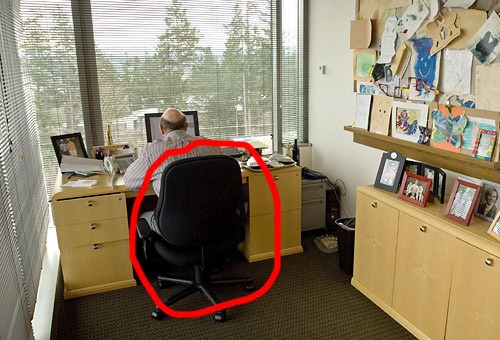
Take the section above and reverse it. Why? Because corporations don’t throw chairs. People do.

504x_thechair

You can talk all the trash you want about the company but once you go after it’s people don’t be surprised if those people don’t want to help you.

As a field exercise, the next time you see Arnie Bellini or Steve Ballmer, tell them their companies and products suck. They might ask what specifically you had a problem with and offer to help or hook you up with someone that can.

Then pick your favorite expletives and string them together about them personally. Note the difference.

Being abusive in general won’t get you far. If you’re in the IT businesses you’re dealing with professional companies, not Subway. You don’t get to yell and holler out loud until someone asks you to come to the counter and remove pickles from your sandwich.

Being abusive and personal, in public, will get you punched.

Frustration

I understand and appreciate the frustration. I really do. It’s normal and it happens.

Business disagreements happen. Business models conflict. S@#% breaks all the time.

You have the right to be frustrated and to be angry.

You pay for the service.

You don’t pay for the right to be abusive when the service doesn’t meet your expectations.

So if you’re pissed off about the server being down or something not working right or not making enough money or not getting the vacation you wanted or not winning the lottery – that’s your personal problem – you still have to work.

And when you’re working with people, keep in mind that you’re not the only one out there they are trying to help and do business with. They are dealing with the crap too. So if you’re nice to them, they will try to help you.

Personally

Ever worked in a company where you’re always being lied to? Under constant fear that your job, department or entire company will disappear if the next round of funding, sales, product release or government grants doesn’t come through? I have, it’s not fun.

When I decided to make OWN a serious business, I promised that we will never be that company. That’s why I answer the phone, give away my cell phone, help my partners when they need help – be it advice, be it financial, be it technical even if I don’t stand to gain anything.

It’s gotten me thousands of great partners that I love to work with and that’s something that doesn’t make us the most profitable company in the world or the most aggressive one. But it’s fun and it’s the best place to work. I can actually go out with my employees every Friday and take them out to dinner and drinks because I genuinely don’t want to kill them. I can also take my partners to dinners and party with them because I really enjoy their company.

There are perfect relationships out there. I married mine. For everyone else, just be nice. If you’ve got to find an outlet for your misdirected rage, go to wordpress.com or better yet – join a gym. At least that way you’ll be better prepared when you say the wrong thing and someone throws a chair at you.

P.S. I credit Karl Palachuk and Andy Goodman for enlightening me on most of this. Back before we were a real company, we took money and abuse from everyone. At the time, that was just business and there were difficult people out there and you don’t want to piss off your clients because they might tell others about it and it will cost you money. Andy and Karl reminded me that I make more money than a McDonalds employee and that all the chairs at McDonalds are bolted to the floor for a reason. As Karl puts it: “We only work with nice people.”

The Meaning of Work Life

Boss
Comments Off on The Meaning of Work Life

It’s Sunday night and I’m sitting on the couch hanging out with the family, catching up on TV and work, planning a week ahead, a month ahead a year ahead.. and I figured I’d offer you this insightful observation: You can’t be emotionally detached from what you do for a living if you’re a business owner or manager.

Most of the moderately successful people I talk to often express their desire to treat their business as an ATM that they can rely on to fulfill their dreams all while not having to have a job in the said business.

The rest of this is not really for folks who have jobs, it’s for people who own companies.

Right now I’m working on getting ready for a huge week.

This huge week is really just a matter of lining things up for a huge November – without this baby step things just stay the same.

With a huge November, Q4 will look great again and as the complexities and frustrations we face now get solved the 2012 will look even more incredible.

The more successful this week, this month, this quarter, this year become the better next year will be and the less problems we’ll have.

Slow down..

This entrepreneurial trap of reducing problems in a growing company is a moving target:

The more successful your business becomes the smaller your current problems will become. If your issues are related to the infancy stage in which you’re lacking talent or funding or time, growing business revenues and profits will certainly eliminate a lot of your current problems. Don’t worry, you won’t get nostalgic or start writing a book about how great business success is because you’ll have brand new problems to deal with that will be tougher than the ones you’ve had to deal with before.

Back into the wheel little hamster Smile

The bad & good news..

The bad news of course is that the business never quite becomes an ATM so long as you’re in charge of making sure that ATM has cash in it to spit out at will.

The good news is in realizing that and being realistic about it.

As the carnage of SMB IT consulting and SPFs has taught us, you can’t stay small or think small and build a successful business. There are no mythical blue oceans and you’re not necessarily any more brilliant than the next guy so the challenge isn’t in trying to build a better tool but challenging yourself to become as good as you possibly can with your existing toolset and managing risk correctly as you grow along.

You cannot separate yourself and your ability to manage/control the company. You cannot stay on top of things and become detached. You can’t be in charge and on vacation. You can’t have your cake and eat it too.

This shouldn’t be depressing at all. If it is, then this is probably a good sign that you don’t really love your job/career and you need to sell the business and move to something you enjoy. Or you can completely divest yourself from the business emotionally and make someone else run it, at which point your say and your job there are done. It’s a potential means to an end.

Alternatively, you can learn to love what you do and relish in the challenge of solving tougher and tougher problems. That seems like a lot of work though. I suggest taking up blogging to let off some steam. Or MMA classes, but don’t let them lie to you and tell you it’s a great strength and cardio program because they will hit you and it will hurt much worse than your typical muscle fatigue. Overall, expect a huge toll on your ability to focus.

Now, alternatively… You can become the core of your business that is simply there in an advisory role while not really being a part of the direct output of the business. You may be able to help refine processes, give your opinion on them and how they are implemented.. but you wouldn’t be the one proposing them, implementing them, controlling the quality, execution management, tweaking, revisions and so on.

This is kind of like having your cake but licking the icing off the side of the cake you can’t see. Smile In my opinion, it might be the best.

Personally

Above is kind of wishful thinking on my part, what I’m working towards. I still love what I do and love being engaged in being the actual part of the direct input. I’ve always figured that once the day came where I didn’t care enough to think about work someone else would do a much better job, easily.

The beauty of having a small business is that it becomes what you want it to be. You get to enjoy (afterwards; in the present tense it’s a series of calculated risks, long hours and putting up with crap) the journey and if you’re good and lucky it can eventually just become a chain in your investment portfolio that is that emotionally detached cash spitting box in the corner.

In the meantime, I’m the 0.1% and fortunate/motivated to move to 0.01%. Wouldn’t trade it for anything.

ABP

So apparently conferences suck for you too

Events
1 Comment

Wow. What was meant to be an explanation of why we’re dropping a lot of our road schedule in favor of more digital and partner focused content sure resonated with many of you. I’m always humbled by the number of people that read this blog and I’m thrilled that so many of you can make it through the grammar/spelling carnage that is Vladville to consider a point that I’m trying to make.

P.S. (skip this part) Yes, I went to college. No, I’m not illiterate. Sometimes as I write I think of another great point and go back and forth to edit stuff as I’m writing it – so sometimes you’ll see misplaced punctuation, verb tense mistakes, plural misuse and in general sentences that look like they were written by two different people. Sometimes my hand slips on my Macbook air and I notice later that I’ve been writing in the wrong paragraph. The only time I’m actually in my perfect and real form is when you see a gigantic runon sentence because that’s how I speak in real life – until all the room in the air is sucked out and everyone drops to the floor unconscious.

First, Thank you so much for reading my blog. I’m floored by the number of you that not just read it but have an opinion that you share with me through Facebook, twitter, email and so on. Folks, if you consider social media important and you have your Facebook chat turned off… you’re missing out.

Second, The conference situation is clearly much worse than I laid it out to be. Not that all conferences are bad, but that so many of you want to have a better experience at them – be it as a vendor looking for ROI or as an attendee looking for content and engagement. Unfortunately, I’m not the guy to fix this as I’m not the guy running conferences, I just pay to sponsor them.

Finally… Some of you misread my post as a conviction that all conferences are horrible and shouldn’t be attended or sponsored. That is not what I said. I just laid out the many problems that I saw with many of the conferences that we’ve sponsored and explained why we needed to step back from pursuing diminishing returns and focus our money and attention elsewhere. I am pestered each day by event sales people to sponsor stuff and since that was not my job anymore.. and more importantly because I don’t believe in just walking away from business relationships without explaining why we are changing our focus, I decided to lump it up into one blog post because I don’t have the time to have a 1 hour exit interview with every conference organizer and every new sales staffer they hire for the next 5 years.

Many of you agreed. Some of you disagreed. One of you (and it had to be the nicest guy in the bunch) actually got offended.

I think having these opinions out in the open is worthwhile because this is the way things end up improving.

If you stay quiet, things only get worse. If you don’t stand up and say that there is something wrong, it won’t get fixed. I’ve always championed this for us through this blog and that’s why we have such awesome products – because our partners have always openly and at times harshly beat us up over stuff that was wrong. I’m not going to lie, it’s hard as hell to look at and have people tell you that you suck. But once you fix it, there is no greater satisfaction and there is no other product/company I’d rather be the CEO of (well at least in Software. If Playboy or Hustler are hiring I’m one.)

So that’s what I have to say. However, since many of you don’t read comments I wanted to pick out a few here for your enjoyment and consideration.

Folks, if you don’t like the content and what you’re spending your money on, just stop. Otherwise the situation gets even worse. We live and work in an opportunistic environment with a bunch of entrepreneurs. So long as people get away misrepresenting the audience there will be vendors willing to roll the dice and sponsor an event because everyone is trying to make money. But.. don’t talk to me, I don’t run a conference. Talk to the conference organizers you like and tell them what it takes for you to attend/sponsor again.

Now, on to your comments.

Jeannine Edwards, ConnectWise. Interesting feedback because she’s not only in charge of one of the largest conferences out there but also one of the largest show marketing budgets as well:

I think this is an interesting post…I actually appreciated it. I needed to rethink my event spend in 2011, while at the same time work hard to plan an event that brought the best ROI possible to participating sponsors. So I had a razor sharp focus on where I felt real ROI was to be had… and also made sure I baked those deliverables into IT Nation.

I also appreciated the importance of the unbiased perspective. I think it’s important to remember why we’re spending the money we’re spending – to spend time with partners and potential customers, not our friends – that’s a nice to have when the opportunity presents itself, not a must have.

Net net, I do still find the face to face community the best place to engage with our partners, and potential partners, so I’ll spend the money – maybe less of it, but I do see value in the conduit.

Bold and interesting post pal.

Matt Makowicz from VARTrek blogged at length about this. His point is interesting because he was with SMB Nation until recently.

When I turned on my PC this morning, I logged on to Facebook and saw something different.  My friend, Vald Mazek, with his sometimes controversial and always “in your face” vladville blog, expressed concern that he was about to offend some folks out there.  Well, that’s not news, although the concern may be.

After reading Vlad’s blog (www.vladville.com) I found it thorough, informative, insightful, and a wee bit of “what no one else is saying.”  Great blog, Vlad – as usual.

I have a bit of a unique perspective on the subject of the industry events and particular the vendor side of conferences having worked for clients on both sides of that fence.  In fact, I chuckled at some of the “value statements” Vlad cited as I know I have uttered some of them myself and some to Vlad’s marketing team.

Vlad was wrong about one thing:

Where Vlad got it wrong, in my opinion, is that the attendees don’t see the vendors as a “vital component of the event.”  Attendees I have spoken with have consistently responded that a given event’s expo hall, or an introduction to a vendor is in the top 3 reasons they either chose to attend the conference or found value from doing so.

Especially, with the change(s) that are sweeping the IT industry, and in particular with the SMB focused Partners, integrating vendor solutions is the only way to stay in business much less be or remain competitive.

My own $0.02

I have “seen” behind the curtain of the conference business in chatting with several conference organizers as well as my own work experience.  I’ve seen the good, the bad, and the bullshit.  And for the most part, Vlad is right – it ain’t pretty out there.

In fact, the entire reason I am building a consultancy around helping vendors with their Channel Partner programs is I see tremendous opportunity for improvement.  I’m amazed at the Channel Marketing budgets of some vendors.  Of the 100 plus vendor Channel marketing programs I’ve been closely involved with in one way or another, I am shocked at how few really focus upon ROI on an event by event basis.

Of course, there IS something to the goodwill, community, or the impact of “not being there.”  While real, these intangibles should be used to sway “on the fence” decisions, not be at the core of decisions that involve precious marketing dollars.

Regarding attendees and their “quality” as it matches (or doesn’t) to any particular vendor I suggest a few old, but solid techniques for flushing this out.  I suggest the following:  1) Simply attend the conference the first time you hear of it and use that “scouting trip” to help in determining if the event should be sponsored next year.  Do this for the events seriously being considered but aren’t absolute certainties.  2) Share with the event sales rep what your “A” Partner and “B” Partner look like and get a number of each that will be in attendance.  3) Most importantly, question that number.  Typically, as it was in my case, the sales rep believes what he/she is saying.  Look at the history of the event.  Ask about what marketing activities the event organization is doing to generate the promised number.  Look for or negotiate a guarantee.  Find a bottom number that the sales rep sees as worst-case scenario and base an ROI calculation on that.  4) Finally, strategize on how your firm can stand out at the event.  Approach the buying decision like buying a boat or bigger house.  There is a lot more than the purchase price involved to “do it right.”

Last thought:

I disagree with my friend Vlad on another point as well.  It’s not necessarily true that there are too many events in the industry.  If attending these various events has taught me anything, it’s that each has its own ”community” following and unique audience.  Vendors, however, seem to limit their scope and marketing budget to the event’s they know of or their competitors are sponsoring.  I know of an event that only two vendors “in the circuit” have ever sponsored and it’s a goldmine.  But beware, it’s a different event that requires a different strategy.  Email me and I’ll share, plus it’s more fun than my looking at “view” statistics.  :-)

Happy Hunting!

The following is courtesy of an exchange between Kate Hunt (who works for us at Looks Cloudy) and Ryan Morrison formerly of IPED and perennial keynote eyecandy for the 3 ladies at an IT conference:

Kate:

the real problem, in my estimation, is that an event that actually serves both the solution provider and the vendor, and justifies the time away for both parties, is an impossibility. why? because in order to do so would require the event hosts to accomplish something that’s impossible: serving two masters.

Ryan:

Perhaps two masters, but one purpose: creating profitable business partnerships. I mean, no one is naive enough to think that vendors are there to do anything other than recruit, but solution providers also need to refresh the portfolio. If you dispense with the pretense that the vendor is just happy to sponsor lunch because they care about the community, is there a way to bring people together on a logical basis that serves the basic purpose of business development?

Amy Babinchak, who is often the main content at the technical conferences and currently on the SBS MVP tour with Microsoft/HP. Show stuff aside, Amy is the CEO of Harbor Computer Services and the kind of person folks like me pay to meet at these events:

I like small conferences, the smaller the better. I’m there to connect with vendors not to be sold to. If you want to sell to me send an email. If you want my feedback and input and to hear how the market perceives your product be present in the vendor hall and the hallway of a small conference. Vendors should not see these events as sales opportunites but rather as product development events where you can really reach out and get real information.

Update: Here is another from Arlin Sorensen who runs HTG peer groups:

Very thought provoking and solid post. As someone who tries very hard to put on two solid vendor events each year, you have nailed some of the realities in the marketplace. There are too many shows, at least from the vendor perspective, because you are expected to be at all of them.

Solution providers and MSPs belong to a variety of communities and groups and aren’t faced with the literally hundreds of shows that are available to the vendor community. I agree, even though most SPs and MSPs have a more limited menu of options than a vendor does, they should not attend any event just for the sake of something to do. If it doesn’t drive their business they should stay home and be working on it.

We at HTG are completely focused on driving ROI to our sponsors and supporters. And equally important, providing real tangible value to our members. If those two aren’t in alignment we have to make changes to make it so. Our goal is a quality set of vendors and members who are willing to build relationships and have conversations. That is what we focus on – creating an atmosphere where people can succeed on both sides.

Running trade shows is a challenge to be sure we stay fresh and continue to add value. We are evaluating ideas and will be piloting some ways to increase the interaction, and relationships, in 2012 and beyond.

Thanks for the thoughtful and very insightful post. Great food for thought as we make plans for next year.

My advice to solutions providers and MSPs – know why you are going to any event – have an agenda ahead of time and a list of people you want to connect with. Spend your time doing that. Relationships are the real value of these events. You can get content lots of places. The face to face opportunity is the real value.

– Arlin


If you’d like to read more there are additional comments on the blog post as well as my responses, or you can check out the few threads on my Facebook wall at www.facebook.com/vladmmd – my only suggestion is to get involved.

It’s clear that this is not worthwhile for many of you, vendors and VARs alike. There are many great events out there and they only happen with the participation of vendors (like us) and we only spend money if great attendees show up willing to work. This community is what we make of it and sometimes we have problems that aren’t pretty but we work and we work and we make things better and almost everyone benefits. Finally, I am truly sorry that I have offended folks. But give me a break – if these problems apply to you – I’m not the one you should blame. And I would never publicly disparage you, your brand or your company – but it’s better you hear it from me now than from further decline of what could be something great. Love it or hate it,

The beauty of small business and entrepreneurism is that we are the masters of what we create – and none of us wake up to create garbage. So if this is a wakeup call for some of you, take your attendees and sponsors feedback – the real feedback, not the polite non-confrontational crap.

Update: Just an update on the potential conflict of interest some of you asked for. Some of the names listed here are in fact shows that my company, Own Web Now Corp sponsors – SMB Nation, Connectwise, HTG and the HP/Microsoft show all contain/feature OWN as a product or we’re a sponsor. However, much like I said in the first post, I will not take anyone down by name and the opinion is just mine about the problems out there in general.

If you want to see us, call us anytime

Events, Pimpin
13 Comments

I’ve had this on my mind for a while and seeing how it’s the time of the year for trade show sales I figured I’d write one post both and lay out my opinion for the event sales and the IT pros alike. I’m no longer in charge of OWN’s marketing budget so everything you’re about to read here is just my opinion – and you’re welcome to disagree with me since I’m not the one choosing what we sponsor. I’ve also been quite careful to avoid using any names because while trade show circuit is a business like any other, I do have friends there and some of them are really trying to do things that are in the best interest of both the vendors and the partners.

Problems (Law of large numbers and diminishing returns)

There are way too many trade shows aimed at the IT Solution Provider, VAR, MSP. Everyone with an audience has an event – and more of them – with seemingly no purpose other than to bill vendors.

Content at most of these shows is pedestrian at best – expert panels made up of sales guys masquerading as content. Some shamelessly hold a bucket of cash up just to keep the audience in their seats until the end of the day.

Audience is unqualified. At some events you’ll meet college students attending the event for extra credit, at others you’ll meet end users while at some you’ll just stand there and be pitched by other vendors who didn’t spring for a booth.

There is seemingly no point for vendors to be there. At some events even the show floor layout reinforces the vendor carival boardwalk games as the attendees go from the entrance to the main location. “Step over here ma’am, I can guess your weight or you get a free tshirt!”

Engagement is difficult. Most shows never tell you who will actually be in attendance. Some tell you a day or even a week ahead of time giving you little time to get in touch with anyone.

There are way too many vendors. It’s quite clear what the objective is when you see 40 vendor logos with a show that promises 300 people to be there (which is likely including the 120+ vendor staff, show staff and the valet out front)

Biggest problem: Vendors are an accessory – that pays for lunch, venue, maybe a party, parting gifts and whatnot. They are not seen as a vital component of the event (“Hey, connect XYZ from the booths and charge $X for it”)

Our Story

I don’t want to sit here and lie to you by saying that the show circuit is useless. Far from it. We’ve managed to build an extremely successful company that had the shows at the core of our marketing.

The return on investment over the years has been heading south and it nearly fell off the cliff recently.

I had two options: double down or walk away. In 2011, we walked away from tier 2 and tier 3 shows. There are several reasons:

1. I kept on seeing the same people everywhere. I know some small shops have a demented illusion that the CEO’s job is to deal with strategy, not to build a business – but when you’ve got less than 10 employees you’re spending more time with me than your clients it’s pretty clear where you business is going.

2. I got the wrong sales guy. When I’m told “But we’re the best, all your competitors will be there” that only tells me I’m about to burn a lot of money on a lot of leads that won’t go anywhere. No thanks.

3. I asked my biggest partners where they were going. I sponsored their answers. If you can’t tell me why you are going to an event (or if the answer is to play golf, party, got a free hotel room, etc) then I see no reason to interrupt your vacation with my spam.

4. Lower ROI. I don’t run a business for the sake of sustaining the employment of my marketing department. “But people will think you’re dead” is not a valid reason to spend marketing dollars. When we pulled 40-50 shows a year we were barely breaking even on some.

5. Lower purpose. I’m “connected” to 1,300 of my partners and their staff in realtime, every day. I can touch base with the rest of them through email, newsletters, our portal, support services and so on. So why should I go to an event?

The result? Higher ROI on marketing investment, more focused marketing and sales staff, better mood around the office.. I can go on but reducing the travel schedule helped us out a lot – and we have more partners now than when we started 2011, with better revenue/profit.

I don’t really have many encouraging words to share regarding the problem however – If I were an IT Solution Provider I don’t know which trips I would spend $ on or even if I’d take a half day at work to attend one of the local ones. It’s gotten so bad that you can learn more useful stuff from blogs and your vendors marketing collateral than you can at the average industry event. The only downside is that you won’t get any swag and beer will be exponentially more expensive.

2012

I don’t know the exact layout of 2012 yet but I’ve heard that we’re even taking a razor to our tier 1 sponsorships. We’re only going to events where we’ve got a strategic relationship with the event and can squeeze something else out of it (video, case study, etc). It’s strictly business.

To my vendor brotherin that are facing the same issues I’ve outlined here, do what I’ve done and shift the entire responsibility to an unbiased person. I have many friends, alliances, etc, etc and we’ve in the past sponsored stuff just because the folks were nice or we did really well at the show in the past or I knew they were doing something good for the community even if it didn’t directly benefit me. Let someone deal with the numbers, returns and the investment objectively. The downside to that is that your mommy and daddy may decide that the party you want to go to or a playground where all your friends will be at is a ginormous waste of company resources and your time.

To everyone else: Don’t let this discourage you from creating great events and attending great events. This is by no means a conviction of the channel or the showmanship – all I’m offering is the reason why we’re going to stay off the road in 2012 and focus on our partners more instead.

Frankly, I think this is something our partners deserve more than tshirts and I’ve seen firsthand how much the content we’re now generating is being used by our partners and how they are transforming their business with it. If I can pull a large 6 figure budget from the road and apply it to more of what we’ve done this year, I think all of my partners will be happier – and hopefully recommend us to those that haven’t heard of us before that I’ll miss on the road.

As far as I can tell (and this is a separate blog post) the IT business is getting much better in 2011 but it’s certainly not a tide that’s lifting all boats – the good are getting better and the poor are getting jobs. Every day you wake up you have an opportunity to either slide by or do something great – it’s really all up to you.

P.S. Every year around this time folks call me to ask what I’ll be sponsoring next year (as we all seem to have more options and all wonder if the ROI is as bad elsewhere) and I also get calls asking for money. Hopefully this post explains it in some context – Yes, the ROI is terrible with a few exceptions and if we want to sponsor your event we’ll get in touch with you.

Vision Deconstructed

IT Business
Comments Off on Vision Deconstructed

My inbox is flooded, my cell has 3% battery life and the housekeepers organized all the charging cables… somewhere. So instead of doing something useful to make up for taking a 2 hour nap at work today – hey it’s good to be the king – I’m going to answer something that people desperately beg me to teach them every day.

PD*27494816

Vision

Overly simplified, it’s not much more than an easy punchline for Scott Adams to throw in the Dilbert comic and help disaffected middle-level management cope with their inability to come up with a better lie than the one they are copying from someone else. Quite simply:

Vision is a process of buying into the lie that someone else has figured out an answer to a problem that nobody else has figured out yet. When you see your bosses talk about the vision, company mission, agenda and even something as routine as promotions and company rank it’s all a plea to have you believe in a lie that might come true if we all wish hard enough.

But what if you haven’t completely given up on life and work?

Over time people become bored with their jobs, companies and lives and decide there are better ways to spend time. For some it’s drugs, for others it’s vacations and for some it’s spending 2 weeks fishing. Whatever it is, some people never see their work through to the eventual success and decide to quit without actually walking out the door. It happens to every mediocre business out there.

But it doesn’t have to.

Allow me to simplify this vision thing, at least in the way that I see it. I spend most of my time emailing, chatting, Facebooking, conference calling or just shooting @#%^ with my partners. When you talk to enough people you start to hear some common problems and you start to pitch different solutions or proposals – either stuff you’ve failed at or seeing what they have failed at so far. Then you think of a solution. Then you wonder if it would work. Then you do some quick math in your head and figure out if you could sell it and…

Voila.

Done.

I know the problem. I know the solution. I’m pretty sure I could make $ marketing, selling and delivering the solution. The vision is the process of getting from where I’m at now to people using it to solve their problem.

It’s actually quite simple. It’s the process that’s troublesome.

The Foolproof Vision Making Process

In the past year we’ve launched three different companies. Two of them are already making money and the next one will in a few weeks. So allow me to share some tips.

Every day I talk to people who have no creative way of figuring out their way out of the box they’ve taped themselves into. It’s probably because I spend most of my time talking to people with technical backgrounds whose job it is to forsee potential problems instead of creative ways to get around them. If you’re one of those take a tennis ball and go hang out in your sales guys office. Keep on bouncing it against the wall behind them until they either jump up and catch it with their teeth or challenge you to a game of phone-handset-tennis-ball baseball world series. If you have more than one sales guy you can either start a fantasy league, betting pool or have the others play the outfield. No matter the process, once the first tie hits the ground you’ll be in the right mental state to work on your vision.

First: The first person you need to sell the dream to is yourself. One of the biggest problems small biz IT folks have is thinking that someone else has figured it all out. They haven’t. So start lying to yourself about the thing you’re about to produce – this way when you lie to your potential clients it will seem extremely genuine.

Second: Understand that your idea is stupid but hopefully nobody else can figure that out until they sign the check: market test your ideas. Call your clients, partners, colleagues, have a staff meeting. Lie until something strikes you down. If it doesn’t it’s safe to say you’ve got the divine go ahead!

Third: Stick with it. It’s easy to point out problems, it’s hard to work around them and actually build something. Everything is dumb, stupid and idiotic when you’re looking at the first draft. Revise. Refine. Redo. But the process of the lie becoming reality is what the vision is all about. This is the hardest part because it involves the most work and time.

Finally: Give it time to fail but have an exit strategy before you even start. I cannot stress this enough. Just because nobody cares about what you’ve done right away or people dismiss it doesn’t mean you’ve failed.. yet. Give it some time. Try to revise it, play with it. Some of the biggest opportunities I’ve missed aren’t in the projects I’ve lost to others, they are in projects that I was too impatient with and didn’t stick with. It also speaks a lot to the maturity of what you’re doing – if you have a 6 month horizon then who would ever sign a 1 year contract with you?

Summary

It’s easy to criticize, it’s hard to work. Before you can convince everyone else that you’ve figured something out you need to convince yourself. The process of selling the idea starts with the idea itself. Vision is the process of lying to yourself hard enough to believe you’re telling the truth to everyone else who is going to lie to themselves in the process of making you an honest person.

ConnectWise IT Nation, State of Vlad, Cheap Xerox

Boss, Cloud, ExchangeDefender, IT Business
Comments Off on ConnectWise IT Nation, State of Vlad, Cheap Xerox

It’s been almost a week since the last blog post. I’m ashamed not only because it’s been a week since the last post but because I’ve written dozens of them in that time but just haven’t hit publish… yet. On a certain level I’m starting to wonder if certain things need to even be said anymore or if anyone is listening. So if you are, feel free to scroll down to the part that says ConnectWise. Otherwise, here is some stuff that I can’t figure out.

1– Screw Karl Palachuk. Not the guy himself, he’s awesome and I’m proud to count him as a friend that knows the real Vlad. But his work pisses me off at times, particularly Relax Focus Succeed. I’d say go buy the book and read it but I know you won’t. I did. The big idea is that workaholics tend to be less successful and probably cause a lot more problems for themselves but not being able to distance themselves from their work or enjoy their life. What pisses me off is that he is right – or perhaps the fact that I’m just not like that. I don’t “relax” – I just think of something else I could occupy all my time with. Then I look at some of my friends who seem to be on vacations more often than they are at work and how their businesses are crumbling.. I just haven’t found a substitute for hard work (and lot’s of it) and the suggestion that relaxing instead of cramming is better just bugs me.

2– Things sure seem easier. I don’t really have any posts in the queue or additional thoughts on The death of a MSP salesman or where the VAR/MSP businesses that focus on dying infrastructure are going. I have less and less of those discussions with partners these days and things played out pretty much exactly how I wrote they would play out here for for years. My day-to-day is about taking great ideas and figuring out how stuff we’re already doing fits the mold, there is no massive paradigm shift.

3– I have run out of people to be angry at. I used to be disappointed when we lost business to a competitor or when partners told me about how much better solution X was than us. Now I just kind of feel sorry for them all. I think a major factor here is just how successful we are and how much money we are making – individual features and lost deals are so small in context of how big everything has become. I used to talk to folks that just didn’t get it or never acted on something that would be great for them and their clients – now I just feel bad for them. I feel even worse for my competitors – from seeing just how hard they have to work and travel and how many stones they have to turn to find that next person… to the ones working for my large nameless competitors that seem to have figured out they want to kill each other on price but all they seem to have managed to do is completely dishearten their employees. I no longer work on the guts of the solution so I don’t take it personally; I no longer face competition that isn’t a step or two behind us and that is making it difficult to be mad at someone and work with incredible passion that comes from competition. I’m only focused on making everything I’m making better every day – and that generates a lot less blog therapy.

All in all, I am feeling pretty good and extremely fortunate and thankful for what I’m doing, where I’m at and all the awesome people and partners we have in this business. I don’t really feel like I need to put up Vladville scarecrows up and make scared partners talk to Andy Goodman first 🙂

Now.. ConnectWise

I’ll be there next month for HTG and for ConnectWise when the big show kicks off at the beginning of November. ExchangeDefender will be there officially as a sponsor and we’ll have a booth and a golf hole and all that usual stuff. Be nice and don’t ask about Shockey Monkey, my team will have a lot of stuff to talk to you about when it comes to our new ConnectWise integration. As a matter of fact (and respect) we won’t even discuss all the changes with Shockey Monkey until the ConnectWise IT Nation is over. I know you’re curious but if you can’t find enough stuff to be excited about at the IT Nation there is something wrong with you.

I probably will not be at the event in a very official role.

Last year I wasn’t scheduled to be at ConnectWise at all – my second kid was about to be born and I didn’t even bother asking for a show pass. But whenever I could sneak out I would go and spend a few hours at the bar talking to partners about what we are doing. It was the absolute best thing I ever did.

I showed up at the event and sat at the bar. I sent out an email to our partners and asked them to send me appointment requests.

Then as they sat down I handed them a cheap xerox copy of the features we’re thinking about working on and asked them to rank it in the order of priority. It had everything from stuff we had nearly finished to the sci-fi features we didn’t even have on the drawing board. I sat there, chatted with my partners, got a sense of what we should focus on and for the most part just chatted about business in general and where we’re collectively going.

Now don’t take the “sci-fi” to mean things that we had no intention of developing. Some (honestly – most) of my more ambitious plans are really just good and well intentioned ideas – but without pitching it to people and getting the feedback and ideas and help I don’t really know how to go from point A to B to C and so on. We figure it out collectively.

I’d like to say just one thing – A year after that initial survey, all but one feature that was on the list has been finished and by IT nation, 100% of that feature list should be done.

This is why I always talk about the importance of our partners to our business. I could take that list and give it to the people that work on these products and services and tell them – Hey, I know you’d rather get A or B or C done. But our partners need K sooner, shift gears and work on that – and as much as everyone that works for me likes to argue with me and play me out to be an idiot with a thick accent, they take your opinions and demands a lot more seriously. It was evidence of what we needed to do – and I look forward to doing that again this year!

So there you go folks. Life is good. We delivered. You made us extremely successful. I don’t even feel compelled to link to the partner application or pimp anything in any way – just thank you from the bottom of my heart and my money bin, look forward to all the awesome stuff that’s coming.

P.S. I’ll be in Scottsdale, Arizona this week for the nAble conference. If you’d like to meet or have a drink or see any of the cool stuff that we’ll show off next month – drop me an email.