
Ouch, the death of SBSC

IT Business, Microsoft, SMB
Comments Off on Ouch, the death of SBSC

Due to the popular and seemingly angered demand, here is a blog post for you today. In the few years that I’ve posted here on nearly daily basis I’ve encouraged you to take these rambling, incoherent, grammatically and politically incorrect posts not as the gospel from some all-knowing entity but to just think consider them and hopefully start a blog of your own and discuss them. Wonderful things happen when we talk, when we take enough pride in our work to discuss it in the open and hopefully let others understand just why we do what we do. Maybe we even learn something new or find an error in our ways.

So my thought for today is, whose fault will it be when the SBSC is dead?

If it would make it easier to consider this, whose fault is it that the Firewall Dashboard from Scorpion Software is dead. Now Firewall Dashboard is a commercial product by one of the best friends and peers you can have in this business, Dana Epp. Dana has made enormous contributions to the community, from presentations, to blogs, to conferences, to user groups, to all the MVP stuff, and a ton more than I can account for here or that even Dana could put on an expense report. Time is money, right? This guy gave and gave, and will continue to contribute to community, because great people like Dana do not see the community as the brief marketing outlet, or a stepping stone to the next promotion. He is our peer. But today, according to Wayne, SMB community has lost a great product and very likely a great vendor that supported and understood the needs of the SMB community. Wayne goes on a little further to explain the connection between community investment and the types of products built for the businesses that people in our community serve. He goes further to say:

“So the next time a vendor makes a great product like this go out and buy it.  Don’t continue to use it in “trial mode” if it’s giving you value.  Don’t complain that vendors don’t build product for the SMB space either.  They do and we continue to screw it up by not supporting them.”

http://blog.sbsfaq.com/Lists/Posts/Post.aspx?ID=141

Who can we blame?

If I am going to channel a VAR, the easiest person to blame here would be Dana, since it’s never my fault and he’s the face of it so it’s easy to take a potshot at a reputable IT leader in hopes that my miniscule penis will grow beyond 1.75″. Dana is just a bad businessman, he made a product available for free and I am not some dirty stinking vendor that takes peoples money for software, I am a noble IT consultant who gets compensated for the time and expertise to recommend the best product for the client and implement the cheapest possible solution that saves everyone money. So what if it has a watermark?

If I am going to channel a horrible, inhumane vendor, I would say its the customers fault. They refused to support my product, I do not have unlimited funds so screw this, I am going to make software that people want to pay for.

But since I am both a vendor and a VAR in this space, I am going to try to explain a compromise here. The compromise is that for the most part VARs are not good businessmen (if they were, 99% of this space wouldn’t be one employee and a cat/dog plus spouse on part time basis), that vendors do not have the level of funds required to properly market and target the kinds of VARs that can make them profitable in this segment.

But blame never really accomplishes much because the ultimate loser in the entire equation is the SMB customer.

Why this even matters….

This matters because it explains why things are so bad in SMB IT, why there are so few solutions specifically created for this space and most importantly – why your vendors are trying to go around you and direct to your customer. The reason is, SMB VARs have no loyalty to the vendor. One bad release and you’re through. One cheaper reasonable alternative and you’re out the door. The product that made a ton of money for years was replaced in 2005 and you’ve got nothing good to say about them – they suck but you haven’t tried them since. Hey, those are the breaks.

But it’s not entirely the VARs fault. The reason VARs have so little loyalty is because the vendors have a split second attention span when it comes to VAR demands, needs and complaints. Everything is brushed aside, will be fixed in the next version, we’re trying to address the issue – all while the people you’ve formed relationships with keep on getting promoted to bigger and better jobs. The SMB VAR apathy is well earned.

We all know this, both the VARs and the software publishers, so how do we change? How do we do better? How do we improve?

From a vendor to another vendor, avoid the SMB community like a plague. Advertise, but do not buy the ring just yet.
From a VAR to a VAR, buy the products that serve your customers the best. Likewise, do not look for a marriage.

Over time, vendors will be able to look at their balance sheets, find the good, smart people in the VAR game and find a way to get their advice and help them grow. VARs will tell one another, recommendations will make the product successful far more than advertising, sponsorships and talking about how the great the product will be.

Now, what do we do with the other 90% of the market, both solution providers and software publishers? That in fact is the death of the SBSC

The Death of The SBSC

Microsoft Small Business Specialist Community, is in my opinion, the greatest gift to the SMB sector any software publisher has ever provided. Global presence, local involvement, sales assistance, marketing collateral, free training, free priority support, free presentations, free trucks, tshirts, swag and more all for the people who choose to ask.

But what happens to this wonderful SBSC community if the actual community shows no support for it? What happens to those telePAMs that everyone loves to hate? What happens to all the trucks if you aren’t relying on them? What happens to the licensing models, promotions and incentives if you don’t take advantage of them? What happens with PAMs, PCMs, PALs and other resources as they go unappreciated and underutilized?

What happens when after years of trying Microsoft suddenly realizes that the 90% of the SBSC community will never really turn into a business, but is only in this as an immaterial participant that is perpetually on the sidelines of going from their basement to the corner office?

What happens when Microsoft realizes that the only function of the SBSC is to help find those 10% of VARs that actually make it up the certification and business process enough to extend big time resources to and make a true partner – not just a target to throw tshirts and pens at?

What happens when Microsoft kills the SBSC as we know it today and just makes it an entry point into the Microsoft partner program where those who run a VAR business separate themselves from people who like taking money for playing with computers?

That is the day the SBSC dies. Who will we blame then? Will we be able to beat down Dave Overton for drowning little kittens in a lake? Will we blame Eric Ligman for the bass in his voice that blew out our speakers? Will we blame Steve Ballmer for not jumping around yelling “SMB VARS. SMB VARS. SMB VARS.”

I know it is a delicious fantasy to hold on to the image of software publishers with billions of dollars of marketing and not an ounce of fiscal responsibility. I know its easy to call out the idiot VARs for their lack of commitment. I know its very easy to pin one pile against the other, all while everyone sits around and protects their turf.

But I will share something with you folks, something that I hope sticks with you because you’ve read this long post and at least you care. The big, ugly, fundamental truth no matter which pile you are in is that we look for hungry, ambitious people that are not afraid of hard work. Those are the guys and gals that make it. Those are the partners that you want, be it a vendor or a VAR. Successful people tend to hang out around other successful people because they find motivation in the people that work for where they are, they learn from them and most importantly – they see the person that values hard work and show a bit of faith that they would work just as hard for me.

The rest is riffraff, and if you’re in it that’s your own damn fault – and the blame for that is very easy to place.


BB in 1 Week with Monkey & Weasel

OwnWebNow, Shockey Monkey
7 Comments

After two years of pushing this stuff forward by myself (and a few thousand partners) the time has finally come to put the Own Web Now monster behind The Monkey and The Weasel and let it out of my direct control. What this basically means is that I’m in for a week of documenting, explaining and selling the idea of the entire OWN enterprise, everything we run and support, tying together with everything and everyone we work with.

What this means is more money, more time on development and yes, phone and full support for the Monkey. Unfortunately, it is going to take all my time as well as everyone you know and work with at OWN so expect the things to be a little slow at OWN this week. I will not be available on the phone, no blog, no IM and if you have a big issue that you email me about either use the portal or you’ll get a response in a week.

See you next Monday.

Time based Outlook 2007 rules

Exchange
7 Comments

Every now and then time-dependant rule questions come up and today I took a few minutes to figure them out. The good news is, Exchange 2007 transport rules make this easy and seamless. The bad news is, Outlook 2007 can do this too but only as a client-based rules. This means that without Exchange 2007, time-dependant rules can fire only if an instance of Outlook 2007 is running.

Corey Powell asks:

I have a customer with 6 sales people.  They have leads arriving via email to one email address.  They want the “on-call” person to receive all of the leads that come in for the period of time that that person is “on-call”.

So, how do you do this in Outlook 2007? Easy:

Click on Tools > Rules and Alerts > New > Check messages when they arrive > with specific words in the message header:
” 07:”
” 08:”
” 09:”
” 10:”

Forward it to people or distribution list and pick a user.

This will effectively forward messages received from 7:00 am – 10:59 am to the user or distribution list you specify. Repeat for the other 6 shifts with respective 4 hour windows.

Few notes: leading space is very important because some MTA’s use IPv6 which without a leading space can match the wrong part of the header. Furthermore, Outlook does not have the “and” operator (something that Exchange 2007 does in its transport rules stack) so if you receive mail from other time zones your filter may not work as intended.

Determination over Awareness

IT Business
10 Comments

Over the course of the past week, two of my very dear friends Karl and Marx have blogged about how they will not let the negativity over US economy interfere with their business direction this year. Among the notable quotes:

Mark:

“I may have slept through economics but I do know what my peers and customers are telling me.  Between the news and the fear manipulation being done for the sake of votes I’m done listening to negativity.  Now if you will excuse me, I’ve got a profitable business to focus on.”

Karl:

“I don’t understand why the media want to talk us all into a recession. This morning I turned on CNBC. What’s the story? Target same-store sales are up. Walmart same-store sales are way up!!! Walmart’s dividend is 95 cents a share. That’s huge.”

Now, don’t let these guys fool you. They are not ignorant by any stretch of the imagination, they have both done very well with the basics of American capitalism in that they have both built successful businesses, they have both given jobs to a bunch of people thereby fueling more than just their own pockets, through their companies they have given a lot of businesses a chance with the latest technology without the surprise costs.

They are not saying that things aren’t going in the wrong direction.

They are not disputing that we lost 68,000 jobs on Friday.

They are saying that they have a business to run and that playing into the fear and propaganda is not something they want to engage in. They are not letting the pundits distract them from their mission.

Does that mean that just if you wish upon a star hard enough and if your heart is pure you won’t see your customers go out of business? Does it mean that Mark and Karl have been sprinkled with pixy dust or that prince charming kissed their articles of incorporation so their companies can life happily ever after? No.

Business leadership is a delicate combination of determination and awareness. Know what is going on around you and work hard towards your goals. They are not mutually exclusive traits. (see posts on “execution” – being a determined and driven idiot does not guarantee success) Determination and awareness need to be in balance and most importantly, they need to be ongoing.

Most people let their circumstances dictate their direction, they believe that because they are agile they will be able to adjust to anything that comes their way.  Thats like saying that it’s OK to hit a wall at 60 mph because you have car insurance. Business success does not come as a result of tiny adjustments over the course of time – maybe business survival at best.

Business success comes from seeing an opportunity (or threat) before everyone else does, giving your customers/clients an insight into what is going on, presenting different options and showing that you are basing your recommendations both on your expertise and your awareness for what is going on.

So back to Karl Marx. Obviously successful guys. What are they seeing and saying that the others are not?

Is Shrink-Wrapped Software Dead?

Web 2.0
6 Comments

The latest issue of Time (March 17) questions whether we’ll soon see the end of commercial software installed on the PC in favor of web-based apps that do pretty much the same thing. Except for free and without the associated complexity.

I have discussed the web vs. LOB app issues in business use extensively and I believe that the trend to the web will continue. Simply because it cuts costs. Not just in the purchase price of the software but also the maintenance, patching, upgrading and migrating from one version to the next. Not to mention a full time person (or a support contract from an IT solution provider) to keep it all together.

Home market is a different story. While at work you create documents, print invoices, email extensively and manage appointments and calendars, your home life might be a little different. Editing pictures. Producing video. Webcam with friends and family. All very bandwidth intense applications, where having 10,000 fonts makes a huge difference. Has anyone sent you a business memo written in Windings? Now have you ever plucked a funky font for a flyer or a party announcement?

Web applications are great for business which needs the bare minimums to get the job done. For home use, I expect something to compensate for my lack of skill, even if I need to throw the processing power of a small server at it to make it look good.

I don’t think that the home / end user market is going to be as driven to the web apps as they will to the sub-$100 commercial software. Go to your local Best Buy, the most successful electronics dealer in America, and compare the square footage they dedicate to boxed software when compared to the flat screen TVs. They wouldn’t dedicate that much space to something that didn’t sell.

For the sake of the argument, here is what Anita Hamilton offered as the paid software vs. free software alternatives:

Paid Software

Free Software

Adobe Photoshop Elements

Picnik

Microsoft Office

Google Docs

World of Warcraft

Scrabulous

Family Tree Maker

Geni.com

What do you think?

Man of the Year

Vladville
1 Comment

This is the biggest badass I have ever seen. He just ran a half-marathon, at age 101, drinks beer, smokes and stays out late. Among the quotes:

And Martin likes running, “but not as much as I like my beer,” he added.

Martin is also the father of 17 children, which also doesn’t impress him. “Pity I didn’t have anymore kids,” he said with a sigh.

Martin says that in the last weekend, he’s completed a 13-mile half marathon that took him a little more than five hours. It would have been faster, he says, but he says he stopped for a beer and a cigarette.

ht_runner1_080305_ms

Damn. Chuck Norris looks like a bitch compared to that!

And a happy emasculated weekend to you all!

What does Rumba mean in Hindi?

IT Culture
3 Comments

PIC-0040

It’s Friday.. joke time.

Last week, after spending some quality time mopping my office floor, I decided it was time to get some help. As hard as many of you feel I work, I am lazy in day-to-day life on the same order of magnitude. If you notice, those servers were shipped when I moved into this place a few months ago and the tree in the back still has a sales tag on it. I am afraid if I pull it the whole thing will fall apart and then I’d have to explain why my office has a dead orange tree.

So last week I got a Rumba. I fully expected this thing to simply blow all the crap around the office and make the dirt more distributed (and less noticeable) but I have to say that it has surpassed my every expectation. This little monster not only gets into everything and manages to finds its way out, it also sucks hair, dust and assorted crap right off the floors. Now, granted, its hardwood so not a big deal but I am still impressed. It has certainly eliminated many hours from the local assortment of illegal immigrants.

Which leads me to believe that we are being replaced by robots.

Which further leads me to believe that there aren’t billions of people in India, or even millions. I believe there are exactly 5,000 Indians on that subcontinent, all of whom rush into the street for the annual picture that makes it seem they live on top of each other with the collection of edible and homicidal animals.

But why? Why do that? What are they hiding?

And then it hit me.

Indians have already been replaced by robots. They are just trying to make us not go over there and see them living in their gold palaces while IVR responds to technical calls, support requests and customer service!

Here is my list of evidence:

  1. Tech support Indians sound nothing like any of my Indian friends. They all speak in the same tone, with no inflection, no volume changes, no respect for any punctuation.
  2. Tech support Indians do not respond to questions you ask but are answering the questions they believe you are asking.
  3. Tech support Indians do not interact well with humans.
  4. Tech support Indians either lack self awareness (“So, where are you at?”) or are unaware of their surroundings (“What time is it there? How’s the temperature?”)

Finally, I have developed an algorithm for checking if the Indian tech support is human or just a robot:

Step 1: Make up a word. See if they ask for a definition of the word or play along. “The computer is bizongling.” – Human will ask for a definition, robot will do a pattern match and proceed to answer a question.

Step 2: Stress test. Fire several questions in rapid succession. Human will try to respond to the most relevant question immediately. Robot will have a long pause.

Step 3: Full Duplex Check. Talk over the Indian tech support. Human will stop and get confused over why you’re such a bastard. Robot will continue to talk.

Step 4: Suicide check. Ask them to spell their name. Robot Indian Tech support names are Roger, Mike, Rod or Ted. Human Indian Tech support are either Patel or look like a Sunday newspaper put through a paper shredder and reassembled in random order. Ask them to spell their name. Third repeat into it you should hear a loud scream.

You don’t want to know how much time I have spent on tech support to become this cynical. I firmly believe that if I’m paying you and you’re not there to help me, you might as well be there to amuse me.

Year in review: Is SBSC community better off?

Microsoft
Comments Off on Year in review: Is SBSC community better off?

I’ve been blogging about doing business with Microsoft for a few years now and every year, as our program renewal comes up, I like to ask myself if we are better off or worse off as a community that relies on Microsoft to make most of the l00t. I specifically break it into the following categories: product roadmap, brand strength, partner services, local presence and competitive matrix. So let’s review:

Product Roadmap: C

In 2007, Microsoft in my eyes not only lost the mobility game, but also appears to be losing focus going forward in the space I dominate (MSB). As a result, my customers are demanding services (Salesforce), devices (Blackberry) and software (MacOSX) that increase my cost of doing business because we need to be more familiar and ready to support a wider range of products that end up in a business because Microsoft loses. 

Brand Strength: F

Another year of live.com. Another year of big losses to Google. Botched launch of Vista. Nearly non-existent launch of Server 2008. It is my sincerest belief that none of my customers would be even aware of 2008 if I hadn’t told them. To make matters worse, even the IT partners we work with are asking for 2003.

In 2007, Microsoft took the potshots and digs from Apple sitting down, to the extent that may even be admitting that Apple is right. With everyone else gunning for the same space, when will Microsoft hire an advertising/marketing agency? Microsoft is at the moment the very uncool solution with nothing seemingly turning it around.

Partner Services: A+

We have never gotten more for less in the history of OwnWebNow. Microsoft has beefed up its sales staff, provided multiple ways, venues, people and portals to get answers, information and support. I don’t think Microsoft has ever been a stronger partner than it is now.

Local Presence: A

Although the TS2 events are noticeably down, the TS2 guys involvement with the partners is way up. Every event we had locally was attended/presented by the TS2 guys, I keep on getting great feedback about JJ and the other guys on that team, they really have elevated their game.

Competitive Matrix: A

It’s still hard to touch Microsoft on the server. There is still little in the tipping point between going from as-is to “All Mac” offices though more and more Apples are turning up. New Office SKUs are making it easier for us to recommend licensing and not have to be the middleman of selling / provisioning / managing it all.

On the areas we directly compete with Microsoft and look to directly compete with Microsoft (Software + Service) things are looking better and better. Microsoft is still building their data centers and probably years from successfully implementing and offering competitive solutions. Looking at the new “Microsoft Online” SaaS offerings, its clear that their support is going to remain the same its always been, I just have yet another competitor advertising my business model and funneling disgruntaled customers my way when the new partners take over.

So both as a partner and a competitor, I’m pretty happy with what Microsoft brings into my SWOT.

Overall

Gotta give it up to Redmond, they are definitely making it a more valuable and profitable relationship to be in. While their products need work and their marketing is placing them into jeopardy of falling to the distant option instead of dominant contender, so long as people are on Windows the ride should be smooth.

Local stuff is doing better, though mostly due to the death of SPF/RiffRaff hobbyists, so it leaves more bandwidth and assistance for the people that are building and growing. One interesting thing is that over the past year even the most determined “one man shop” mindsets have started to change as a result of demand and nearly everyone I talk to is looking to hire and outsource aspects of their business. I think the stricter control over piracy, MAPS restrictions, requirement for certification for certain deals and really the most minimal of Microsoft control over who gets benefits has nearly decimated the unreliable computer guy syndrome. The calls I used to get “Oh, that guy just destroyed them” are few and far in between now and a lot of folks are merging and teaming up simply because our space is growing and demand is skyrocketing – people that used to be desktop jockeys are long gone.

Competitively, anything the 500lb gorilla does in my space keeps on improving my business because they drive the awareness for a solution and partners flock to me because of the support we put behind it that Microsoft can’t.

Overall, if Microsoft worked a little on their brand advertising things would be perfect. But even without that, nearly everyone I talk to is on the up and up and looking to invest and grow. Do we as a community have it better because of Microsoft? I think so, whats your take?

Exchange ActiveSync in iPhone

Apple, Exchange
1 Comment

Courtesy of PC World, Apple today announced that 1.1.5 will ship with Exchange ActiveSync functionality which will, for all intents and purposes, make iPhone “business capable,” more:

Enterprises want great push e-mail–“huge request.” And push calendar information. And push contacts. And a global address list. And Cisco IPsec VPN, and a variety of security-related options. And automated configration options, and remote data wiping just in case the phone is lost or stolen.

“I’m really excited to be the one telling you today we’re doing all these things in the next release of the iPhone software.” Applause.

Back to push. Customers have asked for built-in Microsoft Exchange information. Apple has licensed the ActiveSync technology needed from Microsoft to support Exchange.

Schiller explains how old-school push is complicated and unreliable, then says that ActiveSync is modern, simple, and reliable. iPhone apps like its e-mail and calendar will support it.

He walks over to a podium to demo all this. His phone has no contacts, no events, and no e-mail. But the screen for adding e-mail has a new option: Exhchange. He’s skipping that, but is turning on an Exchange account he had pre-configured. He wants to use ActiveSync for contacts, calendars, and e-mail. He turns them on. “And that’s it.”

His contacts show up, as do his appointments and his e-mail. Apple’s Bob Borchers is in the audience on Wi-Fi helping Schiller with a demo. Schiller creates a new contact, and Borcher confirms that it was instantly synched via Exchange and has shown up on his device.

Next, Schiller goes to mail. Borchers sends him an e-mail. And there it is on Schiller’s phone. Applause. “This is exactly what enterprise customers have asked for.”

Schiller’s looking at his calendar. He asks Borchers to move a meeting up, and the schedule change shows up on Schiller’s iPhone. “All that is happening live.”

Schiller says the last part of the demo is the most fun. He’s saying that maybe he’s lost his iPhone. He asks Borcher to wipe the phone remotely. He does, and Schiller’s phone loses all his data. Applause.

Also interesting is the quote on sales. iPhone is now the second most deployed smartphone (28% market share), second only to Blackberry. I am not sure if Windows Mobile devices are counted under a single brand, or if Samsung Blackjack and AT&T Tilt are two completely different smartphone brands. However you define it, nearly a third of the smartphones on the market now supports Exchange along with its push email and remote wipe. That is… significant.

Google Calendar Sync

Google
1 Comment

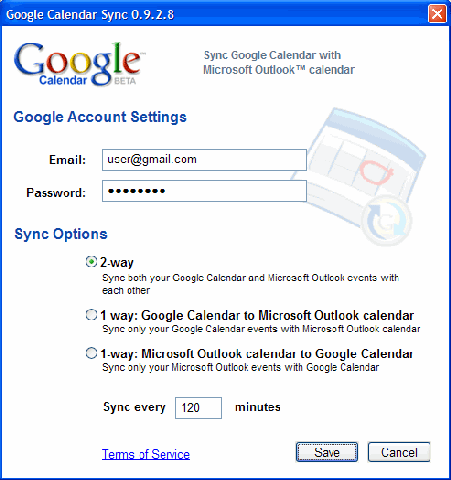
Cal SyncMost of my community work and freebie stuff runs off of Google and I don’t think I’m cutting it short when I say that Google has by far the best calendar/scheduling app on the market today. So this release has definitely brightened up my day, Google announces Google Calendar Sync that does one way or two way sync with Microsoft Outlook, but this also opens up a synchronization from Google Calendar to Windows Mobile.

Leech it today..