
Howto: WordPress AJAX Newsletter Subscription with jQuery

Vladville, Web 2.0, WordPress
Comments Off on Howto: WordPress AJAX Newsletter Subscription with jQuery

Today I took the first steps towards publishing my newsletter and that of course means putting up a signup form. This is a dreadful, backwards process of creating a new template page, building a form, a processing script and then sending the user where they started out from. It involves unnecessary clicks, diminishes from design and flow of the site. But it doesn’t have to – enter jQuery and WordPress.

Using jQuery framework and a simple backend server script you can collect data from the user and post the response inline on the same page with the minimal interruption to the browsing process and minimal changes to the layout. For example, my form prompts users for their email address in the sidebar to the right. It communicates errors or success by fading in a container with the error or congratulations text. No page reloads, no dedicated pages to design or maintain – just embed another widget in the sidebar and enable the site to be more functional. Gotta love AJAX.

I wrote a quick and simple HowTo article on creating AJAX driven forms in WordPress: Check it out.

Enjoy!

My iPhone Buying Experience

Mobility
1 Comment

Earlier today I went to the Apple store to try and make myself like the iPhone enough so I could ask my wife to get it for me for Xmas. I failed… the keyboard sucks, the phone sucks, the mail app sucks (15 minute mail check intervals were ok.. five years ago) the configuration sucks and it really boils down to a midgetized, albeit beautiful, tablet without actual applications. So I need a new Christmas present idea for the wife…

This post, however, is  about something else – customer disservice. I spent close to 30 minutes playing with the iPhone, really doing everything I could to see myself dropping the Samsung Blackjack for. In that time I was harrassed by no less than 10 separate “Geniuses” – I suppose they don’t often see people using their devices as the name of the game is “let’s make idiots gawk at pretty pictures and run to the register” – so I paid them no attention. Read the swag bitch, you may be an Apple Genius but you’re not qualified to delete SPAM from my Junk Items.

So as I was trying to will myself into thinking iPhone would be for me, I got to listen to the “Geniuses” blast their arrogance on their customer base. All of whom left without purchasing anything. All of whom, as a result of this experience, will likely never return to an apple store.

The key argument: Unlocking. Can you unlock the device? Can I use it in another country? Can it be unlocked. The answers were not “no” but were far more threatening and egoistical. It was as if you were committing an act against the humanity by trying to be on a carrier other than the one Apple chose to abuse its monopoly with.

“It’s possible but its difficult and I would not recommend it. You are likely going to destroy the phone and we will not take it back.”

“We cannot unlock the phone, it can’t be done.”

“If you try to unlock it you void the warranty and we will just lock it back the next time you connect it to your computer”

What cracked me up was the shere ignorance of these walking Apple infomercials – they are a smug little bunch, for being a bunch of retail retards making I venture to guess $12 an hour tops? I wonder if there is a huge gap in the Apple staff training that needs to go a long way to explaining to these geniuses that they are not actually “geniuses” in the IT space that can showcase ego but rather just retail sales people, you know, like the kind you find at Macy’s. Without this check, Apple seems to be antagonizing a fair amount of sales through their customer disservice.

As usual, time to grab the mirror and make sure we aren’t doing the same.

Overwhelmed? Relax, you’re doing fine.

IT Culture, Vladville
Comments Off on Overwhelmed? Relax, you’re doing fine.

BBS Forums…
FIDOnet, CCi…
Usenet…..
IRC……
SlashDot…….
AIM……..
MSN………
Yahoo Groups……….
Digg…………
LinkedIn………….
Facebook…………..

……. Just a few of the ways I have wasted my time over the past 15 years, none of which I touch in a significant way anymore. When things are fresh and new you find people with which you can have an open exchange of ideas, early adopters, energetic.. but over time the medium gets exhausted by everyone and the meaningful conversations and connections no longer happen.

There are always folks out there treat every new community technology as the second coming of Christ – it’s not. Things are now as they have always been, there is a huge new popular thing out there and people jump on it. The only new variable is the difficulty of participation – as it becomes less difficult to participate, more people do so. That’s it.

My message is simple: Take all the new fads for what they are worth: A new way to reach new people and exchange new ideas. Hopefully you are decent enough of a human being that in the process you both learn something and form long lasting relationships that can look back at some good times together.

So jump in, the water is warm because we are all peeing in it.

(This bit of motivational insight is brought to you by a spectacular Carrabba’s steak and reading Scott Adams new book: Stick To Drawing Comics, Monkey Brain!: Cartoonist Ignores Helpful Advice)

Westcoast Event in UK

Events
Comments Off on Westcoast Event in UK

Just a courtesy mention for an event that my dear friend Susanne Dansey is planning in the UK this week. Over 170 have signed up, and you can register here. I believe in Susanne enough that I can blindly endorse this, she can throw things like nobody’s business, and I can tell you that the sub-200 crowd is far better than the larger events, especially if you’re trying to build relationships and network with everyone there. So if you can, go.

Andy mentions that the event may have sold out already, but he can get you in. If that fails, remember that tech events in SMB are highly dependant on the things that “come up” so the odds that you’ll be able to get in might be better than you imagine. And if you still can’t get in, contact me for some incriminating pictures and video of Susanne that will get you right in and into the VIP seats*.

(* Limited to the first 10,000 people that request it.) 

SPAM Worse Than Ever But About To End?

ExchangeDefender
Comments Off on SPAM Worse Than Ever But About To End?

Take a look at the following article discussing the current state of SPAM, discussed by the ones with perhaps most to gain: antispam vendors. As a highly biased vendor, I can tell you that the threat description by the marketers below is pretty much dead on. The logic at the end is horribly flawed because it questions the end of spam because the consumers now have freebie filters and commercial mail is getting more difficult to send.

Quite the contrary, dear Watson. The SPAM has gotten far less expensive to send because it is being distributed through huge botnets that do not send enough SPAM to get blacklisted quickly outside of the honeypot system. At the same time, it has gotten prohibitively expensive to filter mail at the server and/or the gateway – We sign up dozens of customers daily, almost all of whom are pulling out GFI and Barracuda appliances. Those systems are now worthless, despite their cost advantage over hosted networks, because they cannot handle the volume of mail being sent – even the largest appliances are getting overflown in SMB not to mention the tight T1 or broadband pipes.

Hosted SPAM filtering is taking a hit as well. Those “free” offers are going away and effective hosted filters are starting to raise prices. Hosting companies are also adding larger premiums for this service, cornering customers to use the client-based SPAM protection, having to rely on Outlook Junk Mail filters.

As my favourite demotivator says: “It’s always the darkest right before it goes pitch black.”

Now, here is the article:

“Two years from now, spam will be solved.”

— Microsoft’s (MSFT) Bill Gates, 2004, World Economic Forum in Switzerland

SAN FRANCISCO — Why, in 2007, is spam worse than ever? Let exasperated consumers count the ways: PDF spam. MP3 spam. Pump-and-dump spam. E-card spam.

It may sound like a broken record, but spam continues to do just that — break records. This year marks the first time the total number of spam e-mail messages sent worldwide, 10.8 trillion, will surpass the number of person-to-person e-mails sent, 10.5 trillion, according to market researcher IDC.

“Every year for the past four years has been the worst year yet,” says Rebecca Steinberg Herson, vice president of marketing at e-mail security firm Commtouch.

Unwanted commercial e-mail touting Viagra, get-rich-quick schemes and more is growing by electronic leaps and bounds: an Internet-buckling 60 billion to 150 billion messages a day. “It was one of the rare times (Gates) was wrong,” says David Mayer, a product manager at e-mail security firm IronPort Systems, a Cisco Systems (CSCO) division.

The sheer volume of unwanted commercial e-mail is like a tidal wave, washing over the best-built digital dams and, despite a federal anti-spam law, resulting in spam leaking through to consumers.

Feeding the spam-alanche are advances in spamming techniques, the rise of bots — millions of compromised PCs that spew spam — and the fact that more people have multiple e-mail addresses. Market researcher The Radicati Group estimates there will be 2.4 billion e-mail accounts worldwide by year’s end.

Eliminating spam is “a war you cannot win,” says Greg Toto, vice president of products and operations at computer security firm BigFix. “It is much cheaper to send spam than stop it. Spam is becoming more specialized, and spammers are taking advantage of bad practices by consumers and businesses.


“The stuff continues to spill through,” Toto says.


A surfeit of spam


And how. Despite Gates’ bold prophecy, a revolving door of anti-spam products and the Can-Spam Act of 2003 — whose advocates breathlessly predicted would deter spammers — the total volume of meddlesome stuff has continued an inexorable climb.


So much so that Gates recently clarified his 3-year-old prediction.


“I never said it would be solved,” Gates said in an interview with USA TODAY last month. “I said it would be substantially reduced, and in fact it has been reduced a lot.”


When reminded that numbers are spiking, Gates begged to differ. “Sure, there’s a lot (of spam) out there, but software is deleting 99.9% of that anyway,” he said. (Microsoft now pegs the figure at 85% to 95%.)


Spam is popping up in different guises — whether as attachments that appear to be PDFs, MP3 files and Excel spreadsheets — to evade anti-spam services, says Scott Petry, founder of e-mail security firm Postini, a subsidiary of Google (GOOG).

Faux electronic-greeting cards, containing links to viruses, have also picked up. Since July, Postini alone has blocked more than 1.5 billion copies of Storm, an e-mail virus masquerading as a greeting card.

Meanwhile, spam containing PDFs, non-existent in May, now accounts for 8% of unsolicited commercial e-mail. “The bad guys have taken a highly mutated approach because they’re only paid for what gets through,” says Jose Nazario, senior security researcher at Arbor Networks.

This summer, a PDF promoting a pump-and-dump scam urged consumers to buy shares in an obscure company called Prime Time Group. Anti-virus firm Sophos reported a 30% spike in spam moving across the Internet at the time, fueled by the missive. The fraudulent spam messages were sent from compromised home PCs by Storm, the e-mail worm that entices victims to click on tainted e-card links and thereby turns their PCs into spam-spewing bots.

Although Sophos blocked more than 500 million copies of the Prime Time PDF, it is likely the Internet was swamped by several billion copies of this particular piece of fraud spam. Many copies were getting blocked by anti-spam filters, but some made it to unprotected in-boxes.

“As long as even a small percentage of people continue responding to pump-and-dump scams like this, the problem will continue to exist,” says Ron O’Brien, Sophos’ senior security analyst.

And then there is phishing, those fraudulent e-mail and websites designed to rip off personal information. An insidious version of spam, its levels are at all-time highs. In July 2007 — the most recent month for which data are available — the Anti-Phishing Working Group said new phishing sites pole-vaulted to 30,999, from 14,191 in July 2006.

One in 87 e-mails is tagged as phishing scams now, compared with one in 500 a year ago, according to e-mail security firm MessageLabs.

Fighting back

All is not lost, however. Consumers and corporations are getting creative to cope with the problem, operating on the premise that spam is inescapable.

“You can’t eradicate (spam), but you can manage the problem,” says Arbor Networks’ Nazario, who compares spam to the flu.

Industrious e-mail users are using an exotic mix of software and services to tamp down spam across several fronts. Think of it as their idea of spam inoculation.

For a start, tens of millions use Google’s Gmail because it was designed with built-in spam defenses. Others are joining social-networking sites such as Facebook and MySpace, where they control who has access to their personal profile, to exchange e-mail with friends, family and business associates.

Many also use phishing filters provided by Microsoft on its Internet Explorer browser. Last month, Yahoo, eBay and PayPal took a major step to shield customers from phishing attacks. They announced eBay and PayPal customers who use Yahoo Mail should start receiving fewer bogus e-mails because it now uses DomainKeys, an e-mail-authentication technology.

A new breed of e-mail services, such as CertifiedEmail from Goodmail Systems, put the financial onus on the senders of unsolicited commercial e-mail.

CertifiedEmail treats e-mail as a FedEx-like service. For less than one-fourth of a penny per message, commercial marketers, government agencies and non-profits are guaranteed delivery of e-mail to individuals who have indicated they will accept the messages from that specific sender. Recipients see a blue seal verifying that the message is legitimate, says David Atlas, senior vice president of worldwide sales and marketing at Goodmail.

Another free option, Boxbe, lets users of Gmail, Microsoft Outlook and Yahoo Mail create a guest list, giving them final say on who is allowed to send e-mail. Anyone not on the list receives an invitation to join when they send an e-mail to the Boxbe user.

The multilayered-defense approach has worked to stop such scourges as image spam, which varied the content of individual messages — through colors, backgrounds, picture sizes or font types — to slip through spam filters. Image spam made up half of all spam in January. Since software makers came up with a solution, image spam has dropped to 8% of all spam, Symantec says.

Given all of these free available solutions, and their success in some cases, could the future be brighter for spam-slammed consumers?

Richi Jennings, lead analyst for e-mail security at Ferris Research, thinks so. He expects evolving anti-spam technology to slowly choke off unwanted commercial e-mail.

Could Gates’ oft-disparaged prophecy be right, after all?

“As more people have in-boxes protected by better and better spam filters, their experience of spam gets closer to Gates’ vision,” Jennings says. “He was a bit overaggressive with the prediction, of course. But spam isn’t an easy problem to solve.”

Contributing: Byron Acohido

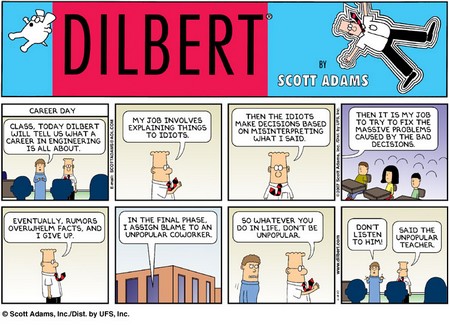
Don’t Be Unpopular

IT Culture
Comments Off on Don’t Be Unpopular

Ok, this made me laugh to tears, hope it cheers you up:

Dilbert200711195248

The K.I.T. Challenge: Pursuing Leads

IT Business, SMB
Comments Off on The K.I.T. Challenge: Pursuing Leads

YearbookRemember your senior year of high school and all the K.I.T.’s in your yearbook? Keep in touch, a promise you probably live up to every 5-10 years around reunions. That may work for friends, but that does not work for business even less so if they might rely on you for technology advice. Perhaps the worst words anyone can say to you are: “Are you still in the computer business?”

Since I dumped all my Yahoo groups subscriptions and most blogs (over 1 month clean!) I have started keeping a 30-day, 60-day and quarter folder. Every month, I drag the items in my Inbox into these folders. Then I go through the 30 day old mail folder and process the flagged items. Are there things that need an extra clarification? Do I need to touch back with some people? Any issues that I thought “I’ll catch up with it later when I’m not swamped” and then the weekend came in and I just lost track of it?
Hey, it happens. I’m human. This is why I check.

I must admit, I’m far from where I need to be with the followups so I am trying a few new things to stay in touch. The difficult part of it is the contact preference – some people look at phone calls as an interruption, some people consider email thread they did not initiate as SPAM (or it inadvertently ends up there anyhow), some people prefer mail / fax or a cell phone chat while driving from client to client.

It is often cited that it is more expensive to land a new client than to keep an existing client there. What I’ve been successful with is taking it one step further: It is cheaper to convert the existing leads to clients than to go out and get new ones. However, this takes some TLC – and lead qualification is an emotionless process the sales people use to pack their pipeline and meet goals: Are you buying in the next 30 days or not? Yes = pressure; No = Disqualify lead.

I believe our products are good enough that they don’t need to be pressure pushed – so we don’t. But I also do not believe that anyone needs to be dismissed just because they don’t need a solution here and now. Staying in touch, responsive and most importantly relevant is the difficult part.

So here is some food for thought.. how much money do you spend on advertising to pull in new leads as opposed to keeping relevant to the leads you already have?

How do I get ExchangeDefender to deliver inbound mail to multiple IP addresses?

ExchangeDefender
Comments Off on How do I get ExchangeDefender to deliver inbound mail to multiple IP addresses?

I was sitting around writing some documentation and felt compelled to share some general knowledge on how Internet mail is routed around. The basic problem / solution here is how do I get a multihomed Exchange environment on the cheap? Enjoy.

Please first consider the following document: ExchangeDefender Deployment Guide

ExchangeDefender can deliver inbound mail to a static IP address or perform an MX lookup and deliver to the first available server. We support secure TLS delivery to both IPv4 and IPv6 addresses.

If you have multiple static IP addresses that you wish to deliver inbound messages, ExchangeDefender can perform an MX lookup in order to deliver mail to one or more mail servers. Larger clients tend to have multiple Internet providers on multiple IP ranges and use them to provide failover service or load balancing. ExchangeDefender fully supports this configuration.

In order to get ExchangeDefender to deliver messages to either a failover or load balanced connection that has multiple external IP addresses you need to create another MX record in your domain and add the hostnames of the IP addresses to that MX list. Your default @ MX record for the domain will still point to inbound30.exchangedefender.com but ExchangeDefender will deliver to your new MX record. Here is an example:

# Primary / default MX record
@ in mx 10 inbound30.exchangedefender.com.

# Host records for individual mail servers
mail1     in a 65.99.192.2
mail2     in a 65.99.255.3

# MX record for direct load balanced / failover access
directmail  in mx 10 mail1.domain.com.
directmail  in mx 20 mail2.domain.com.

In the example above, your default / primary MX record for domain.com is inbound30.exchangedefender.com. You have defined a hostname on each IP range you own as mail1.domain.com and mail2.domain.com. Finally, you have created a new MX record directmail.domain.com that will resolve to mail1.domain.com and mail2.domain.com

Under this example external mail for user@domain.com would be sent to inbound30.exchangedefender.com. ExchangeDefender would then route the message according to the MX lookup for directmail.domain.com which goes to mail1.domain.com or if unavailable to mail2.domain.com. This is the failover configuration. If you set the weights on directmail MX record to 10/10 (or any other numbers, so long as they are equal) then ExchangeDefender would deliver mail in a round robin fashion allowing for load balancing.

This configuration is independent of router choice, because it does not require the router to fail over the link. You could just have multiple routers with multiple gateways on your network. This configuration will work with virtually all routers and load balancers on the market because it uses DNS to route mail, not a hardware switch.

Of course, to set the MX record to deliver mail to access your ExchangeDefender configuration and click Advanced Settings for Inbound mail.

Important Notes:

  • Make sure you check that the MX record exists, nslookup -q=mx directmail.exchangedefender.com should return two or more mail servers. If it returns invalid domain, something went wrong.
  • There is a difference between a host (A) record and a mail exchanger (MX) record – if you point ExchangeDefender at a host the message will bounce.
  • This is an advanced network topic and we strongly advise it be done by a competent IT Solution Provider, please contact us for a reference.

The SMB Microsoft Partner Challenge

IT Business, Microsoft
Comments Off on The SMB Microsoft Partner Challenge

Happy Thanksgiving Folks! I hope spending time relaxing, hopefully with family and the ones you love is recharging your batteries and making you look forward to cracking that SMB Microsoft Challenge I asked you to think about the other day. If not, hopefully this will:

First of all, if you’re taking a blue colar approach to IT business (I’m small, love small, always will be small because I can’t/won’t lead/hire/manage/work full time) or if you are not an entrepreneur (i.e., you see the end game being a “good job”) then this is not for you. Go back to the turkey. See ya.

Now if you are still reading this you are probably an entrepreneur and you are shaking in your boots over what the competitor with $30 billion a quarter is going to do to your business. Fear, uncertainty, uneasiness, reservations.. are perfectly natural and normal. Only arrogant fools that are about to lose their heads can go without those qualities (see: .com bust) that make someone face difficult and uncertain terrain and overcome it. It’s a part of leadership, its a part of you that people are willing to follow. So relax, take a deep breath, Microsoft or Google or GM or Walmart will do what they do, you can’t control them – but you can control yourself and what you do.

I hope you took a moment to read why this is happening. Read Karl’s excellent overview of “What are we worth to Microsoft” to get an even bigger picture. I hope that at the end of reading both blog posts you have somewhat of an understanding of how big business works and that its just as ambitious, just as greedy as you and I. Again, this is not something you control, not something you can change and not something you ought to spend your time worrying about.

Remember WHY you got in this business to begin with. I got into it because I thought I could make more money by providing a better service than the people I worked for at the time. I can guess your story may be similar to that, but it is you who stepped out and thought you were the component that will make the difference. So focus on you and what you can do – not what Microsoft does, what BestBuy wants to do or what the vendor whose stuff you sell is telling you to push.

That’s pretty much all there is to it. It’s that simple. You need to be cognizant and aware of what the others are doing and preparing yourself and your company to do it better, faster, more in tune to your customer base.

My Story

I run an ASP, Application Service Provider. We manage 14 data centers full of servers, network gear, etc. Some applications we write, some applications we buy, some applications we rent, some applications are brought in by the customer and we just watch over their servers, their networks, their homes, whatever. Bottom line, our expertise is network infrastructure beyond a SOHO router and a T1.

Microsoft is my biggest friend out there because it enables me to do what I do and to scale it in ways that I could not do on my own. In particular, I am talking about Small Business Specialist program. Microsoft is training, filtering, financing and enabling an army of people that I can count on when I do my projects. Be it Los Angeles, Dallas, Miami, London, Bonn, Vienna, Hong Kong, Adelaide or Honolulu, Microsoft is working on my behalf as a filter separating self-enabling IT folks from the charlatans and pretenders. It’s not a great filter but its a better filter than I am and more importantly, it’s a free one. I consider the filtering and enabling capability of Microsoft their primary quality.

In a far distant spot is Microsoft’s ability to design software that can interact with the garbage Dell or HP shipped to the customers site. I can offer them a whole suite of Microsoft applications to fit their need and sell myself above and below that layer. Under the Microsoft layer I am the company that knows the current state and future condition of their network and their technology business. On top of the Microsoft layer I provide guidance as things change. Nobody likes change, but everyone loves a new cell phone. How’s that for a contradiction of needs?

Finally, and perhaps key for me, is Microsoft’s inability to react to the market (see: live.com, System Center *.*, Vista *.*, etc) and its growing bipolar disorder between a company that only designs software and enables third parties to integrate it, or an integration company that eliminates one partner at a time. This uncertainty in their business model is enabling me to remain agile, to grow my solution stack,  to keep on adding clients as fast as Microsoft alienates them.

Big Picture

Big picture, as far as I am concerned, is increasing revenues and profits and client base quarter over quarter through a larger solution portfolio. I am not struggling to keep myself in a box, to think smaller or more efficient – I am struggling to grow, to reach more, to offer more and be more helpful. This is where I bump heads with some MSPs who think the only way to sustained profitability is through automation and optimization. After all, look at Microsoft – they didn’t become a $30 billion a quarter company by building a better, more secure operating system – they did so by expanding the features, even if broken, expanding markets, even if unprofitable, expanding the reach, even at the cost of angering their partners.

What drives me is seeing our solutions work for our customers and always thinking of a solution to the new problems our partners and customers identify. We provide our services at a cutthroat discount to our partners and sell them at an exponential profit margin to the direct client base – my partners help us build our products, my clients help us build our company.

What Microsoft, Google, Yahoo, GM, Best Buy or others do is relevant, but inconsequential. In 2004 I had job offers on deck from some of the above and the decision I had to make was what would make me a bigger millionaire. You can see my answer here every day, if you’re traveling in the same direction you may want to ask yourself the same thing.

Enjoy the turkey.

I sold a Mac today: The Hell Has Officially Dipped Below 0 C / 32 F

IT Culture, Vladville
1 Comment

Ok, this hurts to admit.

I have officially sold my first Mac… six of them. In about two weeks or so there will be six designers in Pakistan equipped with their shiny new iMac’s, complete with Core 2 Duo’s, 2 GB Ram & Adobe Creative Suite.

 The conversation was ugly from the getgo but the customer was pretty much standing there with check in their hand, just waiting to give me money. The question, and I quote: “What do you think about those Mac computers?” which in Vlad language translates to: “How do you like it up your ass, with lube or with broken glass on a stick?” – there is just no pretty way to answer a question like that. Moreover, Mac is usually just something I use to emasculate my partners from California..

Anyhow.. iMac’s. “What did the designer use in school? Mac? Ok, buy a Mac. Add more ram. Done” There was no feature conversation, no processor options, no versions of the OS. Just wham, bam, thank you ma’am, it will be in Islamabad in 2 weeks. Oh, you want VoIP too?

I feel very, very dirty. Off to cry in the shower.