The Dip Modified: Are you -er or -ed?

IT Business
1 Comment

The Dip book has really reaffirmed my long standing (and often criticized) belief that not everything can be fixed with hard work, or at least may not be worth the time investment. However, I disagree that it’s a black and white case of stick with winners or kill the losers. There is a lot of room in the middle, especially in business, where there are other options. You can read Seth’s excellent book on his take about why people don’t know when to quit, but since you are here, let me offer you mine.

In a nutshell: Over the large sample of transactions, there are some in which you are the fucker, or you’re getting fucked. Thats the reality of business, you win some, you lose some, and in the middle you’re just trying to turn something into a winner or find the least expensive way to kill it. Over the course of time you will lose and win – the key to making it big is making sure the wins are big.

Win
Not much to say here except congratulations. Just don’t get arrogant about it. See _every rapper that ever lived_.

Lose
S*** happens. Move on.

Things Suck
This is the big gray area in the middle that requires a lot of consideration because world is not black and white. If you’re in a difficult situation you have some decisions to make.

Planning & Evaluation

So, your plan failed. Ok, don’t panic, sit back and lets look at it. Before you decide where you go, you need to find out where you want to go. Or not go. The thing is, before you decide you need to evaluate all your options. Here are the key one in any arrangement, at least as far as I am concerned.

Whats in it for me?
Do you have anything to gain if you stick with the current course of action? Is this a personal gain in monetary terms or are you just doing it for your ego?
Do I control the outcome?
This is the question you need to answer because it controls the outcome more than anything else. Truth is, if you are in control no amount of hard work is going to fix this because someone else controls the outcome – not in direct terms but indirect terms like satisfaction, timing, etc.
What else at stake?
Is it just your ego that will get bruised or will it be your business? Will it be your business in the short term or are you going to lose revenues for years and years after giving up on this project. Does it impact you indirectly (reputation) or directly (revenue).

Now that you’ve answered those questions and hopefully decided whether you’re going to continue down the road, it’s time for actions and time to establish the new plan (because if the old one worked you’d never be in this spot to begin with).

Actions

Once you have a new plan to make it out of your dip, put them in play. But its not quite as simple, you’ll have a few things that are guaranteed to happen:

Tears and paralyzing fear
We all have these. The feeling of despair, the feeling of inadequacy, the feeling that if you just got a day or two of good sleep, or a break, somehow the problems would magically go away. They don’t. But it’s a stage, deal with it in the best way you can and get back to the problem as quickly as possible.
Know the outcome and stick with it
Remember, you need a new plan. Adjust your timelines, adjust your expectations, adjust your schedule, adjust your promises – whatever you gotta do to make it happen.
Or hell, kill it now
And if all else fails, just kill it.

Key to success

You win some, you lose many. Not really a pesimistic view but let’s look at a case of a sure way to go broke: Las Vegas coin slots. On the average, the wins are tiny. Losses compound over time and are exponential at least by comparison to the losses. This is why the casino advertises 97% payouts, bags of money, etc: Because people are stupid and like to dream about winning!

The key to success is to win big. To hit the jackpot. There are plenty of business contracts that you will enter into where you’ll certainly get the short end of the stick. You’re the -ed in this case. And here is what separates the winners from the maraginal successes and the losers:

Winners stick to it.
Losers cut out too quick.
Marginal successes try to curb both the winning and the losing, in the end really having nothing of value.

This applies to a lot of the SMB IT folks out there. What’s the biggest and best trade tip for a profitable SMB business? Kill the B,C,D,F clients and only keep those A clients. After all, who the hell cares about the deadbeats, difficult business owners, whine, bitch, moan, repeat. If I had a penny every time I got that advice. I tend to look them straight in the eye and ask them: How do you grow your business. Nine out of ten times they say its the word of mouth: Ok, quick – what kind of word of mouth do you get when you fire a client because they are too difficult to make a profit on? 🙂

See how that works? The people that try to cut and run in the short term end up with mediocre or even non-existent wins in the long term. Sure, it’s better than the folks that stick their head in the sand and end up bankrupt, but if you’re looking to be a winner this is not the way to go about it. Business, and entreprenurial enterprise itself, is a game of risks. Sometimes you lose, but if you can win big you can afford to lose more often.

Thats at least how I live.

ASUS ExpressGate & SplashTop

Linux
Comments Off on ASUS ExpressGate & SplashTop

Perhaps two of the coolest new motherboard features in quite some time, shame it’s from Asus, but kudos on producing this.

I really cannot do it justice with my own review since I’m just a screaming fangirl when it comes to things like this so you can read the review on your own.

In a nutshell: Just another motherboard, except this once can fire up an embedded Linux environment with Firefox and Skype in 5 seconds. This is a godsent for quick computer access, troubleshooting and diagnostics, not to mention for homes that do not (or should not) have systems on 24/7. Price tag is $360, more than even a decent server mobo, but first mover always cashes in.

The Monkey Doors

Shockey Monkey
Comments Off on The Monkey Doors

This has been an execiting few days on the signup forms. For starters, the SSL certificate expired the other day. Got it renewed, please go sign up if you haven’t already. I even took Scott Buchanan’s advice to make my ass kicking more friendly:

There are only two rules: Never ever ever ever ever email Vlad (for any reason) and be as nice as you humanly can be (even if your head is on fire). The reasons for these rules are simple: There is one of me and nearly 4,000 of you and if everyone had even just a quick question that took a minute for me to respond it would take me over two weeks of full-time labor just writing emails.  The second rule is there to remind you that the software is free, so if you don’t like it and choose to be rude without unsubscribing I might cut out the middleman. Failure to follow the rules means your portal gets deleted. It has never happened, but I like to set the rules of the game up front.

Aside from the email nagging by a few people, the product development has been awesome for me. I got a TON of feedback, lots of offers to help, partners have been referring one another to it, helping build the whole thing. People that chose to bow out did so gracefully, I helped a few with their Connectwise migration, all in all, over a year into it, I’m quite happy with what we’ve been able to build.

How do you sell to SMB?

SMB
Comments Off on How do you sell to SMB?

Yesterday I was the quintessential business owner. I was looking at the future of my small business, not quite sure what the best decisions were, and I took advice from knowledgeable (but at the end of the day, in my eyes) sales people. I had no idea what I needed, I had a rough idea of what my budget was but had a lot of wiggle room if I was explained why and how. I also had a 2–3 year outlook on everything.

I spent all day in an empty office seeing one sales guy after another:  handyman, drywall, flooring, alarm system, Internet. Who won you may ask? Well, that depended on the circumstances and the need but I hope some of these give you an idea of what you may be able to improve in your own business. And if for a moment you think you’re not a handyman, to a person that can’t tell the thermal compound from a joint compound, you’re no different. As a matter of fact, roughly 3/4 of Orlando ITPRO dresses worse than the people that came to my office yesterday! On to the knowledge..

Remodeling

Easilly the most complex (read: messy) part of the job. I wanted one of the walls in my office knocked down and removed because I wanted to turn it into a lounge. I called a few people, most of which never returned my call. Construction business must be good!

Anyhow, there were three people that could have gotten the job. One was a very knowledgeable but NewYork-y lady, one was a good ole’ boy and the last one was a guy that likely answered the cell phone on I4. I was inclined to give it to the hard working guy that risked his life and his truck to take a sales call but he was packed until next week and I wanted it done today.

Here is how the NY lady lost:

I explained the situation to her and she had more questions than the answers. Despite my continuous repeating that “Lady, I work with computers, not construction.” she continued to ask questions and explain her terms in more and more detail that had no consequence on my business, my remodeling or anything of the sort.

I asked if she would come down to take a look at it – “No need, this is a really simple job.”

This was such a simple job indeed that every time I gave the “wrong” answer it went up a $100 on the quote. Does the wall have any electricity in it? Is it a load bearing wall? Is it attached to the ceiling? Is it wired to the ceiling? How thick is the wall?

After the tenth time I told her I don’t do construction and hope to die as ignorant of it as possible, I told her I would call her at 9 AM when I got to the office and would go through it. When I got back to the office I realized that it looked far different from my description. It was a full wall, with a door, attached on both ends to the walls and they ran cables through it. I called her back, explained the solution and I think I heard the sound a coin machine echoes when you hit five 7’s.

I told her that due to the complexity I am just going to want to patch up the hole in the wall (this used to be a legal office, they had one of those receptionist holes in the wall where you sign in and sit in the waiting room. This is where it turned pretty:

The Blow

I explained that because of the complexity I was not interested in doing it anymore. I asked her instead for a quote to come and patch up the 3×3 foot hole in the wall.

She first blew up at me about how this was such a small job.
Then she told me that in order for her to do it she had to pay her guy for the whole day plus travel plus gas.
Then she told me that she had to keep her business up and running too..

That last line is where she lost the ball game. Oh, you have to keep your business running? Uveee, really a give a s…

Lesson: There is such a thing as a graceful way to turn down a sale. Thank them for the callback, explain that the job may be too small for you because you don’t specialize in anything below remodelling, etc. But don’t try to make the customer feel guilty for not being good enough to buy your services, especially since you’re on the line to sell them stuff!!!

I asked her for a recommendation. She said to call a handyman. She also said that in order for her to do it, it would cost $350.

$350? I’ve lost more than that just listening to your drywall dribble. How soon can you get here? “I don’t know it would take this and that and this and that and <cutting her off> Listen, I am seeing a lot of people today, find out and call me back. Ok? Ok, thanks.”

Not before the phone clicked did I pick up the Orlando Sentinel to find a handyman. I dialed the first damn listing, A-Z Handyman.

During my call, the lady called my phone number no less than 10 times during the 5 minute period. How is that for a sign of desperation?

Here is how the good ol’ boy lost:

I asked  for a quote on a drywall removal. He was busy on another job but I could tell he wanted to work with me. Great! Appreciate that.

So we set a date. He blew it. Set another date, he rescheduled it. Today was the final straw and frankly, after talking to the lady, I gave him a call to let him know I had changed my mind about the drywall and that it would be staying.

Lesson: You are never too busy for a lead. Especially if you sell services that are likely to be required again. I can accept a busy McDonalds, I can’t accept a busy contractor when the rest of my business continuity depends on it. If you are too busy, do not make empty promises to meet with the client in person or you will lose the sale before it even becomes viable. And they will tell others too.

Here is who won:

A-Z Handyman.

Vlad: Hey, I have a new office, I have a drywall with the receptionist hole/table and molding on it. I would like that stuff knocked out and the hole filled. Can you do that?
Handyman: Of course, how big is the hole?
Vlad: 3 feet by 3 feet
Handyman: Ok, not a problem. It’s $80 the first hour, $40 each hour after that. Do you have the materials or not?
Vlad: Nope.
Handyman: Would you like us to buy you the materials?*
Vlad: Absolutely. I have no idea what is needed.
Handyman: Ok. You’re looking at $180-$220
Vlad: How soon could you do it? (thinking: please, please say by Tuesday)
Handyman: Downtown Orlando? I can have someone down there in an hour.
Vlad: Awesome. I am on Magnolia..

About an hour later, I get a call from the handyman that was actually going to do the work, he came in to do the actual measurement, see whats there, etc. Amazing, isn’t it, this guy was doing an infinitely smaller and less complex job and he still came in to look at it first, unlike the NY lady.

Lesson: Customers tend to lie, or have no clue what they are talking about. So make sure you know what they are asking and that what you are selling them is actually appropriate for them!

He told me he’d be back in an hour, explained what he’ll buy, explained what was going to happen, etc. He didn’t ask me to sign anything, look over anything. He just seemed to know what he was doing and he went about it. No time out of my day.

Hour later, guy comes in, starts working and about two hours into it he is done. The invoice is on the money, I am presented with a complete invoice, a receipt for the materials, an explanation of what was done and how, what I might want to do tomorrow. He leaves me with a can of compound, tells me how to sand it down, etc. He even goes to his truck and gives me a bottle of orange peal so I can make the new drywall match the texture of the rest of the office!

Lesson: People like to be empowered when it comes to taking care of the assets of their business. This is akin to showing someone how to patch their workstation or add a new hard drive. Yes, it might kill an hour of your billing time down the road, but it gives the business owner a concept that this isn’t something to be afraid of and guess who they will call when they need help?

The handyman was out after two hours, fought to refuse a tip (after what I had to go through with that lady there was no way this guy was walking out of the office without at least a $20) and left the place clean. What are the odds I’m going to be a repeat customer?


The Floors

The floor competition was not nearly as intense. As usual, half the people will not call you back, the other half is clueless. Home Depot kept me running in circles – local store told me to call the national number, the national number told me to go to the local store. At the end of it, I was in the local store, with no laminate rep, on the phone being told the same story by the national number they dialed from their Avaya VoIP. They even left it logged in as the admin user. Way to go Home Depot!

The flooring contract was between two guys that came in and really handled the whole thing very professionally.

First, they measured the entire place, looked at the areas, looked at the molding, looked at the quality of the current floor. Then they gave me a quote on the floor installation – with or without.

Second, they proceeded to show me what they would do, how, how many hours it would take, explained that the contract job only took X hours at best, if they had to come back they would but I would not be charged for the second day. (Wait, a blue collar job that doesn’t explode in cost along with complexity and time demands?)

Third, they gave me options on the molding, on the flooring, different vendors. I did find that part funny:

Vendor: Well, its going to cost around XXX for the good quality floor with a 25 year warranty and..

Vlad: How much for one that is rigged to explode in 3 years and a day when my lease expires?

Vendor: Well, the one has a really good warranty!

Vlad: Yeah, but I have a three year lease….

Vendor: Yes, but you don’t want to have holes and tracks in it after a few months either.

Vlad: Oh.

The guys left, offered to come and drop off some samples of the flooring and left their contact information.

Very good experience. They came, gave me options, offered a followup, left a quote. Short of having the laminate in their hands to lay it down right then and there, this was about as good as it got.

The Security

Own Web Now offices tend to be state of the art data centers that require fibs, biometrics, DC personnel and six cage locks with keycodes to get into and everything is committed to tape. And while I’m not dumb enough to put a server or anything of value into a box that anybody form the street could walk into with a crowbar, I would still like to control access to the office and perhaps get a phone call if it burns to the ground.

The Brinks guy was absolutely phenomenal. He came in ON TIME, looked like a  million bucks for selling something that cost a few hundred to start and less than $40 a month in service. He explained the process, the contract, the services, the options. He inspected the office. He explained the entire service and how things work.

He then sat down in the middle of the office (I only brought one chair and my laptop since everything inside the place is going to be gutted in one way or another) and wrote up a contract. I was definitely signing it, but he didn’t ask me to sign it, there was no pressure at all. Just – here is your contract, let me know when the remodeling is done, I will schedule an installer to come out and thats all there is to it.

Thirty minutes, no complexity, no issues. I need it, its in my budget, it rolls. Plus the guy did everything he could to let me know what this thing would do for me and my business, addressing both the issues I have and the issues I didn’t think I would have. I haven’t even bought the thing and it already exceeded my expectations.

The Internet

As ignorant as I am of remodeling, and hope to go even more ignorant, the Internet connection was one of the areas that you couldn’t pull a fast one with me. People tried, which I admire, but the service from all the companies I spoke to was just amazing. Perhaps its because us “phone” service folk have to be a lot more hospitable because we don’t have that face-to-face familiarity with the client.

The first thing that surprised me was my laptop. I sat down in my large empty room, powered on my laptop and found an unsecured AP. wtf? Ok, connected, online. SmartCity, eh? Their page gave me three options: Free (256K), $5 (high speed, for a week), $15 (high speed, for a month). Ok, so I had to call these guys right away because they just saved my day. This is advertising that works folks!

I called a number of people and  I have to say, I am proud of my industry. Not only do we know how to take care of the customer, we know how not to waste their valuable time.

Vendor: It can take me a couple of minutes to enter all of this information to qualify your address. Instead of putting you on hold, can I call you back in 5 minutes on 407–7… ?

Vlad: Absolutely. Thank you.

Vendor: <after 5 minutes, on the dot> I have the results for you but unfortunately none of the speeds match up your requirements.

The SmartCity guy was actually very cool and we will definitely do business together but I want to make one point of distinction here.

When it came to a local choice of my local service, I was only going to give it to a local shop. Hell South didn’t stand a chance. Why? I want a company with a committment to the local community it serves because thats where my infrastructure is and I want their infrastructure too. Now then it comes to the cloud service, I want that as far away from my neck of the wood as possible. Why? If my office disappears (New Orleans anyone) I want to resume the business with 0 interruption. Never keep your eggs in the same basket. So my servers, my VoIP, my fax and everything of the sort is going to be somewhere safe, far away from hurricanes.


The Sales & Service

This is one of the lessons I got to learn very early in my career: “Sales” doesn’t exist. Sales is just another service you provide and if you try to make it exist without the users input and concern for their needs… well, you aren’t getting the sale. This is where most sales people fail, they never account for what the customer is asking for — they push what they want the customer to buy which is what they want to sell. The goal of a sales service is not to push the customer to buy crap they don’t need, it is to get them to sell themselves on what they want! Your job in sales is obviously to guide them to that point, but when you pressure and push, especially in reoccuring services like what OWN does, they will drop you the moment they something they were not bargaining for. Again, unless you work at McDonalds your job is to tell the customer about their options, evaluate their needs and show them the impact of their decisions.

So, thats my SMB owner buying experience, see any areas where you might want to improve your own b2b sales process?


I want to see that Video!

Vladville
2 Comments

Image_thumbMark gets me in trouble again..

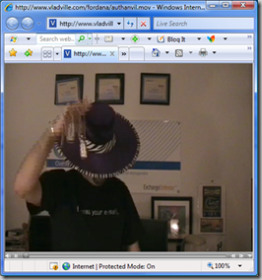
The video to the right, which I hinted about earlier, was a short video I shot for Dana as a means to introduce AuthAnvil VM and our joint project to offer the turnkey two-factor authentication for SMB as well as sell it in lots of less than 5.

However, this video was shot for the rookies at SPF Nation and as such really isn’t appropriate for my audience. Dana wanted to air it during his presentation but if you’ve ever tried to play a video from a PowerPoint slide you can guess why that didn’t happen. We’ll reshoot a more appropriate video for the product at another time, hopefully when the API for the automatic signups is ready at OWN.

If it makes you feel better, here is what you missed out on: The video opens to me in a pimp hat and Cryptocard pimp rings dancing to T.I. – You Know What It Is, budget bottle of Bacardi Limon, Costco-sized bottle of Aspirin and a king sized pillow. Classy as usual.

Your last chance to sign up for Shockey Monkey

Shockey Monkey
Comments Off on Your last chance to sign up for Shockey Monkey

I’ve been debating this for a while as the project has become far more popular than I ever expected and I’ve become more busy than I ever wanted. So here is the deal: You have until October 10, 2007 to sign up for Shockey Monkey. By Monday, I will have everyone that is currently waiting in the queue in support.ownwebnow.com portal and ready to go. If you aren’t in it then, sign back up.

Shockey Monkey signup form will officially go offline on 10/10/2007

I did not come to this decision lightly but around 18 months ago when I started down this journey I never anticipated more than a few hundred SBS community folks would ever sign up. Today, three thousand people plus and counting I’m at a point where I will be spending more time adding new users than adding new features. That is simply not fair to the people that have established their businesses on the monkey and are currently using it in their businesses. There is a lot that the monkey needs to do to improve for those people and I still have a few hundred in the queue just waiting. So out of respect for those and for the features that are coming, I have no choice but to close the gates and reopen them when this is a fully documented commercial program within a few months.

P.S. I want you all to know how eternally thankful I am that you have found so much in SM to continue promoting it to everyone you meet. Nearly everyone that signs up does so because they know someone else is using it and they love it.

Dear Vladville Spammers: Suck it

WordPress
Comments Off on Dear Vladville Spammers: Suck it

After deleting the billionth trackback spam from Vladville I figured it was time to do what I do best, wack lines of code until something happens. Thanks to Aksimet and Spam Karma 2 I don’t have a lot of comment SPAM. Yes, every now and then I get to delete one or two but I am at the point where I’m deleting dozens of trackback spams each day.

Trackback SPAM is just spammers way of getting more traffic to their site. They ping the popular blog in hopes that people will accidentally hit the link and end up on their site. Doing a trackback is also very convenient, spamwise, because it does not require them to have an account here, confirm anything or even exist – just put up a blog post and hit pingomatic. Life is good.

Two can play at that game. Here is how you disable trackback linking using WordPress:

/wp-content/comment-template.php

Edit the get_comment_author_link() function and replace it with what I had below.

function get_comment_author_link() {
        global $comment;
        $url    = get_comment_author_url();
        $author = get_comment_author();

        if ( empty( $url ) || ‘http://’ == $url )
                $return = $author;
        else
        {
                if(get_comment_type() == ‘comment’)
                {
                        $return = “<a href=’$url’ rel=’external nofollow’>$author</a>”;    
                }
                else
                {
                        $return = “$author”;
                }
        }

        return apply_filters(‘get_comment_author_link’, $return);
}

Pretty simple. Here is what it looked like before:

        if ( empty( $url ) || ‘http://’ == $url )
                $return = $author;
        else
                       $return = “<a href=’$url’ rel=’external nofollow’>$author</a>”;   

What I have basically done is to add another wrapper around the line of code that returned the author along with a link to their blog. My wrapper checks for the comment type and unless the comment type is a comment (which implies they have a registered account here, that I can nuke easilly if they start to SPAM) I don’t print their URL.

So SPAM away boys, nobody is going to click on your junk from this blog anymore.

Why doesn’t anyone care about us?

IT Business
6 Comments

This is an open letter to the reseller community that just cannot figure out why vendors do not write software to support them.

Hypothesis: We, as VARs/ISPs/MSPs/GSIs deploy, manage, maintain and recommend vendor software. It stands to reason that we reduce vendors cost of support, provide free marketing, provide free installation (doesn’t cost vendor anything) and as such the vendor should be writing software to enable us to reduce our costs of the said support, deployment and ongoing migration/maintenance.

Sound reasoning. And if it weren’t a fantasy, no software vendor would ever have a sales force, R&D department or even technical support. Who do you think those folks are working for? What do you think they do all day long? What do you think pays their salary? Here is how the world actually works:

Reality: Indirect sales channel is more expensive to market, support and sell through than direct sales to the end customer. The indirect sales channel has no buying power, no volume, no expertise and generally no loyalty to the product in the same way that an end customer would when it comes to signing multi-year renewal contracts. To top it all off, the indirect sales channel demands free software, free support, free internal use licensing, free trials for their prospects, free sales assistance and most importantly – huge margins that make most indirect sales an unprofitable venture in the long term.

So if that is the reality, why would any company want to have a reseller program to begin with? Because it is all about marketing and getting the product out, even at a loss if it establishes the product within its target segment. Ever notice how low-end commodity software comes with a margin of just a few points? Ever notice how ridiculously overpriced and specialized software comes at an incredibly high profit sharing margin, at times close to 20–40%? Why do you think that is?

Commodity software: Commodity software like antivirus for example comes with a very low discount rate and a margin for the reseller. Why? Because the reseller is given the same level of discount (though usually less) than the retail channel that commits to a much larger volume.

Specialty software: Specialty software like complex accounting and ERP systems, government, custom scientific solutions and others come with a huge profit margin for the reseller because reseller adds an actual value beyond that of getting the sale. They deploy, customize, manage and work with the client day to day or  month to month to keep the software evolving with the requirements of the business.

So, if the software or hardware vendors make most money out of their direct sales, why do they have partnership agreements, APIs, integration frameworks and software development kits?

The key to software and hardware profits is volume. The easiest way to gain volume is to become a preferential vendor or an underlying engine of a third party software or hardware solution that has a massive direct sales force. Again, think antivirus. The dominant SMB VAR solution in the antivirus game is Trend Micro. Reseller friendly, solid product. Surely they are the largest company out there? Surely its dominance in the SMB channel would make them difficult to beat, who in their right mind would install McAfee? Yet, McAfee is larger than Trend Micro (5.8 billion vs. 5.6 billion) because as absent as McAfee happens to be from the VAR space they sell as an engine – to a little company called America Online.

Software and hardware companies look for profitable partnerships. Profitable partnerships happen in large volumes because they mean less time and headcount spent on training, support, sales, feedback and conflict resolution.

That is short sighted, you might say. If you were in charge, you would do all you could to explain these naive software companies that the future is the VAR and they need to integrate with one another if they are to get your business.

This is a statistically unproven myth. If it were a realistic argument there would be hundreds and hundreds of companies out there trying to create mashups of all the APIs and administrative controls to allow the VARs to centrally command and control their entire enterprise.

Yet there are none. Why?

Volume. VARs expect everything for free. Enterprise pays through their ears for solutions like MOM, SMS because they have to manage thousands of seats. A lot more people integrate their software with MOM and SMS than with companies like Autotask, Connectwise. Don’t believe me? They don’t integrate with MOM or System Center because they want to make their products friendly with Microsoft, they do so because they want to sell thousands and thousands of seats at a time – and those companies tend to use MOM.

The most flawed misunderstanding of the VAR community: “Software and hardware companies fail in the SMB space because they are overpriced or provide dumbed down solutions.”

Wrong on both counts.

The key reason software companies fail in their entry to the SMB market is because they underestimate the need for bandwidth for dealing with the SMB market. A thousand run of brochures can cost a company $18,000 to produce, qualify and mail. If they get 1–2% qualified leads they are lucky. By comparison, an enterprise CIO can be flown to Hawaii in first class and 5 star accomodations for $15,000. If you were to put your money, where would you invest?

Dumbed down solutions called “SMB” or “SmallBiz” editions lead to higher sales and higher satisfaction than the enterprise at the lower price. Truth of the matter is, the end customer is buying a feature set that addresses a particular problem and is making a purchasing decision based on budget (if they have one) or on the potential productivity savings to be gained from that solution. So when dealing with VARs a software vendor trying to enter the space can either offer a turnkey version that is easier to deploy and manage but does not have all the features or the flexibilities of the enterprise version, or they can offer the incredibly complex and expensive enterprise version that requires 3 servers and two sales engineeres to set it up. Would you like to guess which one sells better?

Finally, why doesn’t anyone care about us (VARs)?

This is also a flawed, emotional argument made by external parties with no insight into what the companies are doing on the inside. All non-manufacturing companies are first and foremost service companies, we all strive to provide the best possible service to our customers. However, assuming limited budgets and hard release timelines, the primary goal of a software company is timely release and responsiveness to the market demands. People purchase software to address a problem, even for commodity solutions like antivirus.

So, I ask you to put yourself in the antivirus software makers shoes. You have six months to design, develop and deliver your new antivirus program. Your competitors are working on integrating an antispam piece and you are behind. What do you do? Sit down and focus on the API and management consoles to reduce the operating costs of your reseller base that accounts for little if any profitable prortion of your sales, or do you try to beat the other antivirus maker to market in quality or efficiency of your software? If the answer to that isn’t self-evident, take the money factor out of the equation completely. If you were no longer the leading piece of software in the market, and you did not provide the most features that the end customer needed, don’t you think the VARs would dump you for the competitive solution?

Therein lies the problem in the VAR-Vendor relationship. VARs lack loyalty, sales volume and expertise to support the complex or even the most basic solutions on their own (doubt that? how much time did you as a VAR spend to train your first employee? How much productivity did that cost you?) and the software vendors cannot make a profit without huge sales numbers because the commodity software has a lot of competitors.

How do we fix this?

Well, as a VAR you might want to try being more loyal to your software vendor. But let’s face it, thats not going to happen because that will put you in the red and when it comes to your house or vendors house…

How can we as vendors address this? I am going to let you in on a little secret over at Own Web Now. Even though we don’t make most our profits or our revenues from the VAR space, I consider it the most critical piece of our companys future. Rewind through the post to find out the reason why software companies write software: To address end customer problems and make them more efficient and profitable. Now, how do we make the most important and most relevant product for the end user? By working closely with their trusted advisor.

Long term view. In the long term, our VAR partners will give us feedback, feature suggestions, be our front line of support, our support lead, our go-to direct managers and our R of R&D. Most of the features you see in the OWN products today are directly driven by the partner feedback that they get from their customer base. In return, the development at OWN is completely open. As our partner, you have access to our internal and external bug and feature request sheet. Each partner sees the Development tab in our software and can see what we are working on. If there is something missing, our partners tell us about it. In effect, our VARs become our partners with the vested interest in the future of the product development and become more loyal to the solution because it evolves with their needs. In turn, OWN gets the feature set that actually makes the difference in the end users business.

It is a means of artificially creating loyalty through the joint development and distribution effort by the partners and OWN. It no longer stands just as a VAR-Vendor relationship, where one side  is trying to screw the other for the extra revenue basis point. It changes the economics of the relationship as well, because it eliminates support and research headcount and assigns it to development.

However, this is not something you can expect from your software vendors because it is incredibly painful to reorg the business to support such a change in the business model. As a software vendor, you really have no other choice though. As the VARs mature and start offering services, management and monitoring plans, complex support agreements – they too face the same economies of scale that a software  vendor does. Anything that becomes incredibly expensive to support or sell will fail for the VAR. In order for VAR to survive it will have to sacrifice some flexibility in order to provide a predictable cost and a predictable point in time. The key to marginalizing (or commoditizing) any service is having a predictable cost without unpredictable surprises, such as trying to move from one commodity solution to another. 

So…

I hope this post gives you some insight into the business models from someone who is both a software publisher and a VAR. It is not an easy relationship by any means, but companies that trust one another and have the best interest of each other and the joint end user they serve will indeed be the only ones that remain in business. The companies that accept their partners as material foot soldiers will get a more profitable distribution approach while gaining the research and insight into the end user that is very expensive to reach. The companies that show loyalty to their vendors will receive preferential treatment and input into the direction.

There is only one important factor: money. (struck through for people with incompatible RSS readers) Customer service, satisfaction and solutions that adequately address the problems those customer have.

Everything you always wanted to know about Microsoft Licensing in under 4 hours

Microsoft
Comments Off on Everything you always wanted to know about Microsoft Licensing in under 4 hours

Tell them Vlad sent you and demand they tell you everything you need to know about Microsoft Licensing:

Licensingbootcamp

I’ve got to hand it to Microsoft’s Great South division, they have really been stepping up the community involvement and opening the doors to a lot of the stuff that used to be exclusively available to higher end partners. Here is whats coming for the rest of 2007:

Partner Briefings: All of the registration information appears in the invitation below, but please register today for these half-day events, hosted by our local Greater Southeast team, where you can learn about the latest opportunities you can use as a Microsoft Partner to grow your business.  They’re not specific to Small Business, but I know you’ll find value if you attend, so I hope some of you can attend!

Licensing Bootcamps: This popular series from last year has returned, with 6 events planned between October and December.  If we are coming to a city near you, please attend one of these events, meet the Microsoft team and our distribution partners, and learn how licensing knowledge can help you expand your services business.  Partners that have attended have gotten tremendous value from this event, calling it one of the best readiness offerings we have delivered, so don’t miss it! 

The agenda is as follows:

    • Welcome & Introductions
    • Understand Your Current Knowledge
    • Licensing & SA Benefits
    • Tools & Resources to Help you sell!
    • Vista & Office Changes
    • Workshop / Scenario Training
    • Understand What You Learned
    • Closing – Q&A

These events are free – contact your PCM for an invitation. In the great south thats either Jessica Emmons or Tom Harshbarger, seating is limited, yada, yada, yada. So if you’re not as sharp as you need to be on licensing, this is the place you’ll want to spend half a day at. The events in Florida are on October 31 in Tampa and November 14 in Fort Lauderdale. There are also events in Raleigh, Birmingham, Atlanta and Greensboro.

Now, its not all good news. One unlucky person will be punished by having to carry out a first generation Zune. So bring a dolly just in case, or befriend some coleagues that might help you carry it to the car

P.S. In case you’re seeing double, or a similar post showing up in the XML but not on vladville.com… yeah.. I was trying to nuke some blog spam and ended up nuking the entire blog post. The amount of comment SPAM has just been through the roof lately, one even tried spreading malware yesterday!

Erick’s Sales Book

Friends
Comments Off on Erick’s Sales Book

Lots of inquiries about Erick’s book on MSP Sales. I said I’d have it up over the weekend, and since its already almost the next weekend it stands the reason that the book sucks, right? Must have changed my mind about it, didn’t want to beat up my friend for writing a crap book in public?

Far from it.

The book is 500+ friggin pages, and unlike his first book, this one isn’t double spaced. Not to mention that the text is thick and there are no pictures. It’s just taking me a little longer to read it and give it its proper review and tell you what you’re going to gain from it. Let’s face it, if I just skimmed it and told you to buy it by paraphrasing its back cover you’d never listen to me again. Credibility matters here.