
Cloud Fail

Boss, Cloud, IT Business
Comments Off on Cloud Fail

cloudblock_logoSometimes you are just dead wrong. Despite the best intentions and a lot of good technology, insight, research and demand for your service.. you fail miserably. I talk a lot about the stuff ExchangeDefender does great and here is one that just bombed.

The Original Idea

Back when we first decided o go ahead with CloudBlock we were being pushed by a lot of our partners to provide our Exchange, SharePoint, Lync and so on as a management platform. Everyone was going to be a cloud services provider and a lot of people wanted to host it themselves in their own data centers. So we wrote CloudBlock, the fork of the ExchangeDefender & Shockey Monkey management infrastructure.

Looking back, that should have been the first and last thing I needed to know: If these people were so much better than us at building the cloud – they would have built it themselves not looking to buy it from us.

But it was a great opportunity that didn’t cost a lot and had a lot of promise. We wouldn’t be involved in any of the expensive stuff we’d just build it and sell it.

And we did. Cloudblock has been a profitable experience for us but the growth was pathetic and did not meet our revenue expectations.

The Reality Of Cloud

The humbling experience that has been the reality crushing down on us.. is that the cloud is all about the support.

In the larger scheme of things.. a few dollars per month do not create a significant enough of a hurdle in purchase decisions of real companies. If the client needs a reliable email solution, $2, $5, $20, $50 a month difference in cost is not enough to make them hold back.

Some people are cheap. Yes, and they will subscribe to a free solution.

Some people are stupid. Not a good idea to make a product serving them at least not as a subscription (rob them up front)

For everyone else.. what makes the difference is the customer service, people behind the solution, performance when something goes wrong (because it will no matter what) a long term roadmap, etc.

In the service business the focus is on the service, not so much on the underlying technology. Considering that we built the underlying technology and considered that to be the core of what we were offering – CloudBlock suffered the same fate that so many MSPs and VARs in the extinction category experienced – the demand moves along with the experience not the convenience.

Lessons from the FAIL

Look at the profile of the user that is relying on your service. If you have no faith that they will survive as a company, neither will you.

Keep the line of communication open. If the user does not respond to your inquiries, surveys, etc then there is a good indication that your product is not seen as strategically relevant to even click on the link and that doesn’t bode well for the future.

Stick hard to your expectations. If the product line (given time) does not hit your metrics, do not dedicate more time to achieving diminishing results.

Self-service is in far more demand than good service. This is perhaps the biggest thing I’m picking up from this. I hire smart people, who are there around the clock (and some of them quite literally will get on a call at 3am) but the natural tendency when it comes to technology is to give it a kick yourself first. No matter how great the support phone or chat are, the first thing that usually gets hit is the site and the self-check / NOC tools. We’re bringing that tech to ExchangeDefender in a really heavy way and integrating it up and down through Shockey Monkey and our client-side tools.

So fail, learn, try again. We acquired all the third party assets last year after announcing that the platform was being sunset. CloudBlock will go offline in a few days as there is really no market between free and $10-15/mo email service.

Not gonna lie, taking this one as a bit of a defeat. I really was very optimistic on the notion that there would be more of a follow through on people building out their own infrastructure but there simply isn’t enough to sustain a business model. While this is great news for ExchangeDefender (and gives me more confidence that Microsoft will continue to fail in its effort to get the small and medium sized business) it always stings when you fall down.

The Lie Of Mobile Apps

Mobility
Comments Off on The Lie Of Mobile Apps

Here is some bullshit I heard recently that made me laugh out loud and I thought I’d deliver a little dose of reality when it comes to clueless people selling to uninformed masses. For example:

Over 100% of your clients have a mobile phone.

When polled, over 200% of them said they prefer to communicate over it. That’s 80% more than email, 126% more than postal mail and staggering 600% more than those who prefer to receive messages using smoke signals and sky writing.

It follows that you should dedicate 100% of your time, sales and marketing effort after the mobile user.

Holy shit. I almost dropped my Blackberry onto my Windows Phone when I heard those numbers! Of course, the numbers are about as real as my Blackberry and my Windows Phone but let’s agree not to let math interfere with some good bullshit.

No thing is unpossible for someone that failed stats

Yes, there are lots of mobile phones out there.

Yes, there will be more.

Yes, it’s an exciting platform and few people have figured out how to profit from it so naturally it is ripe for unproven exploitation. Granted, hat tip for the effort.

But any sensible, reasonable and honest smart phone owner will tell you that they only prefer to get mobile information on their smartphone that they want when they are looking for it. Everything else for any other purpose at any other time is a cyber version of a Jehovas witness or an inbound call without a caller ID.

Try to trespass my device with stuff I don’t care about and your “app” is gone.

Reality is that the phone is by behavior a consumer device not business device

This nonsense of you must start your development on the phone first is very popular among the stock analysts and unemployed industry experts… the notion that one day the computer as we know it will disappear and that the mobile device will be the de facto communicator of all commercial communication.

OK. Maybe.

In the meantime, using my device as a billboard will only get you shitlisted and your stuff removed. It’s even more effortless of a task than trying to unsubscribe from newsletters – newsletters get filtered and ignored – apps (that are chewing up the bandwidth or throwing up announcements) are gone.

The successful apps on the smartphone are simply extensions of great services online. With the exceptions of games and entertainment, mobile is just another display factor for what you use online. If you don’t love something online you’re definitely not about to start loving it on your tablet or an even smaller form factor device. It condenses the suckiness. It doesn’t open another channel, it just contributes to the annoyance factor.

Currently Google, Yahoo and Facebook are fighting a huge uphill battle of trying to monetize “the mobile space” and so far only Apple and Google are having significant success on advertising and app store transactions. Beyond that, phone is something that spends far too much time next to my privates to be considered anything other than private.

If I’m ignoring your phone calls, your emails, your web site, your portal, your newsletter, your twitter, your Facebook, your instagram.. I think it’s safe to say that it’s not the matter of you not having the right medium to reach me, it’s more that I just don’t really care about what you have to say/sell. But since I’m a nice guy I will lie to the survey and say “Sure, I’d love you to annoy me in yet another way”

Review of CompTIA AMM and notes from the field

Cloud, Events, IT Business, IT Culture
5 Comments

Over the past few days I had the pleasure of attending CompTIA’s annual member meeting in Chicago. While the event itself was fantastic and featured some great content, I do have some mixed feelings towards the industry in general that just got reaffirmed and I wanted to share them with you in hopes that it helps put some perspective at what is going on out there beyond the marketing fluff. Good times but lots of food for thought, thanks to all that came out and everyone that said hi!

1. There are significantly fewer delusions of grandeur among the vendors.

Last decade was filled with “the next big thing” and “the game changer” and “thought leader of the emerging change in our industry” and to a great degree the level of complexity and reality has really washed away some of the incredible hype that has been around the IT circle as it went from VAR to MSP to Cloud and beyond. The shameless pimping and self promotion was still rampant (and seemingly welcomed as one presenter showed up more than an hour late to the presentation that was seemingly nothing more than an infomercial for their app. Gotta love it baby, ABP. Always. Be. Pimpin.)….

In my humble opinion, this is a good thing. It takes vendors away from our rehearsed marketing pitches and self infatuation and forces us to answer real questions about the reality of working in IT in 2013 – it’s not about what you want to sell, it’s about what you want to help add seamlessly to the existing technology portfolio… And if you only play well with your own toys that’s pretty much the end of it…… The complexity of the solution portfolio and increased sophistication of the client base makes it harder to push incomplete products and services without a track record and that changes the conversation to focus on delivery and the ecosystem, not on the traditional features and cost.

2. Same questions, same answers, same inaction.

Some people in our industry need to buy a calendar. It is not 1993. It is not 2003. It is 2013. The game has changed. The industry has changed. The business practices and business models have changed. If you are still struggling with the same problems you’ve had back then it’s seriously time to seek employment. I know that sounds harsh but the days of easy money and borderline criminal negligence in technology now carry serious penalties.

Otherwise, it is interesting to watch the same concerns solution providers have voiced in the past make an impact beyond the MSP world. Suddenly the same problems regarding margins, scalability, financing, legal, change of business model and vendor dominance are making their way into the communities dealing with Cloud, Mobile and Unified Communications. The technical ineptitude mixed with lack of business acumen or experience is harder to excuse when the solutions are so dependent on the other technologies and vendors that are changing their product selection and technology on a much rapid scale.

For example, I had a longer conversation (than I wanted to have) with a solution provided who was so concerned about the bandwidth and needing a resource to determine how much bandwidth the client needed.

Arbitrary, right? I explained that this is not something that CompTIA can effectively deliver because multiple vendors use multiple standards and multiple compression protocols and scale their application experience based on bandwidth, latency, etc. Skype alone has over 20 different bit rates. This guy wanted a standardized list – I suggested Googling – to which he again remained hopeful that someone will just do his job for him and completely lost sight of the fact that any technical implementation hinges on client usage, budget, experience needs and fault tolerance. Companies that need real time financial data feeds have a different connection to the Internet compared to the call center or a Starbucks.

How some of our industry peers remain in business with such poor work ethic is simply shocking. Which leads me to point #3..

3. Technology business beyond buzzwords is quite serious.

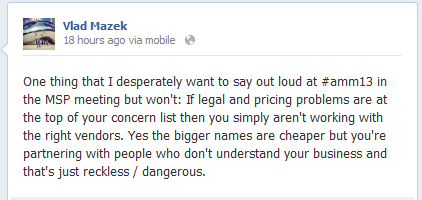
Shockingly, there are still companies struggling with pricing, transition to the cloud, product expertise and the ability to translate technical innovation into true business value. Yesterday I said the following:

image

I was encouraged, by multiple friends, to share this with the audience because “people need to hear it” but if there is anything I have learned writing Vladville for nearly a decade is that people do not like facing the harsh reality. They are happier with polished bullshit by a CEO that is only around right before his big event and tries to pretend he cares about this quarters sales figures far more than his clients long term objectives. So I sat there and fumed until I couldn’t take any more.

Honestly, the reality is that the industry is changing much faster than it has ever before. This unfortunately only leaves the playing field open to the participants who are willing to keep an open mind and adjust as the market changes. If the one and only objective is the sales figures and revenues beyond strategic long term value then I see no reason to ever have anyone look beyond Microsoft, Google or Apple as business partners. On the other hand, there are vendor partners who understand the solution provider business and have a long term strategy that lines up – but I’m sure Steve Ballmer will answer the phone or an email when you have a problem so by all means go ahead and save $2 on Office365, I’m sure it won’t have issues. Or maybe Sergey will hop on Google Glass and take care of your billing issues.

4. Can’t someone else do the hard work?

What I kept on hearing and seeing was great research, thoughtful panel discussions, great presentations and overall a lot of valuable content.

However, the interaction with the audience left me with the impression that “we need more.. More research, more training, more industry direction” and to be honest it just all comes down to whining about why someone else isn’t doing enough to help you with your own business challenges. This is as true of CompTIA as it was for Microsoft communities, the value doesn’t come from the body that paid for the muffins and the cheese danishes – it comes from the interactions you have with the community. The amount of resources was overwhelming and if anyone was left seeking more than I really have to say I am envious of their ability to consume so much data so quickly and shame me in the ability to implement it so much faster than we can. Of course, the reality is that these guys are just whining that the information they are getting is not chewed enough for them and that they don’t want to put the effort into taking this information to transform their business. Sorry folks, nobody is going to do your job for you for free – unless they expect to replace you.

5. Don’t confuse nonprofit with charity.

While CompTIA may be moving at a very slow pace compared to the member expectations (or the snail crawl compared to the industry in general), they are remarkably quick to add a Trustmark and an education / certification revenue stream. Oh the shock and horror of a business that wants to make money!

Folks, honestly, if you have a problem with the above you need to realign your expectations and deal with the reality that these are simply communities. It is all about what we can learn from one another and what we can become enlightened on if we keep a open mind. The meeting isn’t about what CompTIA is going to say, it is about what you’re willing to ask of the guy or a girl next to you.

The expectation of CompTIA to set industry standards or affect large scale change is simply ridiculous. The communities and executive councils are not filled with CxO roles of Fortune 500 companies nor do those companies have any vested interest in anything but competition. It’s a completely different DNA and different mission. CompTIA has always been about the education and helping IT companies capitalize on the trends. They do not set them.

In closing

As solution providers we need to stop looking to the Wizard of Oz for all the answers, we need to stop chasing the big bright logos because those companies want nothing more of us than a credit card number. In some instances, they’d prefer not to have us involved even to that extent! (Took Microsoft 3 years to figure out how to let partners bill for BPOS)

Most importantly, solution providers need to look to other solution providers be it peers, competitors or vendors who are playing on the same level with the same values. Stop chasing the venture capital backed maniacs that are trying to go public and look for the ones that happen to have things that you find important on their top 10 list. How many times do you have to be hit over the head by the people who only care about your money before you realize that your business is about more than competing with the lowest common denominator?

Seriously, friends partners and competitors alike, like it or not we have to come up with these answers and stop waiting for someone to deliver it to us because by that time the answers will not matter. The good news is that for the most part most of us have figured out major parts of the puzzle and we just have to show interest in putting that puzzle together.

If there is anything you picked up from this weeks CompTIA AMM, I hope it was that we still have the advantage and that all it takes is sitting down in the same room and working together.

Guilt & Death in Life & Business (Part 1)

IT Business
1 Comment

I guess it’s a slow news kind of a quarter because all the focus is on the guilt and whining about this little thing called life and things that are just common sense are somehow becoming notable news stories because Marissa Mayer or Sheryl Sandberg happen to say them out loud (or make them a company policy or write a book about it).

Yes, you should show up for work. No, you shouldn’t whine about the glass ceiling or apologize for being aggressive or doing what is best for your career / company. Just kick ass and don’t apologize about it.

Most importantly, you don’t need to promote the sense of guilt because all of us have it.

Which brings me to this reverse rant: I hate whiners.

Apparently people with careers feel too guilty spending too much time at work. Unemployed meanwhile feel guilty about not contributing or working on something meaningful. The grass is always greener on the other side. At home you feel guilty about the work piling up and then when you finally start to attack that pile you feel guilty about what you are missing out at home.

Here is a piece of cheerleading for your Monday: You can’t win. So stop trying.

Deathbed Philosophy

Since you can’t be at two places at the same time, you will miss out some opportunities that will advance your career and you will miss out some moments with your family. Often, personal and professional events will overlap.

Given the two events, which one would you regret missing on your deathbed? That’s the one you should go to.

There you go, that’s your life/work balance solved once and for all.

Feel better? Of course not.

What will make you feel better is the following:

1) Everyone struggles with this. It’s not you against the whole world so stop acting like a whiny little bitch every time you don’t get your way.

2) It is not something that you will ever be able to solve or perfect and the more you work on it the more you will think about it and the more you will feel guilty about because you’ll be aware of more stuff you’ll be “missing”

3) It is not something that is fixed with more money, better job, better house, better dogs, better kids, better cars, better weather, etc.

4) Feeling guilty and overanalyzing it and just general dwelling on the worst case scenario only makes it worse.

5) Following up on #4, consuming yourself with guilt will actually take away from the focus you need to have on your job or on your fun. If you’re at work daydreaming about doing fun stuff and then go do fun stuff and end up working or thinking about work throughout… you’re just failing all over.

There, feel better? Smile A friend of mine wrote a book about this, check it out.

The List

08723610700If you happen to suffer from guilt over the unfairness this world has put on your life, start a diary. Write down everything you got to do that was awesome and everything you missed out.

Keep this log for a while and two wonderful things will happen: You will find out that you aren’t doing nearly as poorly as you think you are and you will see a clear pattern of crap that you are doing that needs to stop.

Truth is, we become so consumed in dealing with our own BS that we cannot see how we are continuously contributing to the problem and making it worse.

This is why the word “balance” pisses me off so much – it just feeds into this notion that there is some hope that you will be happy if you changed your priorities, so please spend all the time dwelling on your woes and feeling sorry for yourself and blame something other than your own poor decision making. Why anyone would sit there and give a second thought to someone that would make them feel worse about themselves (for a profit) is a completely foreign concept to me but some people are into that sort of a thing.

Don’t let others make you feel bad for being yourself.

If you feel guilty about your decision making then just try logging your activities and see if there really is a problem and how you can fix it.

Rememberquit blaming everyone and everything for your misfortunes. Only once you realize that you are responsible for the decisions and situations you put yourself in can you start to make changes about stuff you don’t like. Otherwise there is no shortage of stuff that you can blame that won’t change and result in any meaningful positive impact on you. Take charge.

Or Whisky. I recommend Macallan 18.

Manage beyond IT

IT Business, Shockey Monkey
2 Comments

This is perhaps meaningless but I wanted to share because it’s a hope for how a business should be managed and the stark opposite to the reality. In reality, most problems in the workplace are fixed as a matter of a response not as a proactive process to optimize how things happen.

For example, most small businesses have that one organized person with an overweight Outlook profile that holds every invoice, confirmation email, password reset request, welcome message, fax, instant message log, screenshot collection and extensive notes.

Over time this person spends more time waiting for the search to return the results (or organizing them into a system only they understand) than working. It’s not optimal, it’s not smart but it happens.

As I have mentioned in a lot of my presentations, we use software to solve problems. Painful problems. We get pushed so hard to the cracking point that we spend incredible amounts of money and time to solve a problem that a few years later we have tons of middleware, databases, knowledge bases, SharePoint sites, defunct Doku sites, Joomla sites and apps, blogs, tickets, public folders.. collection of ancient ruins of attempts to organize knowledge.

The SMB IT industry has done a fairly good job of solving the problem of serving clients in terms of managing support requests and billable time. But when it comes to managing vendors, managing employees and HR, managing goals and careers, passwords, schedules.. it’s still a middleware nightmare ballin’ on a budget.

What I’m about to show you…

Is my humble attempt at taking ExchangeDefender (and everyone willing to use Shockey Monkey to manage their business) to unify all these concepts not as a hacked together pile of halfassed apps with no interest with working with one another… but a well thought through system for management of things beyond support tickets.

If we cared about ourselves as much as we care about our clients, we’d be in a much better place. Unfortunately, nobody pays us to be good kids that keep their room clean – our clients pay us to manage their problems not our own.

Motivation just isn’t there.

But read this post again. It’s never going to be as simple as it is now to get a handle on your vendors, notes, employees, HR policies, notes, knowledge bases and more. Your business, if it grows, is only going to get more complicated and more complex and have more people in it not less.

So here is what we did:

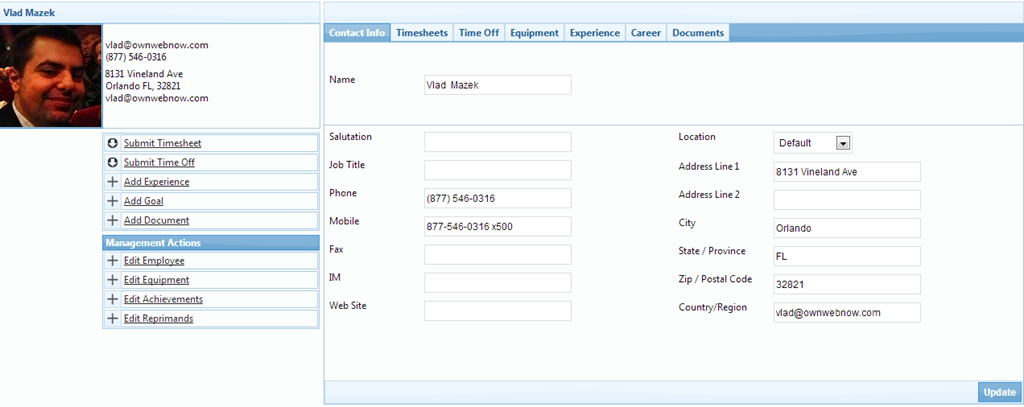
Organize your people (click for image for a higher resolution pic)

v1-employee 

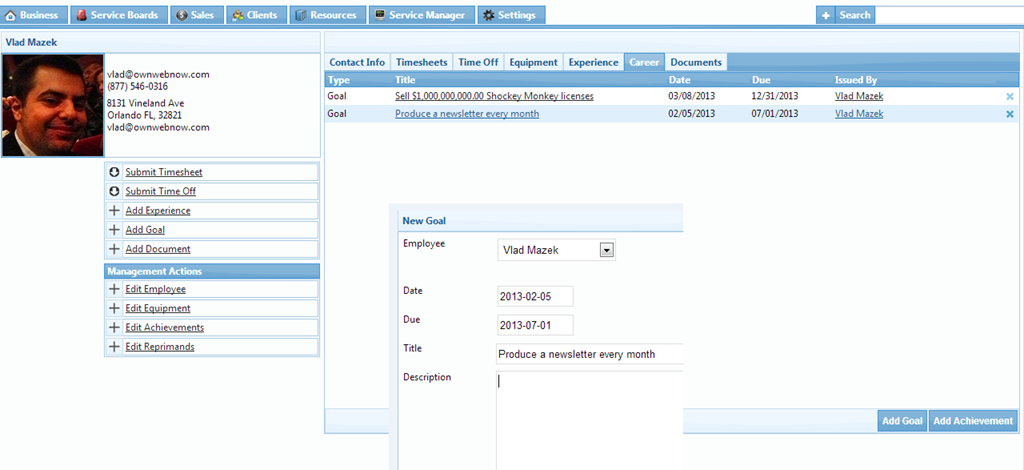
Setup a system to track career goals and accomplishments. Don’t make reviews an annual affair – set the goals and rewards and put it in black and white as to what you want. Then let everyone do what they have to – if people just wait to become more relevant they will never see much progress – but if they can visualize their progress things change FAST!

v1-career

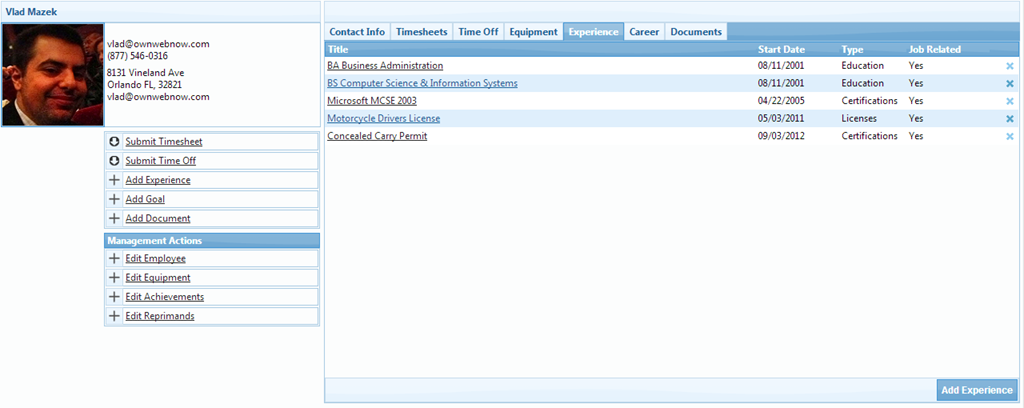
Get better organized about your people. I’d venture every single one of my friends would agree that their team is far more relevant than any of the PCs out in the field – yet we keep metrics and hardware specs and documentation on silicone junk far better than we track even basic stuff about our staff. Track licenses, education, certification. If they are doing it right and you’re managing them correctly their list is longer when they leave – you move them to the next level in their career!

v1-experience

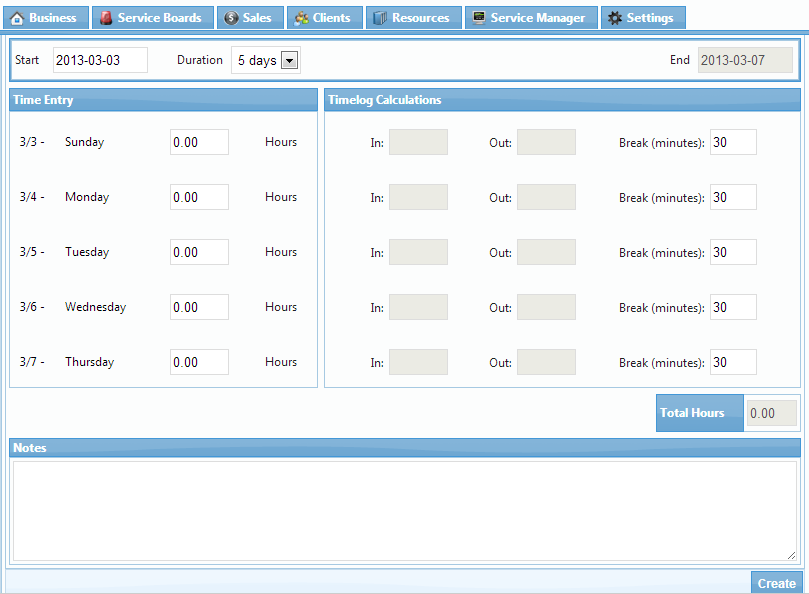
Timesheets that are actually smart. If your timesheet hasn’t changed since 1950’s more than going from a piece of paper to a number entry on the screen then you have the same level of performance and insight that people had in 50’s. Why do you think we have biometrics, checkin, intelligent status boards.. for cosmetic effects? Shockey Monkey checkin systems track when the user shows up for work, when they go to lunch, when they come back and when they leave – they automatically adjust the timesheet for them and document when there is an exception (Are you late an hour every Thursday because you suck or because I forgot that I assigned you a BNI meeting every Thursday?)

v1-timesheet

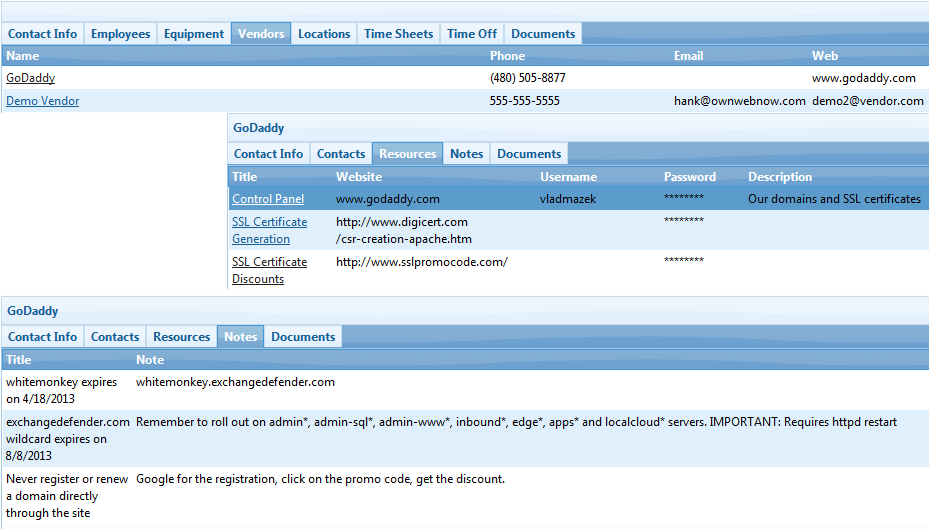
Finally.. If your company is worth anything IP-wise, you have a process. If that process is not documented and you don’t have a way to instantly pass that process off onto a new employee… you don’t have a process… you just have a preferred way of doing something that cannot be measured, audited or trained to anyone unless you do it all yourself. Well, Shockey Monkey flips all that.

vendors

Naïve or just stupid?

I am not naïve, I know that what I have just shown you will be used by a very small number of people. Perhaps it’s just going to be us.

The reality is that people do not face their problems or attempt to solve them until the pain of living with the problem is more than the cost of acting to fix the problem.

Perhaps I just have some faith in the small business world as technology becomes simpler and more convenient. When the really big problems are out of the way – not worrying about updating Windows because your laptop continues to crash, not worry about why your phone isn’t syncing, why your email isn’t arriving, why your Quickbooks keep on crashing… you have more time to right the wrongs in your business.

In a sense, this is the optimistic take on what I see small business evolving towards.

Perhaps it would have made more sense to spend time and money on some common problems people ARE willing to pay for now – but my take is that people that are stuck in the past or stuck inside the problem so deep that they don’t see the world passing them by – will not be around in a few years.

I like to look forward.

In the meantime, I hope Shockey Monkey 3.3 keeps on pushing you there. It’s live, enjoy. If you’d like to watch yesterdays webinar, it’s here.

Social Motivation

Boss, Gadgets
Comments Off on Social Motivation

I have written about this subject before but it’s hard to get motivated to get out of the rut sometimes. Couch is more comfortable than pavement, large cheese pizza is more filling than a salad and bad behavior is so easy while good behavior is almost a mental game of wits. Getting stuck in a pattern of bad behavior makes it more and more difficult to deal with problems and solve the growing pile of crap to deal with (or at times to even know which pile of problems is contributing to bringing you down).

This is why I love Nike+ stuff. I’m training for an Ironman race and I live in Florida which has the same average temperature as the surface of the sun 9 months of the year. Getting out there and training (considering the other 26 hours of the day are packed with work, clients, family) is not easy and Nike+ does a good job of doing two things:

1) Letting me know when I haven’t done enough

2) Giving me a goal to work towards

I know this doesn’t exactly have a very profitable “let’s turn it into an IT business” line to it but stuff doesn’t really exist in a vacuum when it comes to business – if your mind and body aren’t in it then there is really only so far you can push yourself and those around you to the next level.

First the basics… Nike+ is free, it has a free iPhone / Android app and there is other stuff you can buy like Nike Run Watch, Nike FuelBand, etc. I have pretty much all of them and use my Nike Fuelband the most because.. well.. I sit all day. When 7-8 PM comes around and I haven’t reached half my activity goal for that day it’s so much easier to get out for a 5K than if I didn’t have a constant reminder of my failure on my wrist. It also makes it easier to not defer the activity to tomorrow – every time you reach your goal the site gives you another badge and tracks your streak. Sometimes when I really, really, really do not want to do anything the streak pushes me to actually go do something.

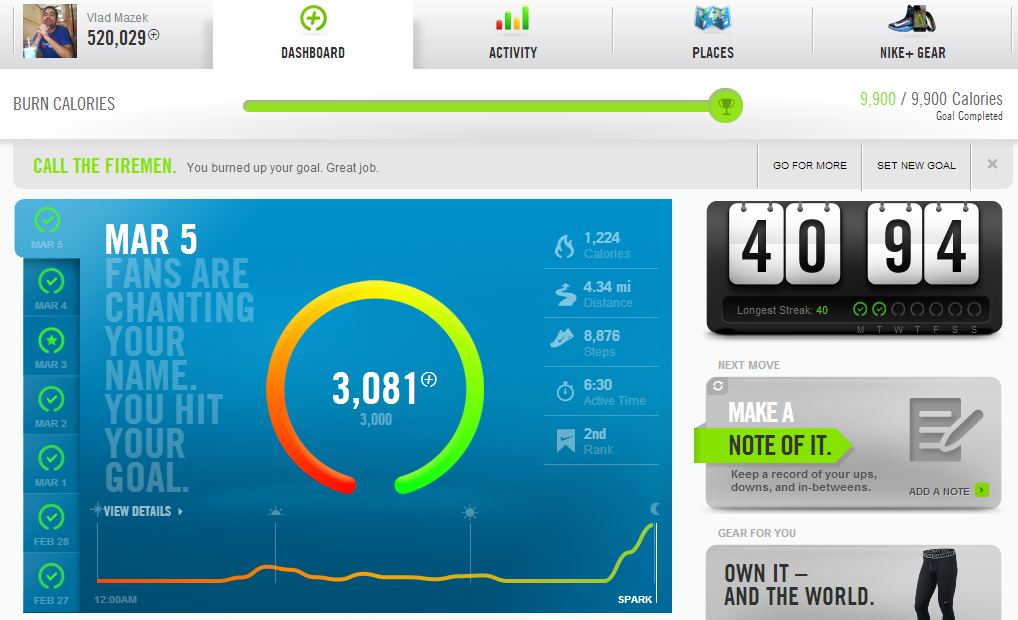
nike1

You set your own goals (activity levels, calories, etc) and all it does is track when you are active. Some days you feel like you’ve been running around a lot but the numbers don’t lie. Either you did something or you didn’t.

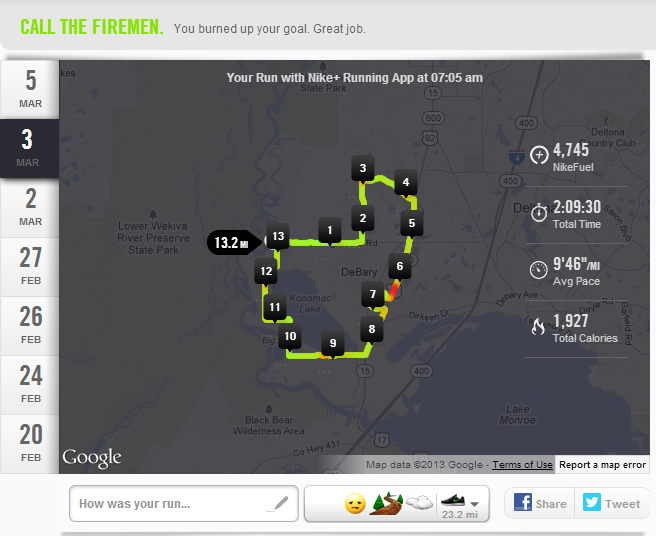
As far as the runs go.. that’s the really awesome part. First, you need to have the iPhone/Android or Nike GPS Run watch – It plots not just your distance and calories but also location, activity level, etc. Look at the half marathon I ran over the weekend – see the orange spots – that’s where my pace was terrible – mile 6-7 was really rough:

nike2

Even better, every time you complete a run you get some really inspirational stuff from a pro athlete. The day I crushed my 5K record I got a message from Tim Tebow. While this may sound kind of worthless to a cynic, when you’re gasping for air and sweating like crazy it’s nice to hear some encouragement.

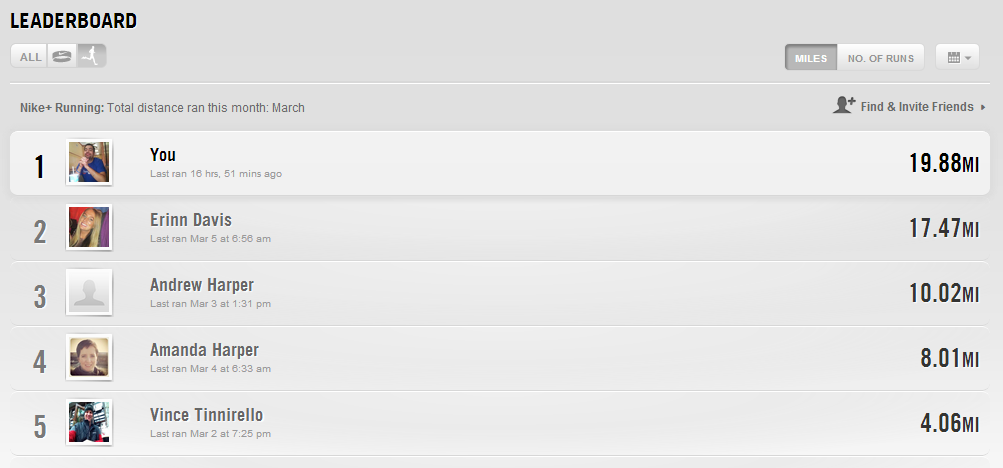
And if you’re a competitive a-hole that doesn’t like to lose.. well, this is the best part: You can compete with your friends. You don’t want to be on the bottom of that list.

nike3

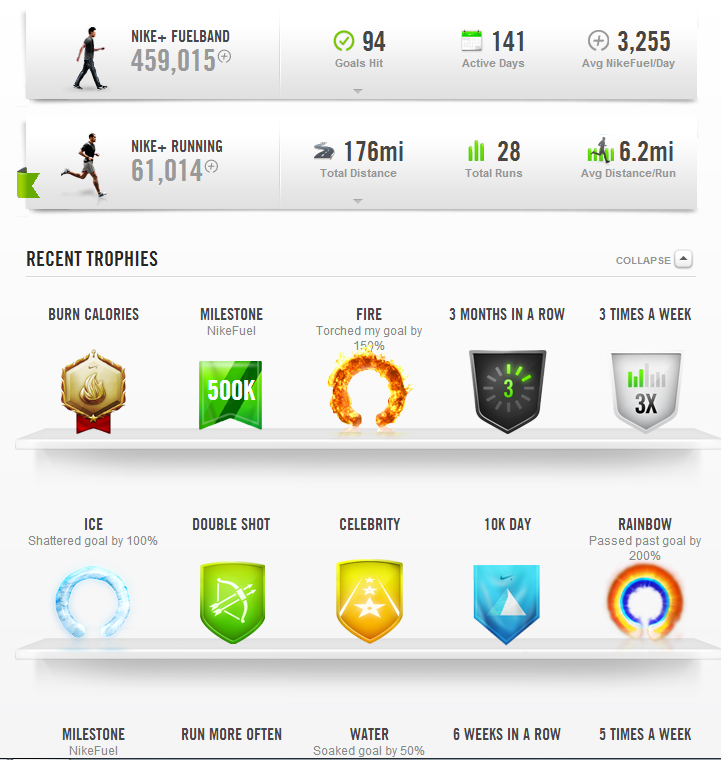
Finally, the swag. You get points (“Nike Fuel” which as far as I can tell is an arbitrary activity measurement) and the more points you get the more swag you get. Things like badges, progress levels, distance, points, etc.. all lead you to getting more stuff.

nike4

No better feeling than syncing your phone / fuel band / etc and seeing progress – visually – of what you have accomplished. If you have a somewhat manic personality that drives you to obsess over meaningless stuff, this is for you.

So what?

It’s hard to get motivated.

Having been fat (and obese) for most my life I know (unfortunately) how delays in physical activity compound all the other problems. Let’s face it – Exercise is not necessary (you need water and food), it’s ridiculously easy to quit and you immediately feel better when you’re not getting physically strained.

Finally, there is no direct or immediate ROI on it – if you’re looking to lose weight get ready to starve and break your ass in the gym. It can take days/weeks/months/years to see significant difference and there is no challenge – short of paying for a gym membership or having a personal trainer calling you to sell you more sessions. The incentive is obviously to look better and feel better but when you’re too tired to even get off the couch what’s more likely to happen?

Nike+ flips this mentality by giving you something that always shows you where you stand, where your friends are and you get immediate feedback. It may not be much and it may not be meaningful but it works. Those of us that grew up playing video games are well aware of the desire to hit the high score even though it has no tangible value. But if it produces motivational long term results… isn’t it worth it?

Changes & Mondays

Vladville
Comments Off on Changes & Mondays

Doublesided post.. Changes to this blog and Dealing with Change..

First a little bit of housekeeping. For the past few weeks I’ve been working more closely with our partners at ExchangeDefender as a result of shutting down the partner program to new blood and really trying to work on making our partners more successful. I’ve heard some really horrific stories about business mismanagement, economy, crappy employees – you name it – and the most disheartening part of it all is that the stories are nothing new. It’s the same thing I’ve heard (or some that I’ve experienced myself) thousands of times dealing with entrepreneurial fatigue, fear of the unknown changes, uncertainty, etc.

Everyone I speak to thanks me, writes me thank you notes and stories about how much something I said helped. Truth is none of it is some earth shattering genius of mine, just a matter of experience mixed with a little bit of sounding the problem out showcasing just how obvious the solution is.

It’s inspired me to start delivering more content through Vladville. This blog still has more traffic and eyeballs than everything else I or ExchangeDefender or even Shockey Monkey do.

Look for 3 weekly updates on Vladville.. everything from business, planning, marketing, management, change/conflict management and some emerging technology opinions as well. Please excuse some visual/layout mess in the meantime while I update this beast.

Depressed?

So true story here:

Throughout the typical day I have more than a few occasions where I feel like something I/we are doing just sucks. Either it’s not meeting my expectations or it’s actually bad. Every time I feel that way I start to fantasize about something I’d rather be doing than dealing with a problem – except the only thing I can do with a real measurable positive outcome is not to avoid the problem but work on it. So I just brush off the whiny attitude and get on with it.

Now, some problems are bigger than just being a petty bitch. I understand that.

Truth is, it’s usually not the really big problems that break us down but a collection of winy little inconveniences that pile on and make it seem like a dark cloud is hovering over us. As they pile, multiply and surface one day after another it just feels like we cannot catch a break.

Take a moment, write down all the problems that are in your head right now. How many of them are petty things that you really could just brush off? How many of them do you have a solid strategy of working around?

The more stuff you let bother you for longer the worse off you’re going to be. It’s far worse to have imaginary problems that are demotivating and beating you down.. than to have real problems that you’re actively working on solving. It may be a nuance, it may just be lying to yourself.. but you can either whine or you can win.

Having said that… here is a short list of shit not to do.

Get drunk. Yeah, it’s a temporary fix and depending on how skilled you are will just bring out more problems. If a problem is big enough to require an investment ($ for booze) then it better be f’n permanent.

Eat unhealthy. There is really no problem big enough (well, bulimia I guess) that cannot be fixed by eating a whole large pizza by yourself. Problems tend to fall into perspective when you’ve stuffed yourself so much you can barely get off the couch. The problem with this is the same as with booze, it’s a temporary distraction from what is really annoying you.

Stay up all night. Nothing compounds problems more like a lack of focus and energy. Staying up all night will double down on this. While it may be great for long-term problems that are directly proportional to the time invested (writing a long paper, f’n government paperwork) for almost everything else it’s a great idea.

TV, DVD, Movies. All temporary, all distractions, none leading to a solution. Get your ass out there an exercise. Get some fresh air, release some endorphins, beat yourself up a little and see how quickly things fall into perspective. If that’s not on the agenda and you absolutely must interact with the TV.. well, that’s why p0rn exists.

Most importantly, don’t pretend you don’t have a problem. Some of the most spectacular failures and blowups I’ve seen among the people in my life have been related to the stress of living a fake life. I’ve seen people whose marriages couldn’t be better snap in half, companies go under and things absolutely ruined. Even if you’re a complete and total scumbag there is a chance that you have people in your life that are willing to talk to you or help you.

Remember, when you have a bad day.. and a few more bad days.. and a few other things go wrong in your life.. things are really not as bad as they may appear to you. Find a friend with an ear (most of us got 2) and talk it out.

aho

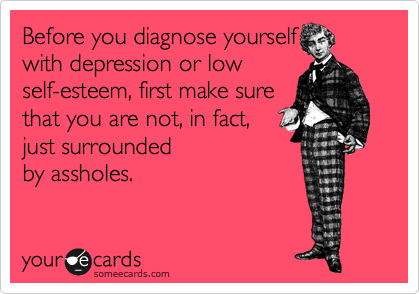
Like I said, it’s usually not as bad as it seems. Whatever the problem, don’t expect the worst case scenario.. play for the most likely scenario and just hope for a little bit of luck. And always check that you’re not just surrounded by assholes because nothing will sink you faster than that. As I mentioned on Facebook today:

Whoever is running the factory that’s cranking out stupid people… can you take a day off? The line is wrapping around the building.

Have a good week folks… and happy Monday!

Live or Lose

Boss, Uncategorized
Comments Off on Live or Lose

I am currently sitting in a movie theater at 3:30PM watching Identity Thief and writing this blog post. I am able to peal out of the office for 90 minutes because I worked until 1AM and the fun resumed at 7AM and I plowed through my task list this morning. I love what I do, I love my life and I wish there were more hours in the day.

Now I’m telling you this because this “workaholic” behavior is generally seen as wrong by many writers and experts. Life should be in balance they say and almost everyone agrees about walls between work and home life and personal hobbies. If you’ve read as many self help garbage books as I have you would know that a common theme is balance: without separating everything and doing it 100% you are not living right.

Now I am not an author. I am also not in charge of a criminal multilevel pyramid scheme. I am not the homeless guy at the bus stop offering advice about a life full of regrets that has passed me by.

What I am however is a CEO of a multimillion dollar worldwide company.. And I’ve worked for or employed or managed or been a business partner with thousands of people literally around the world. And you know what I’ve learned about the difference between successful and unsuccessful people?

Successful people never stop. Failures can’t wait for a break, for time to go home, for the weekend, for vacation time… They wait.

Successful people take advantage of every opportunity no matter how small or quick – power naps, working vacations, mini vacations. Failures go big, make grand plans and just push off.

The problem with all the feel good bullshit life/career balance is that it guides people towards becoming depressed losers. The strive for balance leaves people perpetually unfulfilled. They feel bad about their long term delayed balanced parts not coming to fruition so they come to work all pissed off. Their performance at work slips and they get mad at their coworkers. Now instead of liking the people that pay them or contribute to their success they associate them with problems in their life and have an absolute agony of a career. They go home, even more upset and drained, and try to balance their misery at work with drugs and alcohol and excessive partying, working out or anything away from work. They defriend and push away their work friends but the misery remains because the life out of balance striving for balance also starts to rub on whoever is left around – friends, family.. The feeling that life is imperfect and can somehow be brought to perfection crushes otherwise good people.

Don’t let others make you feel like there is something wrong with your workaholism. There isn’t. Successful career leads to a successful personal life which leads to everything else turning to success. Its not all roses and butterflies, its never going to be. But the more you try to build walls and compartmentalize your life and filter people life and wait for things to happen… The worse you are gonna feel and all the self-help books and gurus and advisors and coaches and all their collective bullshit won’t be enough to fill the hole that will be left in your life that you should be living instead of balancing and organizing.

Just live and enjoy the opportunity to do so from every single minute you get.

Have a great weekend.

An exercise in futility: What to do when nobody wants your products anymore

Gadgets, IT Business, Microsoft, SMB, Web 2.0
4 Comments

Extremely long blog post cut short: When nobody cares about you, your products, your services or what you think you want to sell they still care a lot about their data. Never lose sight of what your client wants and what is important to your client and build your business around that – not around what you want to sell. To find out what that is and why it matters… well, reading required:

The chilling tale of what has been going on at Microsoft the past year or so is a huge warning sign to technology businesses everywhere that choose to stop innovating and become complacent with their cash cows. Those of us that have been in the IT world for a while can tell you that technology hype cycle moves very quickly and that while there is a great deal of money to be made staying behind on the legacy platforms, it’s hard to sustain a business looking backwards.

Microsoft (half through mismanagement and arrogant antagonism of it’s partner base, half through just lack of innovation and good products) has found itself behind the curve and outright slaughtering it’s two cash cows as they find themselves in a quick slide in popularity: Windows and Office. There are too many links to link, articles to quote and my point really is not about Microsoft except that they make a great example:

They killed Windows through a product that is too different from the predecessor to appeal to the current fan base and they are killing Office through a pricing scheme that few will swallow while not bringing much new stuff to the plate. It’s a change for the sake of what was popular a year ago with the hope that they can catch up a year from now.

Windows Phone has been through several disappointing iterations since the Nokia partnership launched with each new device being “better” than the iPhone and Android and still flunking by comparison despite massive advertising. Ditto for Surface, which Microsoft appears to be making it’s final stand on and somewhere between Pro supply mismanagement / managed “sold out” process fails to get a massive level of interest. Windows 8, despite a massive discount at launch, failed to find any excitement even among Microsoft biggest fans (present company included, bought a few upgrade boxes, installed just one begrudgingly and regretted it). As an ultimate change of direction, Microsoft is finally deploying it’s Hailstorm with Office 365: Releasing a product nobody can figure out why they want at a massive price hike with the huge reduction in rights that isn’t raising any regulatory issues or complaints because… well…

Because Microsoft has decided that it’s about consumers now and consumers only want it’s Xbox. Except Microsoft doesn’t seem to want you to pay attention to it’s Xbox which is the only thing it’s got going well, it wants you to buy it’s business software and act like a business not a consumer. How’s that going?

The Point Being…

Microsoft isn’t jumping the shark here. There is no hope of actually missing the shark and surviving on the other side. It’s jumping straight down towards the sharks mouth, ninja style, hoping to dropkick the shark in the nose and kill it before it has a chance to kill it. In a less visual language: Microsoft is hoping to change it’s business model before someone takes the opportunity to make them obsolete. For all the worries about Linux, it’s Android that dethroned Microsoft as the king of all devices, maturing to rapidly and too successfully without ever announcing itself as a Microsoft competitor. That’s an interesting lesson.

But what does this mean to you as a Microsoft partner, IT Solution Provider, worker in the IT field, developer…

1. The ecosystem you’ve gotten used to is changing. So you have to change faster if you want to survive.

2. The single dominant player marketplace where you can hitch your ride to one thing and ignore others is over. You will be forced to diversify.

3. You won’t be able to “sell” your preferred platform, you will work with the one your clients picked (for example, you don’t get to “Support only Apple” you will support Windows desktops, Apple iMac, Android Tablets, Windows Phone, Apple watch) – or you can try your lottery luck at telling your prospective client that they need to switch a platform to get your service after they have already spent the money.

4. You no longer get to choose what you support, because your clients will choose someone that supports what they got.

5. Selling on features is long gone, benefits will become harder to explain.

All this may sound terribly negative if you’ve got a massive successful business. Perhaps it is – but it’s an incredibly positive thing for business development going forward – because just about everyone out there is sitting on their hands working on the past while trying to figure how things play out. Even a blind man can tell you what’s coming: When the consumer knows more about technology than your average IT employee and knows what they want the IT guy and the sales guy lose all relevance. But all this new flawless stuff will still break and will still have to work for a business, creating a massive new opportunity to generate a sticky business that doesn’t live and earn on point releases, upgrades, migrations and the likelyhood that “Well, when it breaks we’ll be there to fix it but we manage it anyhow so it’s probably not going to break very hard either” – Now is the time to develop the glue between what you’ve already have and the layer which your client cannot live without. They may not care about your products or what you and your vendors want to sell: But they care about their data. That, dear friends, is key to the future.

Consumerization is no longer a word that Microsoft dictionary cannot recognize or some future, it’s the single largest driver behind technology spending today. You can ignore it, you can watch it, or you can start to establish your business around it.

No time to start like today. Happy Monday.

382 Shades of Vlad

Boss, IT Business
1 Comment

When I started this business my goal was to make $100,000 a year which was the average college dropout salary in Silicon Valley at the time. I never quite expected the company to grow to what it has become and even at the time when I was responsible for far more than I’m responsible for today I dealt with a different kind of animal. Management of a “smart” company with a few ridiculously smart, talented and creative people is far different from managing an empire of clock-punching idiots and unfortunately the management books are written for managing precisely that. To manage and motivate smart people that can do basic math you need to study psychology, team building, organizational behavior, human behavioral decision making process.

We didn’t develop Shockey Monkey by accident. It’s not as ridiculously successful as it is by accident. It’s current development, again without accident, is built around the reality of managing a service business and not an industrial clock-punching company. Some of you are obviously going to disagree with this notion, looking to manage your business more like a carpet cleaning dispatch center that screams at employees that aren’t billing enough, but much like so many of your peers have found out the hard way.. the margins for dumb businesses are disappearing quicker than the opportunities. To each his own, I love ya either way, I’m here to help, but it’s pretty clear what’s going on out there.

With that in mind, I decided to sit down and write a Vlad Owners Manual per se..  to help people that work here understand how I work, what makes me tick, what my many faults are and how to work around them:

Introduction

Congratulations on joining ExchangeDefender, you are now a part of a very talented team that manages worldwide network operations. You will be working in a high-paced, high-stress challenging environment and if you do your job right this will be the last job you’ll ever need to find. That said, your job will never be the same from day to day and it will never be done. Welcome.

Everything you need to know about working at ExchangeDefender has been officially documented in the Employee Guide and Employee Videos you should have seen by now.

My name is Vlad Mazek, I am the CEO and founder of ExchangeDefender, and you will get to deal with me directly or indirectly as your career here progresses. This document is an honest outline of my background, values, process, work ethic and will give you some insight into what makes me tick so you don’t have to base your expectations on the urban myth of “The Vlad” or the blogs/Facebook/twitter posts that are written for entertainment purposes.

Like everyone else, I have many flaws. My hope is that this document gives you an idea of my shortcomings and gives you the best possible way to interact with me and what to expect. ExchangeDefender is a team effort so the better we all work with each other around our handicaps, the more successful we will be.

Enjoy and welcome aboard.

About Me
–    Personal
–    Career
–    Role & Responsibility
–    Contact Availability
–    I am always right, until I am wrong
–    What I actually do around here
–    Flaws

Frequent Questions I Get
–    Why are our clients so stupid?
–    Is this in my job description?
–    How do I get more money?
–    Why do things change?
–    How do I achieve career/life balance?
–    Why am I surrounded by idiots?
–    Why do certain employees get away with more?
–    Why can’t we have consistency on expectations?
–    Why is everything always broken?
–    Why can’t I talk to XYZ? How do I escalate and who is in charge?

People and Activity I Like
–    Personal Accountability
–    Organized, Reminding, Tracking
–    Transparency & Communication
–    Email & Communication Effectiveness

Activity I Dislike
–    Condescending Smartass Behavior
–    Lack of Personal Accountability, Hygiene
–    Complaints about “The Greener Pastures”
–    Lack of Team Mentality
–    Disrespect of Our Clients

If you happen to do an obscene amount of strategic business with us, I’ll gladly share this with you under an NDA.

I read a few business books a month (some more than once) and without exception they are written in a top down approach with the high dose of self-help. Basically, you have faults that you should fix but spend your time eliminating everyone else’s faults. OK, fair enough and very valuable, but the problem at ExchangeDefender is that I’m the least productive person here despite probably the longest hours and almost everything I do is reliant on the very people that I’m supposed to beat the shit out of. We’re just supposed to come to a mutual understanding that even though I suck they are supposed to pretend not to notice and we dance around it? Hell no.

You may be perfect, congratulations, wish I could be like you. I’m not. Rather than having the new people find that out the hard way (and troubleshoot the correct way to deal with it), I’ve decided to put it in writing as honestly as I could so that they know the best ways to manage their way to getting their job done (even if in spite of me)

The process itself is quite rewarding because when you start putting things in writing the list of things that you should be working on as an executive tends to explode. The amount of gray area is exposed and you have to explain it as well.

I encourage you to sit down and fill out your Chemistry.com-ish executive profile so your team can become more effective with you. Feel free to use my layout as a guideline.