Importance of continuity, and why it doesn’t exist

Microsoft, Web 2.0, Work Ethic
Comments Off on Importance of continuity, and why it doesn’t exist

I’ve been reading a massive amount of coverage about Yahoo shutting down Buzz (competition to digg.com), AltaVista / AllTheWeb (competition to google.com) and del.icio.us. There is far, far more coverage and opinions presented over at www.techmeme.com

I don’t really want to harp on Yahoo!’s woes, they messed up when they didn’t shuffle all that mess to Microsoft and in business sometimes arrogance trumps your business opportunities. That’s just a part of it all so you can’t feel too bad for Yahoo.

However, these moves have two problems:

1) Lack of faith in management

2) Lack of adoption of new technologies by developers

We can ignore #1 since that’s a backwards looking aspect. People that made the mistakes of purchasing these properties for millions or billions of dollars are long gone.

You can’t quite ignore #2. When your development excitement dies, you die. Look at Windows Mobile for example, it had been so neglected that poor Microsoft had to give it the ol’ yeller treatment behind the shed and come out with the device that is modeled after it’s second most popular consumer electronics product after Xbox – Zune! If you’ve seen all the AT&T commercials (and are a marketing freak that pays attention to those things) you’ve noticed that even the Zune penis monster is back in the commercial as a little green or purple beast:

zune-eyes 


image

As we learned in Super Bad, people don’t forget.

And like developers haven’t forgotten about Microsoft’s mobile woes, they will not forget about Yahoo’s either. Microsoft, despite a relatively decent platform and truckloads of money, is not having much success drawing people to develop for them. Not because the platform sucks. Not just because their app store is reportedly stiffing developers and reporting that many won’t be paid until sometime in late January… I can go on but you get the picture.

After the Kin apocalypse and the Microsoft mobile resurrection, many who would likely be ecstatic to develop for the new platform that is so closely tied to the most successful software product of all time.. will likely stay on the sidelines.

Two Sides To This Story

Sometimes you have to admit to yourself (and your shareholders) that some of your investments aren’t all you’ve expected them to be. Lord knows we all have our own share of failures.

However, this is where honesty helps more than bravado. You don’t just take an axe to the leg and start chopping. You explain why it’s necessary. You admit the mistakes that you’ve made that eventually lead to the end result of having the product line killed.

You will never, ever, see the above happen. Ever. Never ever. Because organizations ran by VC and shareholders that overpower the management have a secret handshake agreement that absolutely prohibits honesty.

Being honest about f’ing up not only gets you fired, it makes sure you never work again. It also opens up a stream of class action lawsuits from angry shareholders and scumbag lawyers that make the new managements job of rebuilding the company even more difficult.

Lesson

Communication matters.

Honest communication matters even more.

Transparency matters even more.

Once you lose control of what you are building, and you do so with other people’s money, makes you both more risk averse (“I don’t want to be the one to burn this building down”) and less innovative (“Can’t we just buy something that looks like what we want instead of building it?”)

But let’s say that you can’t do any of the above for whatever reason. Can’t be honest cause you’ll get sued. Can’t be transparent because people will call you on your BS and point out everything you’re doing wrong. Can’t “un-VC-yourself”. Let’s say all of those are dead ends, what now?

Only one thing: Put your head down and focus on what you’re good at – and focus on being the best you can possibly be at the thing that people value about you or your organization the most. In a fast paced technology world where hype is at times more valued than common sense, consider the fundamentals and perhaps even allow to be passed by once in a while. If your foundation is strong, you can experiment – if not, it’s just a gamble (and a dumb one at that).

Shockey Monkey Accounting (aka: I will use your tears to clean the whiteboard)

Shockey Monkey
Comments Off on Shockey Monkey Accounting (aka: I will use your tears to clean the whiteboard)

For the past two weeks we’ve been collecting input on the vital missing piece of Shockey Monkey Accounting that we’ve promised to everyone by Christmas. I spoke to Santa today and he said that it will definitely be under the Christmas tree. So what is this big hole?

Until now, the process of getting time & materials from tickets to invoices was a manual one.

This means that even though there was an ability to enter time, expenses, etc into the ticket, the process of getting those time entries into the invoice was not pretty or automated.

Today, we finalized the process by which time makes it into an invoice, which will be part of Shockey Monkey Accounting available for free. While the process itself is not all that exciting, the development and feature process might be. So here we go.

How do you bill?

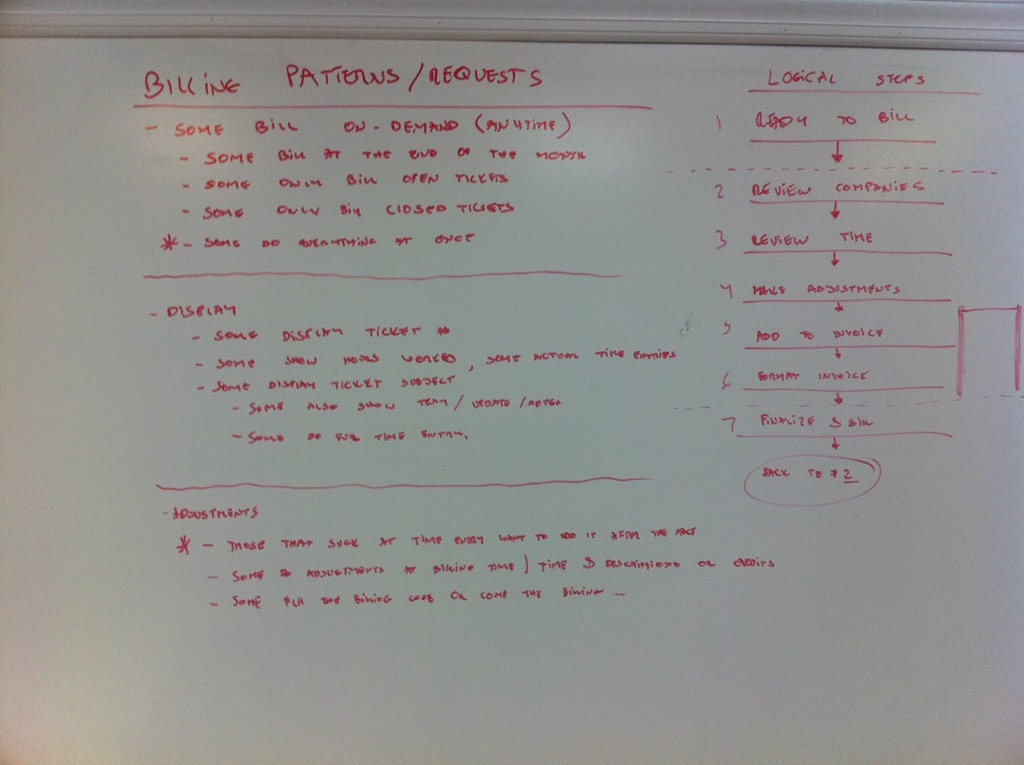
We decided to ask some of our higher profile people, both on Shockey Monkey and elsewhere. Just how does the process of getting money for un-MSP work. Keep in mind that most MSPs are like this – yeah they have MSP contracts but they make a bulk of their revenues from onsite visits, project work, time and materials, etc.

So, when do you bill? Some bill on demand – anytime they need money. Some do it at the beginning of the month. Some do it at the end of the month. Some do it weekly. Some do it depending on how much they are billing their biggest customer.

And how do you separate invoices? Some put everything on a single bill. Some separate MSP and T&M. Some separate everything.

I see, and what do you put on your invoices? Ticket number. Oh, and a subject. Oh, and a ticket description. Oh, and a time entry interval. Oh, and the notes. And everything! Well, except if everything makes it seem like the description doesn’t meet the number of hours required.

So that’s it, you just send the ticket time entries to the invoice? Well, yeah. Except we like to edit and tweak the hours because we may not bill everything if it took much longer than it should have. Or if we messed up and it took so long because we didn’t know what we were doing. So we like to adjust it. Oh, and we also add time if we didn’t add time before because we need something to bill. Or if we forgot to enter the time.

As you can tell, it varies. If there is only one word I could use to describe the typical MSP billing cycle it would be: criminal random. The problem with “random” is that random events cannot trigger automated functions – you need to have a predictable set of inputs in order to come out with a predictable system by which things are done. If you don’t – and you make stuff up on the fly – the result is very similar. What’s worse, it’s nearly impossible for anyone to navigate “the way I like to do things” because opinions vary.

For us, in order for something to be easy it has to be predictable and fit a certain pattern. So here is how we work this.

Step 1: Put it on the board

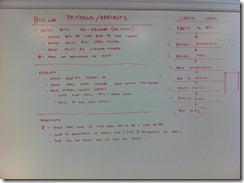
First part in getting anything together is to draw it up on the board. We can be very creative when it comes to just talking – but process of drawing things up allows us to see things that just don’t fit for one reason or another. Everything “sounds good” depending on who is selling it, but it has to look good too. Even if it sounds ugly, sometimes the drawings help us fill in the blank as we go along.
0

Fundamentally, the reason you draw stuff is to be able to organize things.

Step 2: Organize

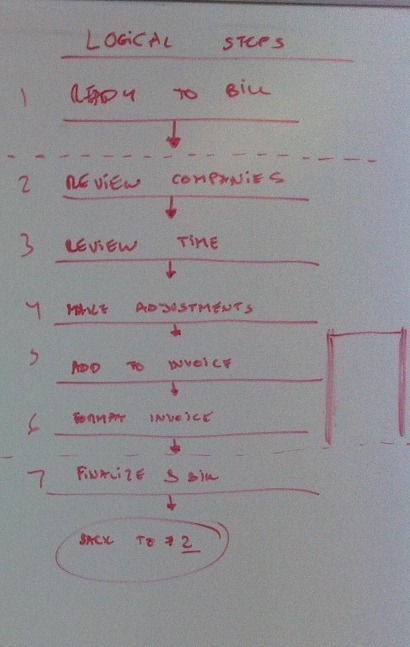
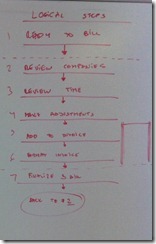
Once all the ideas are on the wall, it’s easy to group those ideas into logical steps. This is where user experience comes to the front because we are approaching our ideas from the angle of a clueless user: “If someone has never used our software, could they figure out what was going on?”
1

The answer better be yes. This is typically represented in a form of breadcrumbs on web sites, there is a starting point and a finish – along with steps in between. Where do our individual features fit in this tree?

This is pretty critical because our “wishlist” includes everything – but the reality is that we have to make sacrifices to get it done. Which means picking and choosing.

Step 3: Cut & Sell Dreams

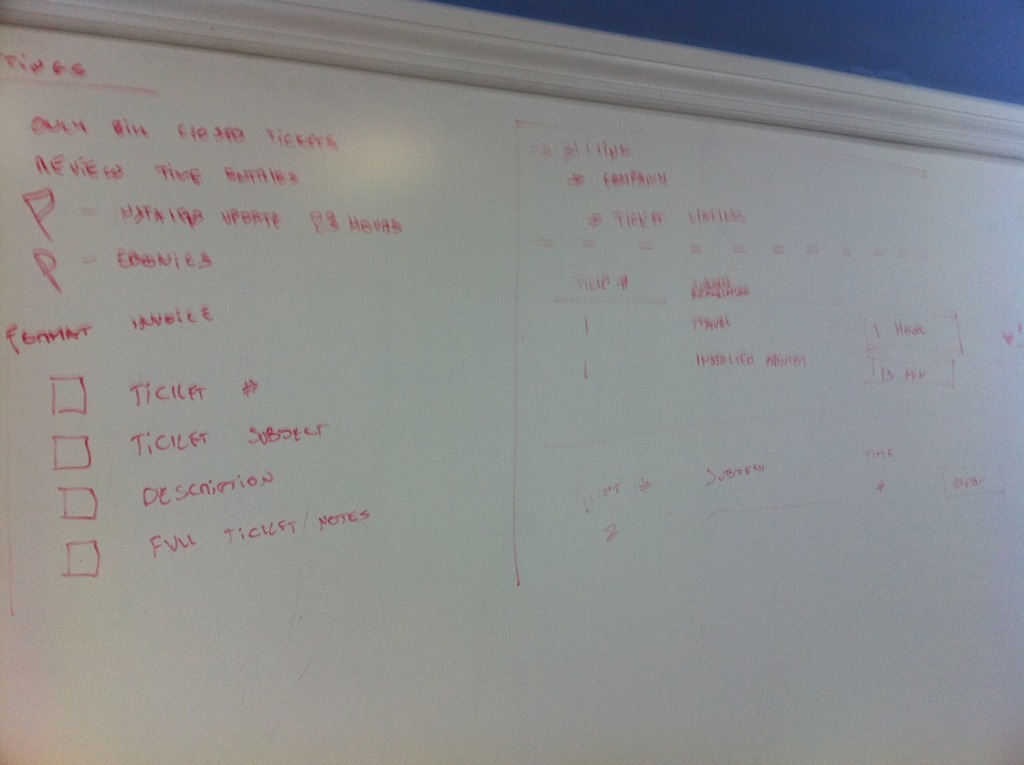
Once we know how our desired features will play a part of the finished product, we start from the inside out. What is the core feature that you cannot live without? That one better work!

Now that we have the core feature, what sort of nuances play a part in it? Are there any flexibilities we can allow for in this feature and how is it controlled or can it be modified externally?
3

It’s important to answer these questions because it’s typically ridiculously difficult to go back to this step after you’re done. Think of it as a foundation for the stack of cards – you can rearrange the top layers without much trouble but if you knock things down at the bottom of the pyramid you will have to rebuild all the levels above it.

“Imagination: Dreams of people that don’t have to do any real work.” – Vlad Mazek, 2010

This has a lot of what-if’s. What if we did this? Wouldn’t it be cool to do that? How about this? – this stage in the process lets us pile on features we couldn’t quite fit before because we didn’t know how the whole thing would look in the first place. Now that we have a better picture, we can pick things up.

Remember: No real work has been done yet. You can go back and forth between drawings. 0 lines of code have been written. It’s all just hot air (and some dry erase marker) so feel free to go back and forth, ask people for input or suggestions.

Once you’re all doodled out, talk about what gets done now. What gets done in a month. Year. Never (In Vladville, 2 weeks = never)

Step 4: Write

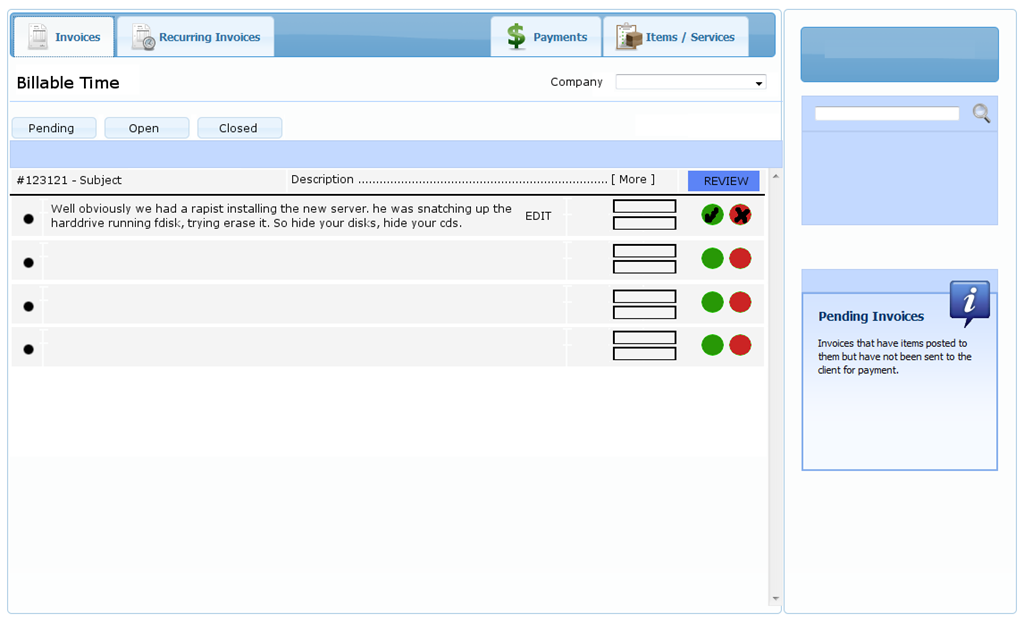
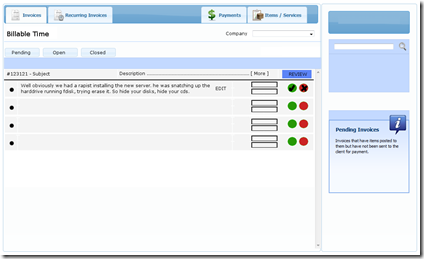
Now you’ve got your blueprint. Draw it up in the UI (or if you’re not writing software, ask for input based on your sketches). You should have something pretty close to the finished product at this point:
new-ui

Remember, you work from inside out.

But you present from the outside in.

For example, I’m showing you the bull@#%$ of how we come up with this stuff and what it’s going to do for you. Someone else has to get the actual process of moving the time into an invoice and prep it for a Quickbooks export.

Step 5:

1098

Any questions? Smile

P.S. Key to your success in steps 1-4 (and especially #5, because it takes a LOT of Free Monkey love to buy a Ducati) is involving people. If you are the designer, painter and creator of the whole masterpiece then you’re really only showing a part of it – part that you care about. The key in getting from step #4 to step #5 is getting enough people in the process so that you can fit your solution to solve their problems.

Seasons greetings!

Introducing: Monkey Remote

Awesome
Comments Off on Introducing: Monkey Remote

Remember Looks Cloudy announcement from last week? Well, it’s on fire: 14 posts, tons of feedback and we’re still just framing the whole picture. But that’s nothing compared to Shockey Monkey Remote beta that we just unleashed.

“Oh god, no, no, no, no Vlad. Not another RMM? Say it ain’t so.”

Kind of. But not really.

What if someone built an RMM not to take your money and help you automate away your tasks, but to make it a part of your marketing and new client recruitment?

<evil grin>

More on that later this week, for now check out the SPAM:

Shockey Monkey Remote is an agent-based application that allows you to remotely monitor and view your users desktops, collect inventory information, receive alerts when the system goes down and collect event logs from managed systems. After over two weeks of very thorough testing, we are excited to make the beta available free of charge to all Shockey Monkey users.

newui_thumb[1]

Check out what it can do for you right now:

Remote Desktop – Remotely view and control your users Windows PC and support them in realtime. Remote view is based on the VNC technology and works really well over low-bandwidth connections.

Downtime Alerts – Instantly see which systems under your control are down.

Full Event Log Collection – Windows Event Logs include everything from hardware problems to software issues. Know before your users do and help them address it.

Asset Inventory – Know exactly what kind of hardware is out there, which software version is installed on it and help track your assets better, automatically.

Autoupdates – Beta will automatically update as fixes are rolled out. You don’t have to manage agents out in the field, all you have to do is install them.

Here are a few sneak peaks:

dashboard_thumbdetails_thumb[1]

details-2_thumb[1]details-3_thumb[1]

Of course, the true power of the solution only comes out when it’s integrated with the way you work and when the users are aware of it. This is a consumer RMM of sorts, we think managers and business owners will rely on it to access their office PCs from home and more. All while relying on your Shockey Monkey portal.

Please, please read the documentation first (it includes information on how to download the customized agent for your organization):

Shockey Monkey Remote Installation Guide

Shockey Monkey Remote Web Management Console

If you want a more technical discussion beyond this documentation, please consider downloading the webinar Hank and Vlad presented:

Shockey Monkey Remote Video

Go sign up for free Shockey Monkey at www.shockeymonkey.com/signup.php and go from there.

I promise to explain the whole hurricane of products that we’re launching this weekend, my friends talked me out of being honest. So check it out. And a very happy birthday to my buddy AB, thanks for the inspiration.

Introducing: Looks Cloudy

Awesome
Comments Off on Introducing: Looks Cloudy

Are you sick and tired of the cloud hype yet? Even Microsoft and IBM are talking about the cloud – on national television directly to end consumers. It’s fantastic – it eliminates complex technology, IT departments and more. It’s closing down computer science programs and technology schools around the world. It’s magic!

Frankly, it’s bull—-. I’ll let you fill in the blanks.

For everything else, I’m proud to present Looks Cloudy to you.

Kate Hunt, formerly of MSP University, is heading up an effort to educate  our IT Solution Providers how to benefit from the cloud. Through webinars, podcasts, blog posts and slicing through the hype machines and PR cloud-happy factories, she’ll be arming you with some common sense to address your clients needs and guide them through the clouds that all this hype is creating.

Fact: There is a lot of money in the cloud.

Problem: It’s not business as usual.

So hop on over to the Looks Cloudy site and tune in. I’ve spoken to a ton of our partners and I heard over and over just how much need there is for this beast. The IT MSP / VAR community needs a common sense approach to the cloud, which is a scarce commodity as everyone wants to talk about it. So let’s do what we’ve always done – throw our resources and brain power together and win. I’m pledging a lot of resources towards this project and will chime in over there from time to time – but the real power remains with you. We have had an unprecedented level of interest in contributing, sponsoring, promoting and helping MSPs move to the cloud.

The future Looks Cloudy and that’s not a bad thing, not a bad thing at all!

P.S. Interested in helping? Email vlad@vladville.com

Who is killing ExchangeDefender?

Exchange, ExchangeDefender
4 Comments

Good headline, eh? Smile 

I’m sure many of you who hate my guts would probably say “Vlad, your service, your people, your reliability and this blog are the reason!”

Hey, if you can’t laugh at yourself who can you laugh at? Smile

In November, we decided to find out.

It’s no secret that cloud is a huge deal.

But how big?

Well, ExchangeDefender is primarily deployed to protect on-premise SMTP servers – Exchange, Gmail, Postfix, Lotus and Sendmail (in that order).

It is ONLY sold through our partners. We make $0 direct sales.

November.

For the first time in product history (since 2001), ExchangeDefender has lost more accounts to third-party Exchange hosting deployments than our competitors or web hosting providers.

This is significant for several reasons:

  1. Typically, we lose accounts when partners go with another provider and switch their services elsewhere – this trend stopped with the launch of ExchangeDefender 5 last December.
  2. Losses are to direct model Exchange resellers. Looking at the MX record directly goes to a provider that you can get Exchange with a click of a mouse.
  3. These aren’t clients cutting costs of going out of business – such as moves to the likes of GoDaddy or Gmail – these are removals of the MSP from the food chain.

I’ve said it way too many times but I’ll say it again – channel is dying. You need to retool, now.

If you aren’t offering your clients Exchange – others are and statistically speaking – they are taking your clients away from you and eroding your business. Don’t worry about OWN or ExchangeDefender – we’re doing better than we ever have.

If you aren’t offering Exchange and other cloud services, you need to. Join us, we’ll show you how. We’re making a killing in the cloud, and you should be as well!

Thanksgiving

Uncategorized
1 Comment

Slightly belated Thanksgiving post, with the new kid there is little sleep and even less blogging time. But I wanted to share something personal with you. Most of you have gotten the horror pleasure of watching me try to grow up on this blog. At least professionally. To be honest with you, most of my life revolves around my work and what I actually do – not out of necessity but out of drive and passion. I can’t imagine doing anything other than what I’m doing now.

IMG_1219I have a wonderful family, I’ve built a great company, I have a lot of friends and I’ve been successful in a lot of stuff. It just hasn’t quite hit me because I don’t think (or strive) about the stuff but this year it did. In a moment of true jackassery. Yes, it’s a word.

I was in London last month. I snapped the following photo of setting my Rolex to the Big Ben during an evening trip downtown.

It was not that long ago that I would have killed just to go to London again and see the sights. To be able to do so.. is amazing. To be able to not even realize how good I have it.. For that, I’m truly thankful.

Thank you for following Vladville and I wish you all the same luck I’ve had through the years in your life.

Let me dumb it down for you

IT Business
3 Comments

I’m on family leave till 2011 and the only thing I forgot to do in my checkout checklist was to redirect my cell phone back to the office. So yesterday as I was cleaning up I got a phone call from a “friend of a friend of a partner who was told he needed to talk to Vlad about this cloud thing”.

Now, for the record, I love this because someone already preped the guy about the kind of conversation he was going to have.

Friend: So X tells me you’re a really straight forward guy so let me level with you: we’ve got a big MSP and I’m getting hit up from all sides to start doing cloud stuff but I just don’t want to change our business model.

Vlad: Ok. How is it going to change?

Friend: <looooooooong story, story of selling copiers and modems>

Vlad: Do you mind if I curse? (now, if you do, the next paragraph is not for you)

Friend: <Laughs>. Go for it.

Vlad: You’re an MSP, right? So for all intents and purposes, you are the cloud. You’re the CIO in the cloud. You’re an IT guy in the cloud. You’re the advice in the cloud. Your business doesn’t change one bit, for the most part the technology you support doesn’t either – but your marketing does. So same shit, different clipart. Get it?

He assured me that I’ve just earned a client for life.

Truth is, MSPs are no different than the cloud. The same fear bullshit you sell about the cloud as a managed service provider can be sold about you. Here are a few examples:

My clients don’t trust their data to be stored in the cloud! Oh yeah? But they gave you administrative credentials over their entire network, domain and third party vendors for phone, DNS, Internet, etc?

My clients don’t want an unreliable or unaccountable third party involved. If that were true, you’d be unemployed. You mean to tell me this strict accountability and internal control freak didn’t want an employee he could boss around and fire at a whim – he signed a binding (at times multi-year) contract with the party that controls most of the licensing and at times even hardware?

What about unreliable connectivity? It’s similar to the unreliable technician, unreliable MSP, unreliable server and everything else – you build in redundancy and survive.

The bottom line is, MSPs are IT departments in the cloud. Call it a Public CIO if it makes you feel more important. Reality is, most organizations are somewhere between a Private IT Department and Public CTO/CIO, depending on where you draw the distinction. Most small organizations don’t have a need for a full time tech person, so they hire an MSP that gives them a fraction of the time and full power of IT expertise. Some have a private IT department that manages all the in-house stuff but they rely on an Public CTO/CIO to give them direction and introduce new technologies, facilitate big projects, etc.

There.

It’s as simple as that.

Now let me blow your mind: What’s the biggest trend in the cloud? Cost cutting. With billions of alternatives, cost leaders win. Now. If the MSPs are the same as the cloud, what does this do to the overall profitability and growth opportunity for the MSPs?

Disagree (come on, you know you want to!)??? Add a comment!

The Best Business Decision I Ever Made

Uncategorized
1 Comment

I’ve had a few days off waiting for our second child to show up and it’s allowed me a lot of time to reflect on a very busy year and business decisions that lead us to where we are now. As every business owner I have my share of regrets and opportunities, I remember exactly when the big decisions were made and how.. yet one thing sticks out:

I made it personal.

So much of me is a part of this business.

So much of my staff is personally vested in the success that we have enjoyed. Many of them put in far more than your usual 40 hours a week and very few of them have “what’s in it for me, when is my exit strategy coming?” attitude that is so frequent among corporate worker bee.

How? Well, we have a few rules.

1. Customer is not always right: Nobody ever gets to yell at or abuse you.

Ok, so maybe it’s just one rule but it’s a huge message of confidence I have in the people that make OWN execution possible. My dear friend Karl Palachuk once told me: “We don’t work with ***holes.” and I’m ashamed to admit that at the time we worked with a lot of them. It’s that typical small business hustler mentality, we appreciated every single dollar we earned even if it took us three dollars to earn it and we went home beaten down.

In my time as a business owner I’ve had some insane people find their way into the revenue stream. I’ve had folks who would not talk to women about business. I’ve had abusive clients who would scream, curse, yell and try to crush the people into violating a corporate policy for their own benefit. I’ve personally dealt with many people unqualified to hold a keyboard trying to argue with me over the functionality of the software I wrote. Death threats, rape threats and lottery claims. It’s built a thick skin.

One thing remains. This is a people business and it’s a personal one. My people, from top to bottom, love what they do and they know who they work for: our partners. And you can feel the energy and the push that comes when we add a feature, fix a problem, hear about a great deal our partners pulled off and how our work actually matters.

When you work with assholes, it works in exactly the opposite direction. People are deflated, they run out of the office without even saying a word, lots of cursing and the sound of heads banging on the desk.

There is a huge amount of business out there.

Earning every penny should not come at the cost of being abused.

Think about it. It’s the people business. It’s not a @#% business..

****, I hope I’m right

IT Business
1 Comment

There are times in business when you make a decision and just hope for the sake of everyone involved that you’re right. If you own a business, perhaps that roll of the dice came when you started your business. Perhaps it happens every day when you try to overallocate funds to your marketing and business development in order to grow aggressively and pursue your opportunities.

Today.. I felt like S. R. Hadden:

From the movie “Contact” based on the Carl Sagan book:

“First rule of government spending: Why build one when you can build two at twice the cost?”

contactma

If you’ve never seen the contact, check this out:

Don’t you miss the MIR?

What I’ve done today will be public soon enough, and from conversations I’ve had over the past few months, it’s the kind of a gamble that many of you will have to make in order to thrive.

The world of B2B is changing.

Many IT Solution Providers have gone to “This will erode my margins” to “This has eroded my margins” to “That is not a business we are interested in.”

I only got one question: Why the hell not? Money is money, and I haven’t met a dollar I didn’t like. The moment you decide you’re too good to take people’s money is the moment your entrepreneurial life is over.

MSP: What would you do?

IT Business
Comments Off on MSP: What would you do?

Last week I spent a lot of my time hanging around the conferences we sponsored in Orlando surrounding the ConnectWise summit. I was not officially a part of any of them which allowed me to have one-on-one meetings with a lot of my partners from literally around the world. On Sunday night I went out to dinner with one of the more successful people in our business. All of these conversations – from startups to the businesses that have been around for decades (no, not a typo, it’s meant to be plural) are at the same point.

Inflection Point.

I like how we’re doing but there is so much more opportunity to do better.

I feel like we aren’t performing at 100%, I am not meeting my own expectations.

If I could have a do-over…

“I wouldn’t change a thing about my life because I wouldn’t have become the person I am today” is the kind of crap you get to say when you’re done kicking a drug addiction or have just gotten out of prison. In all other instances, it’s just plain and simple ignorance.

Evaluating where we are and were we are going always takes into account how we got here and the experience we got along the way. So start here:

http://www.surveymonkey.com/s/W2SWGYY

Before I share my opinion on all the conversations I had last week and share the trends that people have shared with me first hand, I’d like to know how you feel.

If you were to get a clean slate, how would you build an MSP today. Tell me.

It will take less than a minute if you read fast. Two if you like to sound it out.

Which building blocks would you choose, what would you outsource, what would you sell and how would you promote it. Let’s for a moment make a giant assumption that all other things are just the details, I want to know what the majority out there is thinking.

I’ll let it run for a month and share the results then. The survey itself is anonymous, no contact info is collected at all.