Surprises in 2010 (NSFW)

Vladville
Comments Off on Surprises in 2010 (NSFW)

I have been encouraged by a lot of my friends not to write this post because at times my honesty plays a significant detriment to my message / agenda. So I sat on it for a little while. Here is the thing: after 13 years in business I know how to make money and how to build a business. I don’t know how to sleep through the night or talk to business partners if they have to second guess just how honest and up front I am about what’s going on. Frankly, I know a lot of fake people in the channel that havel double, even multiple personalities depending on who they are talking to.

So here is the truth, the whole truth and the complete frustration behind some of the topics that are often brought up to me.

Big Mouth

If you talk a lot, expect to be punched in the mouth.

This is just the nature of the beast. People often ask how much of it I get; I always hear about how certain people find me scary. My Inbox begs to differ. I am brought up every issue that is or isn’t my fault, near and far.

For example, in 2010 I’ve been faulted for marriages collapsing, losing houses, investments, entire businesses going under because of one issue or another that we were even remotely related to.

Are the conferences/sponsorships worth it?

Unequivocally, no. Absolutely no. Hell F no! If you are looking to launch a product or a service in the IT channel, conference sponsorship is probably the last thing you should do with your marketing money. No, absolutely no, questions about that.

However, conferences are about a lot more than closing sales. They are about getting realtime feedback, about modeling your marketing through the eyes of your clients, about establishing long term partnerships and about old fashioned face-to-face business. It’s an investment, and when you invest in something you cannot anticipate a return in realtime.

That said, in 2010 we’ve seen the highest repeat rate of any year. According to my marketing reports, 18% of the leads we got in 2010 at conferences were from new accounts.

Then there is a vendor tax. Even if you don’t anticipate to make your ROI in 12 months on a conference sponsorship, if you don’t attend certain events the channel starts looking elsewhere. Presence is important while some presence is mandatory. Microsoft WPC for example.

“So you’re going to kill Autotask and ConnectWise?”

There is this negative vibe in the channel that anything remotely similar to an established leader is immediately it’s killer. Even when you share hundreds or thousands or partners. This is not how business is done and this is not how partnerships work.

Let me put it to you in one simple fact: multiple Shockey Monkey competitors were presented with it’s feature sheet and potential over 9 months ahead of it’s delivery. Only one of them approached us about a purchase ($3 million) that was far below the market value. If this was such a hardcore competitive product and a threat or a killer you never would have seen it live.

Direction of what we’re doing also couldn’t be further away from the way from where our partners are going either. We’re not out to dominate the IT vertical.

Shockey Monkey

Man this pissed off a lot of people. I mean, livid. Despite years in development, it seems to have caught a lot of people by surprise. They didn’t read my blog or watch the videos or hear the pitch – but boy were they upset. It sounded a little like this:

“How dare you introduce another product when you already have all these bugs in the software I’m already paying you for?!?!?!”

It’s called capitalism. We saw a huge opportunity in the portal space and we saw nothing on the market capable of delivering it for free and still making money off it.

At the same time, our entire messaging and support platform needed to be based off of something in order to provide backend services to our huge MSP client base. We couldn’t have based our solution around the other providers in the space because none of them provide for the purchase handling, PCI compliance and other nasty stuff we get to deal with as a worldwide service provider.

And here is the best part – the part of handling tickets, companies and contacts is actually the easy part. Billing? Reporting? Integrations? That’s where the costs explode and that’s not something we needed to be really sophisticated about.

So let’s review: There was nothing on the market that was capable of supporting our business model. We built it. Then we gave it away for free. Now that it’s free and that all our partners can have it no questions asked and no $ required – ever – we’re able to execute our actual business plan: Delivering better support and more integrated services that serve the client end-to-end.

While to some of you this may appear like we’re looking to compete with other companies, we are simply executing our game plan. The one that becomes even more profitable with everything we’re doing.

So no, we didn’t take people off ExchangeDefender to build Shockey Monkey as a competitor for anything else. We built it to support our business model.

As for our competitors – they remain our partners and we’re continuing to write software for their platforms.

Nobody, and I mean nobody, invests millions in dollars just to pick a fight. So please, drop it. This is my final comment on it.

Did you just say you’re not going to sponsor conferences in 2011?

No, but we will be at far fewer dates than we did in 2010, that’s for sure. We already announced what we’re doing in 2011. Managed Messaging. ExchangeDefender Essentials. CloudBlock. ShockeyMonkey. ExchangeDefender Storage. We announced it, we presented it.

Now watch us execute it.

What I will do, however, is put the money we would have spent on the road into more staffing and training. As you’ve seen by LooksCloudy.com, we’re going to deliver a community powered resource to give you an edge. As you’ve seen through Shockey Monkey, we’re going to lower the cost of entry into the MSP space. As you’ve heard about ExchangeDefender Managed Messaging, we’re going to make you remarkably competitive with professional services firms. And as you’ve noticed about CloudBlock, we’re going to give you an edge on pricing.

You’re also going to see a lot of personnel changes: More support, more account reps, better documentation and more calls.

As I’ll announce tomorrow, I will be working with ExchangeDefender 500 directly in Q1.

We’ll be on the road next year. We just won’t be everywhere. The priority is on you, not on us.

Surprises about 2010?

Lot’s of people speculated about massive consolidation in 2010.

It didn’t happen.

Most of MSPs are still a bit too small and many are struggling, loaded with large long term contracts, commitments, leases or just plain and simple debt and overpaid staff. This seemed to be the trend of 2010 that very few were keen to discuss – the MSP business model has started to show the pricing pressure points and $50/workstation, $300/server is just not growing many MSPs fast while the cost of getting new business is growing.

What I’m really amazed at is how poorly Microsoft BPOS transition (read: Microsoft’s transition away from partners) has gone. Microsoft had to pretty much rename the product as they realized midway through the game that their partners were not behind them or that the clients didn’t want partners to begin with. Lot’s of “we wanted to decrease our costs, not move them elsewhere” came up and it’s going to be far worse in 2011. Listen, Microsoft decided they are a consumer company – and the business doesn’t want to pay a software company anymore – and a networking company, and a MSP company, and a hardware company and a telco company and _____ for 80% of what comes with an iPad for free.

The key word here is free. In 2010, it disrupted a lot of business models and will ultimately take down even more than just newspapers and overpriced geeks.

So we’re trying to transition to managed ser…

Sorry, you’ve missed the boat. By a few years. At this point all you’ll find is bargain hunters, painful migrations and people too set in their ways to accept a proposition that sees you growing over 10 employees.

Anything else?

Even though we’ve faced a ton of adversity as a channel in 2010 (and it will get worse, quickly, if you don’t adapt) the business remains positive and opportunities are out there. No, not for spyware removal or antivirus license sales. Or for building first networks, helping people pick the first server / right server / last server ever. There are many areas where the expertise and business management are compensated very well and we’ve seen many people grow in double or triple digits this year.

Finally….

Believe it or not, I’m a good guy.

There are few CEOs willing to write about what is going through their mind and doing so honestly at times is difficult. If you find my conclusions or opinions tasteless or unappealing, you don’t have to read this blog or do business with us.

I, however, wake up every single day trying to make OWN a better company for it’s partners. I don’t wake up grumpy, kick puppies on the way to work or bite heads off pigeons for lunch. I look at this company a year and three years down the road – and I try to make it go from here to there.

The big question isn’t really what motivates me because I’ve been fortunate enough to travel around the world and work with partners in all time zones that have broadband. You know why I go? I want to know what you’re doing. That’s what keeps me going. Because at the end of the day, we’re one of the few channel-only companies left, and we work for you.

I wish you a happy and prosperous new year and I thank you for reading Vladville.

The Best Investment of 2010

Gadgets, GTD
Comments Off on The Best Investment of 2010

I’m often asked by people that are in growth mode just what the best investments and tools for making it big are. I too have unsuccessfully hopped from one piece of software to hardware through the years always in the search of something magical. 

photo

Truth is, managing and growing a business is a complex combination of always being available, keeping track of every interaction and idea, keeping everyone else on track. Oh, and one more thing: paying attention to social conventions. Pull out a phone in a middle of a conversation or look at your laptop during a meeting and people will assume you are not paying attention. Older generations may even consider the move quite rude. It’s a rough terrain.

Here is what made my 2010 the most successful year, ever. Not to mention that I executed my entire 2010 and even half of my 2011 agenda in less than 10 months. How? Louis Vuitton Notebook & Apple iPhone 4

Luis Vuitton Notebook ($500 leather cover; $75 paper insert)

Not to say that this exact same task cannot be done by a $2 notebook, but keep in mind that the level of abuse this thing has taken is nothing short of immense. You know what your laptop looks like, and it has an aluminum or hard plastic shell. Imagine what would happen to a notebook. Mine looks brand new and thankfully, it was a present.

This is simply the most powerful tool I’ve had in 2010. I laid out my tasks at the beginning of every week and spread them out across the workweek. I could track progress quickly and never forget a thing.

Problem: This applies to almost all business owners. If you aren’t completely ADD to begin with, you soon will be. The nature of growing and managing a business is being pulled in 10,000 different directions at the same time. If you’re lucky to complete one thing before you get distracted by another, it’s a slow day.

So how did I do it? We make quarterly goals. Those are broken down on month-to-month progress checks. I further broke down what I needed to do on a weekly basis. Every week I would have a big task to complete and I would break it up into smaller parts. When I completed each task, I would check it. When something fell in my lap, I would add it to the list and just keep track of it.

I spent A LOT of time on the road and in meetings this year. This gave me an analog way of staying on top of things. It also gave me an opportunity to sketch out my ideas, draw things up and be creative away from the keyboard and the whiteboard.

From social standpoint, people don’t react as poorly to a notebook as they do to a phone or a laptop in a meeting. They don’t feel like you aren’t listening to them or not paying attention.

Apple iPhone ($300 up front, $1200/year)

I can’t really say enough good things about the iPhone. I used to have high hopes for the OneNote but I just found the paper a lot more flexible. Sharing? Snap a photo with iPhone and MMS/Email/Facebook/etc.

It seems a bit ridiculous but the phone has become a camera, a training tool, a marketing research tool (video), instant messenger even video phone calls.

I have spent most of 2010 on the road and I would not have been as productive without the iPhone. The key to this has been the battery life. The iPhone goes a day or more on full blast – video, email, text, IM, etc.

I do not say this lightly – the iPhone has been more important to me this year than any of my PCs, laptops or iPad’s.

Conclusion

The most important thing to getting things done is managing yourself and your time. This is difficult on it’s own, but it’s made far worse when everyone else is after your time too. Get some basic tools to help manage your life and your work.

The Retraction

ExchangeDefender
Comments Off on The Retraction

There are few business decisions that I look back at and think.. man, this is dumb. But hey, if the market demand is there who am I not to take their money.

Introducing ExchangeDefender Essentials.

What is it, Vlad?

ExchangeDefender Essentials is the core of ExchangeDefender – security, SPAM filtering, Virus filtering, corporate disclaimers, outbound mail relay, malware protection, mail queuing / bagging, etc.

All the coolness of ExchangeDefender without all the other stuff you don’t need – for half the cost! Still under your brand, still supported and centrally managed. Now go get paid for it!

What is it REALLY, Vlad?

Well.. So a lot of people don’t know how to sell or how to read product feature sheets or.. yeah. So we get a lot of calls that start with “Well how come this product is more than this other product that doesn’t include half these features?”

I burn money pay someone in my company to answer questions like that all day long.

There really are two parts to this story: 1) Partners are not capable of effectively selling the product and explaining how the additional benefits are necessary and 2) Some of the technology is redundant with what is already available in the business.

We have gotten a lot of feedback about how #2 helps partners close bigger MSP deals because ExchangeDefender eliminates other services and makes the managed service plan get signed fast.

But we’ve also gotten a lot of feedback from partners who are being asked to compete against lower priced alternatives and provide a barebone solution.

Obviously, I think that CloudBlock is going to be the perfect fit for the price shoppers and those that don’t understand the MSP sales process. But, we need to be able to compete better.

With over 50% discount off ExchangeDefender, this makes ExchangeDefender cheaper than Postini and all it’s other competition out there. It also keeps it under your brand, gives you PSA integration that no other antispam/antivirus can match as well the ability to mark it up.

Few important caveats: new accounts only, no minimums, no contracts, no volume discounts, no community discounts and not available against any of our cloud services (we know better than to have something on the Internet without LiveArchive).

You asked for it – and despite my objections – you’ve got it!

Insignificant Dates & Human Work Patterns

Uncategorized
Comments Off on Insignificant Dates & Human Work Patterns

Last week of 2010. Things are slow, nobody is working, there is snow outside, it’s a week after Christmas and.. I dunno, insert your excuse for not wanting to work but this is possibly the only week on the calendar when that kind of attitude is acceptable.  “It’s Christmas, It’s New Years, It’s time you should spend with family!” Yeah, that argument only flies if you actively try to avoid your family 51 weeks of the year. 

But here is a little secret to the last week of December.

While seemingly everyone is slowing down, the important people in business are working harder than ever. They are enjoying their disruption free days where they can go over plans, close the quarter, review budgets and get some last minute things done to make it a successful year.

Here is the reality that is hard to swallow for many:

Winners count days till 2011.

Losers count days left in 2010.

It’s a slight difference. One group is trying to get as much time in 2010 to get things done while the other group is counting down the days, minutes and seconds left in 2010 like they are serving a prison sentence.

Allow me to let you in on a little secret..

You know all those people that you couldn’t reach the entire year – because they are busy working? Or on vacations? Yeah, those folks are in the office right now. Nobody dares run a marketing campaign the last half of December – not because they don’t think they’ll reach the boss but because they know that the secretary is out.

Consider this fact: My phone rings more during the last week of December than it does during the entire remainder of the month.

Why?

Well, because the first few weeks are spent on getting things together, cleaning things up, office parties, festivities, etc. You know what happens in January – taxes, audits, new processes, new forms and yes – fulfillment of what was sold the last week of December.

So if people had social obligations leading up to Christmas and they need to get deals done in tax year 2010, when are they going to make those deals? Forget about January, that’s a year away. Now is the time to pick up the phone and make that call. Think things are slow now and you can’t reach anyone – wait till January comes around and everyone is stuck in day long meetings, policy changes, new systems and other technical problems that come up after the holidays.

January 1st, 2011, New Years Resolutions, etc… they only matter to the IRS. And you can bet they are working overtime. Here is a little illustration of everything that’s wrong with the American work ethic, stolen from LifeHacker:

12-28-2010 3-20-13 PM

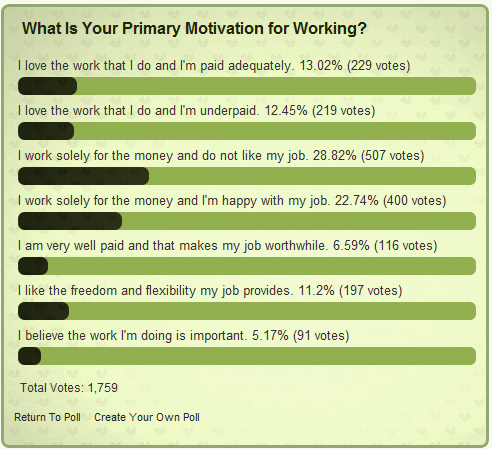
Let me break it down for you – 2 out of 5 workers don’t like their jobs. So when there is an opportunity to slack, you can count on them not to show up for work. They’ll be back next week – along with everyone else – wondering why they aren’t given more money / control / responsibility.

You don’t set yourself apart being marginally better than all the other lemmings. You set yourself apart by doing stuff that nobody else is doing. You don’t just get money / control / responsibility – you earn it by showing people you work for that they can trust you with it because you’ll work as hard as they have to give you your job.

Look, everyone wants to be the boss. Except me. I’d rather lay on the couch naked watching pr0n and eating M&Ms. You want their job? Find out what they are doing and do it better.

The PSA Carol

IT Business, IT Culture, Vladville
Comments Off on The PSA Carol

Once upon a time, in a land far, far away, young Vlad set out to write a free PSA. He failed, big time. The longer he kept on lying to himself about the next beta being useful, the further away the competition moved. Eventually, the goal of building a free PSA and a tool for IT Solution Providers died an uneventful death.

Now with the apologies to the British Empire, estate of Charles Dickens and the fans of A Christmas Carol, I proudly present a (hopefully) inspirational message of what happens when you follow the best in people and focus on doing something nice.

Our story begins in 2008 in Orlando. The trade show exhibit hall area is empty, nothing around but a few Freeman employees running around in forklifts destroying thousands of dollars of marketing material. Ebenezer is busy stuffing the marketing collateral and display booth in boxes where out of nowhere, the Ghost of CPA’s Past appears. He sits in the new IKEA chair and starts to tell a tale of what the life could be for the young Ebenezer:

“You know Vlad, if you tie in your billing together you’d be years ahead of the other guys”

Imagining the life of Maserati’s and someone else tearing down his trade show booth, Ebenezer opens up the window and asks his development staff just how far along the billing integration is. They look up at him as if he’s lost his mind; even in the API’s were there and we could do it, the mess on Ebenezer’s side is far too great. “When I come back to the Office, this is the first thing we’re talking about. Forget that PSA thing we’re working on.”

It’s a cold Nashville morning in spring of 2009 and Ebenezer is long over his PSA days now. Sitting in his booth, exhausted from handing out t-shirts and talking about LiveArchive, Ebenezer is visited by the Ghost of CRM’s Present. Dressed in a t-shirt and a suit jacket, the ghost tells an entirely different future – one filled with social media, interaction, looking beyond a town square and all it’s small trade.

“Imagine a marketplace filled with experts. I don’t know anything about building a VoIP system, but I can find one in the marketplace. We both use the same process control so we can sell a single solution professionally. Then extend that marketplace to the cloud, to Linux, to anything you can imagine.”

Ebenezer awakens in Orlando, looking at the blueprints for automating cloud services.

It’s spring time in Dallas and the land is green and orange. The Ghost of CPA’s Past is back and he’s bought every turkey in the marketplace. Everyone is rejoicing at the feast with the busy farmer working from before sunrise to after sunset to keep the villagers happy. Although the times are hard, everyone is working and trying to earn some more coal for the fire.

The Ghost of CPA’s Past sits down with Ebenezer again:

“I’m ready to blow this thing world-wide. Cloud is the real deal. I don’t know if you’re the guy or not, but if you tie in your cloud services to where we are going…”

Ebenezer calls the office and yells at Bob Cratchit: “Take all the gold off my desk and send it to Dell. We’re tripling the size of our network.”

Ebenezer triples the size of the worldwide network. Spends countless gold to get the system working with both the Ghost of CPA’s Past and the Ghost of CRM’s Present. Earns great praise in the marketplace, people rejoice.. yet.. there is little follow-through behind the festivities. It’s nearly fall of 2009 and neither of the worlds described by the ghosts are quite as nice as they have seemed.

Ebenezer sits down with Bob Cruchit, Tiny Travis, Fred and Mrs. Cruchit:

“Perhaps we are onto something else here. We’re now living in the world that the ghosts showed me. Yet, the marketplace I see is far broader. We meet villagers every single day who don’t have the tools – working with other villagers, other artisans, other crafts people that could use what we do every single day. Perhaps if we gave it all away, we could get them to use our cloud? Maybe if we started thinking about everyone else and what they could do with our software first, for free, we could make a true difference.”

Epilogue

It’s Summer of 2010 and Ebenezer is in Dallas at a huge dinner. It’s the launch of Shockey Monkey, the biggest turkey anyone has ever seen. And everyone is invited. Everyone gets a free meal.

The End? The Beginning.

Editors Cut & Deleted Scenes

Everyone needs a villain. Competition is an easy motivator and it helps polarize the parties so that the few really driven people can move the whole group forward.

Shortly after building Shockey Monkey in 2006 I realized that it is nearly impossible to run two businesses well. Even harder in the same house. It’s hard work trying to be the best. Best at two different things? I don’t know how GE and Philip Morris do it but in my 20’s I couldn’t figure it out.

One difference in the way the world turned in 2006, and how it changed as a result of the ghost’s visitations, is that my attitude towards what I’m building as the CEO turned into something positive instead of something competitive.

When the Ghost of PSA’s Past asked me if I was the guy to build the worldwide cloud, I jumped at it without hesitation. My team spent a lot of frustrating hours to make it happen because it benefited our partners. Our partners embraced us around the world, despite the problems, and we all benefited. Did I know that the ghost was also having that same talk with another guy from San Diego, only to see that deal die last winter and show signs of resurrection recently? Of course, but we pushed forward and built an even better billing tool for it. When the ghost chose my competitors product to protect his cloud and it crippled him for days, I offered to help for free. When he then invited that same competitor to speak for free in front of his user group and later asked me to pay for the same privilege, I still sponsored his party and still keep on developing for the platform. Business world is not about social justice – it is not about what others are getting that you aren’t getting. It’s about what you’re willing to do yourself, your effort, to earn the business.

No matter the roadblocks, you have to stay positive if you actually believe in what you’re building every day. Imagine the negative stance on all of these: They want to buy a different cloud company so we’re going to stop writing software for their platform! They are using our competitor, endorsing and showcasing them to our partners for free so we’re going to do something bad to them instead! Think about it, where does that leave you? Business is not a war in which you kill your competitors, there is no profit in that. Business is about building a better product so you can win your clients trust and business. Plenty of profit in that!

When the Ghost of CRM’s Present heard my presentation about giving away Shockey Monkey for free, he stood up in front of a whiteboard and started drawing up ideas for how my ideas may be able to grow. He broke down my dreams one-by-one and told me just how much effort went into building a professional quality system, saving us literally years worth of effort. This makes sense, this doesn’t make sense, this doesn’t turn the needle, have you thought of licensing that, how about this? I showed up in Albany with a few dozen slides of half baked ideas and I walked away with a business plan.

Both ghosts have been phenomenally encouraging and inspiring in my effort to bring something valuable to the marketplace.

There are plenty of negatives in every business relationship. If you focus on those, all it can do is destroy you. Sure, it makes for an easy motivator and a great story whenever there is public conflict. But how do you win? By focusing on running someone out of business? I have never met anyone like that in my time as an entrepreneur and I’m not sure how one even shows up for work if they are wired like that.

So given all the bad blood in the tragedy that is the IT reseller channel, I have given it the past 13 years. In that time, I’ve always focused on how do we make things better for everyone that relies on us. When we decided to look at Shockey Monkey again, we didn’t frame it in the IT world. We asked ourselves – how can this thing benefit any kind of a business out there. When you boil it down to the basics, all businesses struggle with the same problems so why can’t there be a single simple way of dealing with customer relationships, invoices, work orders, projects, tasks, communications. Delivering the service, charging people for it and then paying your staff is 90% identical in all service organizations.

We set out to build the simplest tool we could imagine.

We are now on a cusp of technical expertise not being a service for emerging technology or a professional skill needed to deal with technical pain points. We are now in a world of mature technology and simplicity, that partners us up with our clients on tying technology to process execution and vice versa.

I hope you find this inspiring. I’ve had every opportunity in the world to be angry, to feel mislead, to be jealous, defeated and feel like I was being lead on. Lucky for me, I failed myself at the very beginning by building a tool that I wanted. When I focused on the needs of others, Shockey Monkey was born and in the 5 months since it’s birth it’s been the most successful product I’ve ever had with the brighter future than I ever thought it could have.

Focus on the positives, take every bit of encouragement you can get and think about more than yourself.

P.S. All the characters, events and similarities to real world persons or events are coincidental. Again, sincerest apologies to Charles Dickens and Merry Christmas to all.

Shockey Monkey Automates Time Billing

IT Business, Shockey Monkey
Comments Off on Shockey Monkey Automates Time Billing

Before I even begin talking about how much we’ve simplified your life, I need to extend some thanks. I would like to thank Vince Tinnirello of Anchor Network Solutions in Denver, Colorado and Howard Cunningham of Macro Systems LLC serving Washington DC and North Virginia markets. Both guys run very successful MSPs that have worked with us at ExchangeDefender for years and I endorse them wholeheartedly. But! I have no words to explain how badass they are: Neither of them uses Shockey Monkey, but they both took the time out of their busy day to share their expertise and talk about what a perfect world would look like in the billable time automation universe.

How sick is that? When was the last time you got a CEO of an organization to drop what he was doing to offer you free advice?

Sick.

I hope the feeling you get reading this stuff comes even a small way towards understanding why we give Shockey Monkey away for free and help so many small IT businesses worldwide get to that next level.

I hope that this, in a small way, goes towards our legacy of helping small businesses win. Good karma, baby! Happy Holidays.

Now, Shockey Monkey Billable Time Automation. You suck at documenting time – you’re among friends (we’ll have a solution outlined and published in Q1 to help along with that by the way) – but once you have it documented, how do you make it pretty and never miss a penny that you’re due for your hard work?

P.S. Last week I outlined the process of how we do our design – check that out then look at the finished product. Who cares? Well, we do this for our service and solution layouts too – remember to DRAW!!!!

Say hello to Shockey Monkey Billable Time Automation:

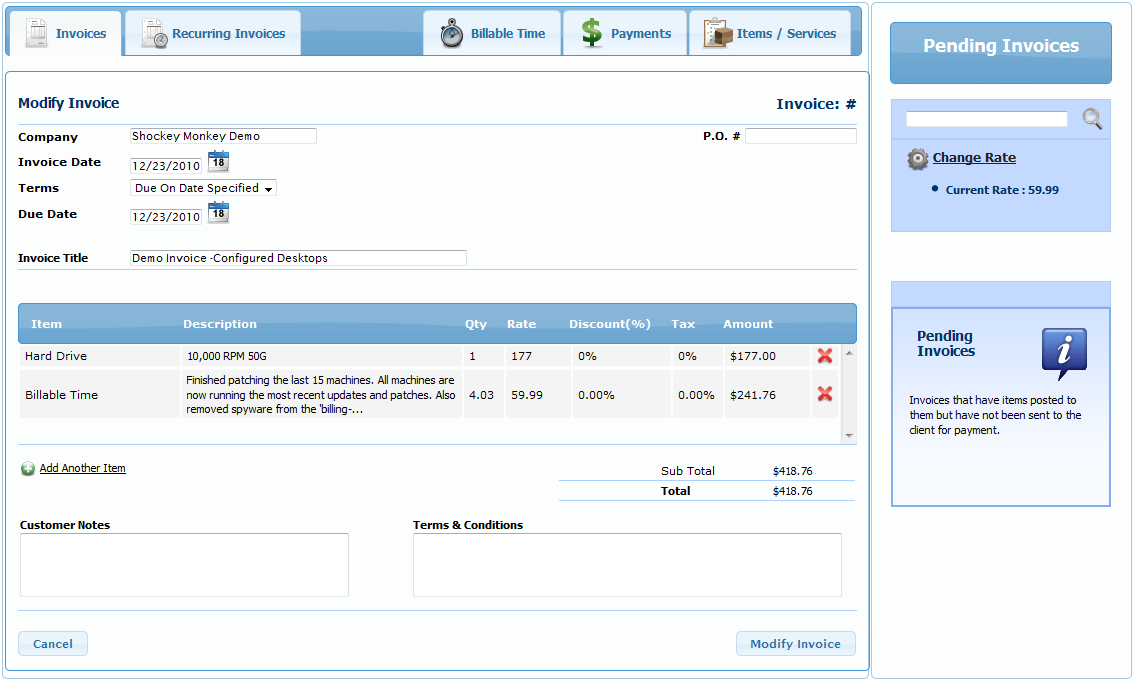
As promised, we are bringing you Time Billing automation to Shockey Monkey before Christmas. It is live now and available to all Shockey Monkey portals for free. It automates the process of billable time entry review, approval and invoice creation. We worked very hard to make it simple and intuitive, please click on the screenshots for a better view.

How does it work?

The automation of billable time is quite simple and a core part of the Shockey Monkey automation. Just click on Accounting and select the Billable Time tab.

Here you will see all of your time entries that need to be reviewed and approved. Under the company dropdown you can filter by the companies that have (uninvoiced) billable time waiting for review.

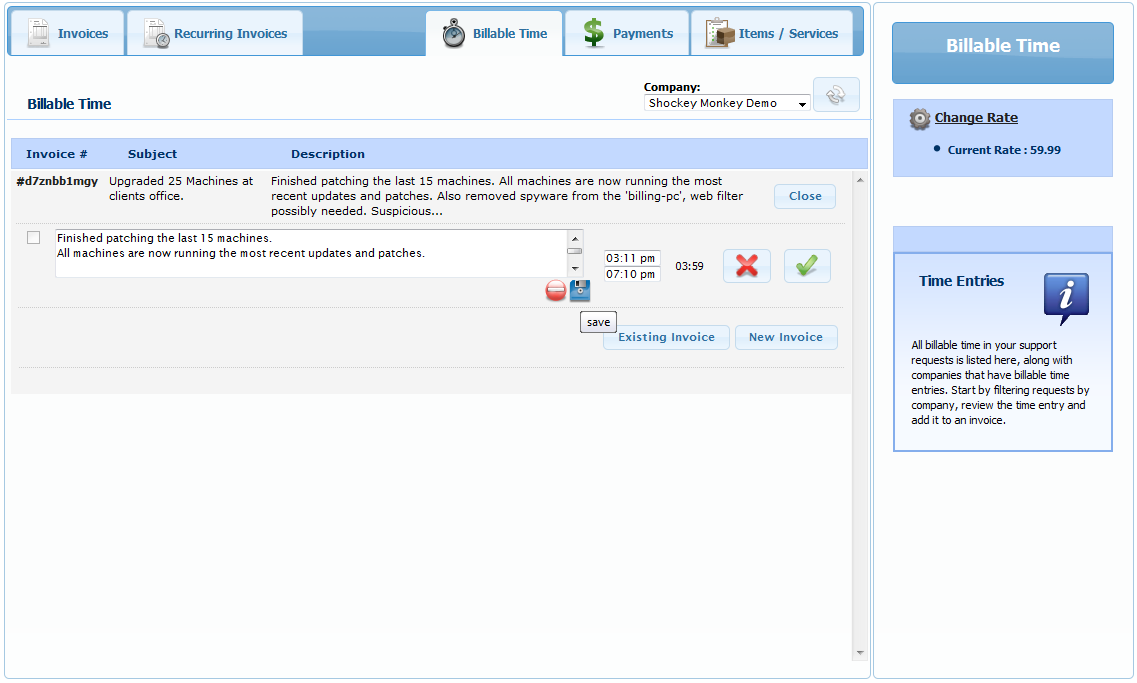
Each billable time entry is here and can be edited – notes, time, rates – everything can be changed. Because what you approve here will end up on the invoice we wanted to give you a single screen to review activity, correct spelling mistakes, correct time entries and make the necessary adjustments.

1

Make the necessary adjustments. In our discussions with many of you, adjustments play a big part of your accounting so we wanted to make it a single-screen effort without refreshing and popup windows.

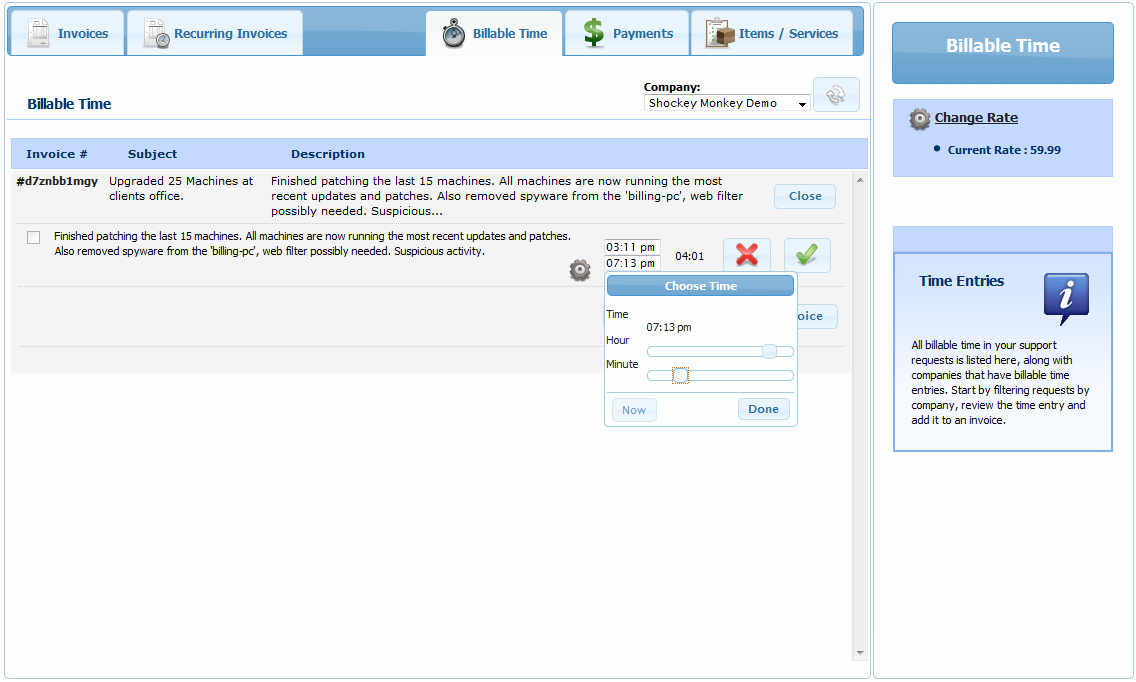
2

Once you’re done with your approval, just add it to the invoice. This is where it gets tricky – it depends on how you bill and when you bill. Some bill at the beginning of the month and add the hours to the invoice that has the managed services fee. Some bill one week at a time and have a new invoice every time. Some separate time and materials. Some do it at the end of the month. However you do it, Shockey Monkey will work.

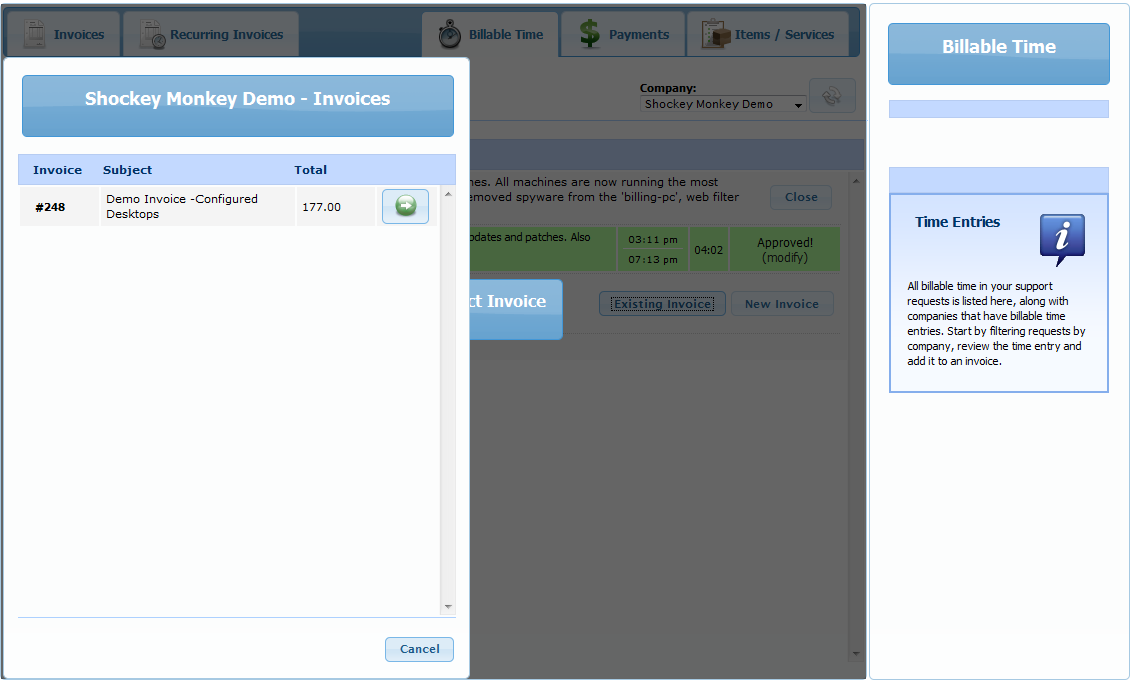
Select if you want to add the time to an existing invoice (if you prefer to give people a single invoice with everything on it) or create a new invoice. The screen below illustrates how to add the time entry to an invoice.

3

You can make adjustments to the invoice as usual, add any other items and work from there.

4

According to several of our partners, “this makes Shockey Monkey accounting actually usable now” as it completely automates the billing process for a lot of service providers that do hourly or project work. It is also flexible enough to let you clean up the mess that is inevitable when you’re pressed for time and not taking full notes. It also adjusts well when you want to make your invoices fair.

We are making it available free, to everyone. Right….. now Smile

For full details and the feature walkthrough as well as the business case scenarios, please check out the quick videos Hank and I put up for your enjoyment.

Shockey Monkey Billable Time – 17 minutes

Shockey Monkey Billable Time Automation (Windows Media, wmv)

Shockey Monkey Billable Time Automation (Apple Quicktime, mov)

Happy Holidays.

If you are still reading all this – and not signed up for the free Shockey Monkey – seriously? Merry Christmas from me, go put the monkey under your corporate Christmas tree (or whichever religious or atheist ritual you celebrate this season)!

My god Vlad, what did you do? (Part 2)

ExchangeDefender, Google, IT Business, OwnWebNow
Comments Off on My god Vlad, what did you do? (Part 2)

Yesterday I held a big webcast to announce our big plans for 2011. To say it went well is an understatement. But in January we start offering all of these services and I want to make sure we are completely on record with everything that we are doing.

If you missed the webcast and would like to check our the official announcements check this out:

Did you miss the webinar? Here is the recording:

Webinar Recording (wmv movie 45 Minutes)
Webinar Slide Deck (pdf)
Webinar Podcast (mp3 higher quality audio)

Read the official announcement of ExchangeDefender Managed Messaging and CloudBlock over on our Own Web Now Blog.

So what’s CloudBlock, Vlad?

It’s three different things:

1. It’s not a solution designed for the channel. It’s a solution designed for the end users that want the bare bones commodity email solution.

2. It’s “Mail” solution starts at $2.99/month and includes Exchange 2010 mailbox (5GB Mailbox, upgrade to 25GB available), optional mobility, built-in security. It’s your typical Exchange hosting available from tons of vendors around the world.

3. It’s “Security” solution that starts at $0.35/month and includes SPAM filtering, Virus filtering, malware scans, DDoS protection, address harvesting protection and business continuity (mail queuing). Unlike the hosting product, this solution is designed to protect your existing email server on-premise.

Most importantly, CloudBlock is not Own Web Now. It’s not ExchangeDefender. It’s not my people. We have licensed pieces of our solution stack for a project that we believe can be profitable.

How does it make sense?

Let me Vlad-ize it for you.

Customer: I want a Ferrari.
Vlad: Fantastic. I have a few!
Customer: So I spoke to a guy at a Hyundai dealership, what kind of a Ferrari can you sell me for $8,999?
Vlad: I can sell you a 1:43 scale model along with an F1 poster signed by Michael Schumacher.
Customer: But I won’t be able to drive it at 180 mph?
Vlad: Relative to the ground? Only if you’re driving it on your tray while an airplane is taking off. Which is against the FAA safety policies.
Customer: So I can’t understand why a Hyundai is $8,999 and a Ferrari starts at over $200,000?
Vlad: [ 2 hour speach ]
Customer: I get all of that with Hyundai according to their sales people.
Vlad: Guess I’m going to lose this sale.

Translate the above to all the conversations you’ve had and all the deals you’ve lost to Google Apps and Microsoft BPOS. In light of all the outages they have had, you lost. In light of all the inconsistencies among the products and Microsoft’s inability to even roll out their latest Exchange and SharePoint releases, you’ve lost. In light of endless fears about the privacy and security, you still lost!

Why? Because when the client is making a decision on the price alone there is no amount of features or business fit that you can talk about, they only care about the lowest cost.

Emphasized enough? It’s true. While you can excuse some of it on clients just not understanding what they truly need – or your inability to explain it, when something is seen as a commodity it’s only compensated and valued as a commodity. Which means cheapest thing wins.

So why did you do it Vlad?

Because I’m a CEO of a for profit business, not a CEO of a religion. Look, it’s obvious from all the pain out there that there is demand for this type of a solution. If people are willing to pay for the bare essentials, who am I not to take their money?

That said, this is another weapon in our partners arsenal. If you are facing a stubborn client that is not willing to listen to your recommendation for what they really need, and they want the cheapest damn thing out there – you now have something to recommend. And when they need more, you should be there to deliver it. We partnered in CloudBlock because we felt it had a unique value that doesn’t exist with BPOS or Google Apps – it doesn’t have a VIP partner list or another business model. So you don’t have to worry about your customers being introduced to the competitors of yours that we like more or being gamed to sell more advertising.

You now have a competitive chip in the commodity space.

Won’t this kill OWN, ExchangeDefender, etc?

There is a certain kind of client that only looks at the cost. So yes, that kind of client wouldn’t consider OWN or ExchangeDefender anyhow.

Will some of the existing clients/partners go to this? Yes. And we’ll make slightly less margin on them. But what’s our margin if they switch to a competitor? Now does it make sense?

If you can’t explain the difference between a Ferrari and a Hyundai then let them buy a Hyundai and when they become to depend on it and want to drive it at 180mph – you’re right there.

Remember: If you don’t have alternatives, your clients will find them on their own. Not everyone is looking for a Ferrari, either.

More details on this in January. We think this is huge for the channel even though it wasn’t built for it. Differentiate, differentiate, differentiate.

My god Vlad, what did you do?

Boss, Exchange, ExchangeDefender, OwnWebNow
2 Comments

Earlier today I held our final webcast of 2010 – in no small way it’s the biggest, most ambitious thing we’ve ever done. And we’ve spent entire 2010 to bring our organization and our relationships to the level to actually make this possible.

I’ve posted my professional thoughts on the subject as the CEO of Own Web Now here: ExchangeDefender Managed Messaging. Here is the more volatile angle:

In a nutshell: I’m tired of bitching, moaning and excuses for not building a business model around the cloud and the messaging platform. I know there are plenty of real business concerns that are hard to make but try to think back to when you started a business and the faith you had in yourself and your solution. Were you immediately profitable? No. Did you have a winning combination that was fool proof? Probably not. But over time things get perfected, details get ironed out and you build a successful business model on top of it. Yes, it took a ton of sacrifice. But look at you now!

Many are looking at the cloud right now and the margins make the sacrifice component less and less tasty. Nothing good happens while standing still in an ever changing world. Not for you, not for me. So considering how well we’ve done through the years, we owed our partners this one. Here is what it is:

Completely managed end-to-end messaging solution built and supported by one vendor with your brand name on the front. When I say completely managed, I mean it: We’ll configure it. We’ll install Outlook. We’ll migrate the mail profile. We’ll support the end user. We’ll bill them. We’ll collect money from them. We’ll cut the commission checks.

This is a culmination of all the bitching, moaning and complaints feedback we’ve gotten about the cloud. Some of it is very legitimate: It takes a lot of time to run the business side of billing, collections and accounting. It takes a lot of time to do the setup and migration but clients hate paying for it. Some of it is not.

So what did we actually do?

First of all, we changed nothing. Our packages are still the same packages with the same pricing, same offering and same specs.

We added a new tier at the top of our offering that includes everything. Everything. Trust and believe that. Because if it breaks, we don’t get paid.

It starts on January 1st. Smile

Initial response has been amazing – and I hope we help a ton of people build a great business in the cloud. This is, pardon the self high five, huge. I don’t know of a time that someone decided to do all of the work – end to end – under your brand and even give you control of the account.

One question did stand out: “So wait, you’re going to set the price on this?* Cause I can sell it for $75/month easy.Slow down. First, the price has to be set in order for us to actually bill the client – and it gets really messy very quickly so it’s not something we could answer right away. Second, we kept it relatively low because in order to make money in the cloud you need volume. Scratch that – in order to make any value on this as an MSP/VAR you need volume – you need a ton of clients to farm and deploy your existing MSP solutions into. If you’re looking to get rich on a few uninformed clients you’re really cheating yourself out of building a huge market presence for yourself.

I’ll explain the reasoning behind the rest of these moves throughout the holiday season. I’m sure the more cynical in the bunch would doubt the sincerity of what we’re doing and I have two things to say about that: 1) Check our track record, we’re always behind our partners and 2) Sitting around and doing nothing will always lose to us actually doing something to help.

Looking forward to a great 2011 with all of my readers and partners. Thank you for your support and attention, as always!

* I am not providing the actual pricing structure in public because this will only be available through our partners. Want to know? Sign up here.

Our Biggest Show Of The Year

ExchangeDefender, OwnWebNow, Shockey Monkey
Comments Off on Our Biggest Show Of The Year

On Tuesday, I will be presenting our roadmap for 2011.

It’s basically the biggest show of the year.

Last year we used it to launch ExchangeDefender 5. This year, we are announcing our new business plans.

First of all, a disclaimer: There are no changes to what we are doing or to our products. Your pricing, service and support will remain the same.

Beyond that, lot’s of new stuff. Here are a few hints:

  1. Lower cost version of ExchangeDefender.
  2. New third party company offering Exchange 2010 and on-premise SPAM filtering solution licensed from OWN (think BPOS, cheaper)
  3. New “managed” solution.

Of course, the devil is in the details and I will share those with you on Tuesday at 1 PM. We are responding to the demand from our partner base. There are basically two new types of partners that have come out of this entire cloud shakeout:

  1. Those with really solid business models – that want to add on the cloud but don’t want to manage it. This leaves room for our premium offering that will be managed and billed end to end under our partners branding.
  2. Those that think the cloud is a commodity and are willing to ignore it but don’t want to lose their clients to Google or Microsoft. This leaves room for a bare bones Exchange offering to move the more essential messaging to the cloud while everything else stays in place.

We are kind of at a point where the cloud is no longer a discussion point at all, it’s a part of business model and partners have to choose what to do with it: ignore it (and lose), embrace it (and take their chances), embrace it somewhat (and try to live on smaller margins) or embrace it shoulder length (and just keep the clients).

In the end, it’s all about the clients needs, and you’ve seen what I’ve done in 2010. We’re built a world class CRM platform with Shockey Monkey absolutely free to help people manage their cloud services under their name / brand / pricing. Then we added Looks Cloudy, a blog to cover the cloud deployment strategies and considerations. We also rolled out Monkey Remote to enable remote support and monitoring.

Next, we introduce the actual support and service no matter where you are on the scale.

Our business model for 2011 is simple: We will only focus on messaging. Yes, we do a ton of backup business, a lot of security, virtual servers, dedicated servers, SharePoint, etc. At this point though, it’s make it or break it time and with the economy still struggling and record unemployment we can bring in the rest of the services later. But if we cannot address the most critical part of their business immediately, we may as well just close the doors and try to tell ourselves that being an Apple Genius still makes us an IT professional and not a slimy 201X version of the 90’s beeper salesman.

SBS 2011 RTMs

Uncategorized
1 Comment

Yeah, I know.

I don’t care either. I don’t have much to say about it good or bad.

I think Microsoft signed the death certificate on this with it’s bravado – if you’re spending 90% of your R&D on the cloud, why should a small business invest in purchasing your on-premise OS? Sure there are plenty of reasons but should leave plenty of people uneasy about it.

Another point of interest – it feels a lot like EBS launch did. Most people don’t care, those that do think it’s awesome. It simplifies management and it’s a perfect fit for the organization that is looking just for it. We all remember how that movie ended.

However, there is something worth discussing here. Obviously, SBS XXXX will never quite die because Microsoft needs to give something to Dell and HP to sell on entry level servers – not because they particularly want to but because they don’t want to lose it to Linux.

So 3 years out – what is the best selling version of SBS 2011: Aurora/Essentials or Standard or Premium? Common sense out the window – if Microsoft is really “all in” on the cloud deal how does it change your projection?

P.S. I know it sounds like I’m beating a dead horse here and I feel bad writing this post and even mentioning Microsoft mobility in any way. Microsoft though does spend an ungodly amount of money on marketing and I hope this perspective offers another point of view before you base your business on something that Microsoft believes has 10% chance of survival in their future based on their commitment to all things cloudy – can’t have it both ways.