What does Rumba mean in Hindi?

IT Culture
3 Comments

PIC-0040

It’s Friday.. joke time.

Last week, after spending some quality time mopping my office floor, I decided it was time to get some help. As hard as many of you feel I work, I am lazy in day-to-day life on the same order of magnitude. If you notice, those servers were shipped when I moved into this place a few months ago and the tree in the back still has a sales tag on it. I am afraid if I pull it the whole thing will fall apart and then I’d have to explain why my office has a dead orange tree.

So last week I got a Rumba. I fully expected this thing to simply blow all the crap around the office and make the dirt more distributed (and less noticeable) but I have to say that it has surpassed my every expectation. This little monster not only gets into everything and manages to finds its way out, it also sucks hair, dust and assorted crap right off the floors. Now, granted, its hardwood so not a big deal but I am still impressed. It has certainly eliminated many hours from the local assortment of illegal immigrants.

Which leads me to believe that we are being replaced by robots.

Which further leads me to believe that there aren’t billions of people in India, or even millions. I believe there are exactly 5,000 Indians on that subcontinent, all of whom rush into the street for the annual picture that makes it seem they live on top of each other with the collection of edible and homicidal animals.

But why? Why do that? What are they hiding?

And then it hit me.

Indians have already been replaced by robots. They are just trying to make us not go over there and see them living in their gold palaces while IVR responds to technical calls, support requests and customer service!

Here is my list of evidence:

  1. Tech support Indians sound nothing like any of my Indian friends. They all speak in the same tone, with no inflection, no volume changes, no respect for any punctuation.
  2. Tech support Indians do not respond to questions you ask but are answering the questions they believe you are asking.
  3. Tech support Indians do not interact well with humans.
  4. Tech support Indians either lack self awareness (“So, where are you at?”) or are unaware of their surroundings (“What time is it there? How’s the temperature?”)

Finally, I have developed an algorithm for checking if the Indian tech support is human or just a robot:

Step 1: Make up a word. See if they ask for a definition of the word or play along. “The computer is bizongling.” – Human will ask for a definition, robot will do a pattern match and proceed to answer a question.

Step 2: Stress test. Fire several questions in rapid succession. Human will try to respond to the most relevant question immediately. Robot will have a long pause.

Step 3: Full Duplex Check. Talk over the Indian tech support. Human will stop and get confused over why you’re such a bastard. Robot will continue to talk.

Step 4: Suicide check. Ask them to spell their name. Robot Indian Tech support names are Roger, Mike, Rod or Ted. Human Indian Tech support are either Patel or look like a Sunday newspaper put through a paper shredder and reassembled in random order. Ask them to spell their name. Third repeat into it you should hear a loud scream.

You don’t want to know how much time I have spent on tech support to become this cynical. I firmly believe that if I’m paying you and you’re not there to help me, you might as well be there to amuse me.

Year in review: Is SBSC community better off?

Microsoft
Comments Off on Year in review: Is SBSC community better off?

I’ve been blogging about doing business with Microsoft for a few years now and every year, as our program renewal comes up, I like to ask myself if we are better off or worse off as a community that relies on Microsoft to make most of the l00t. I specifically break it into the following categories: product roadmap, brand strength, partner services, local presence and competitive matrix. So let’s review:

Product Roadmap: C

In 2007, Microsoft in my eyes not only lost the mobility game, but also appears to be losing focus going forward in the space I dominate (MSB). As a result, my customers are demanding services (Salesforce), devices (Blackberry) and software (MacOSX) that increase my cost of doing business because we need to be more familiar and ready to support a wider range of products that end up in a business because Microsoft loses. 

Brand Strength: F

Another year of live.com. Another year of big losses to Google. Botched launch of Vista. Nearly non-existent launch of Server 2008. It is my sincerest belief that none of my customers would be even aware of 2008 if I hadn’t told them. To make matters worse, even the IT partners we work with are asking for 2003.

In 2007, Microsoft took the potshots and digs from Apple sitting down, to the extent that may even be admitting that Apple is right. With everyone else gunning for the same space, when will Microsoft hire an advertising/marketing agency? Microsoft is at the moment the very uncool solution with nothing seemingly turning it around.

Partner Services: A+

We have never gotten more for less in the history of OwnWebNow. Microsoft has beefed up its sales staff, provided multiple ways, venues, people and portals to get answers, information and support. I don’t think Microsoft has ever been a stronger partner than it is now.

Local Presence: A

Although the TS2 events are noticeably down, the TS2 guys involvement with the partners is way up. Every event we had locally was attended/presented by the TS2 guys, I keep on getting great feedback about JJ and the other guys on that team, they really have elevated their game.

Competitive Matrix: A

It’s still hard to touch Microsoft on the server. There is still little in the tipping point between going from as-is to “All Mac” offices though more and more Apples are turning up. New Office SKUs are making it easier for us to recommend licensing and not have to be the middleman of selling / provisioning / managing it all.

On the areas we directly compete with Microsoft and look to directly compete with Microsoft (Software + Service) things are looking better and better. Microsoft is still building their data centers and probably years from successfully implementing and offering competitive solutions. Looking at the new “Microsoft Online” SaaS offerings, its clear that their support is going to remain the same its always been, I just have yet another competitor advertising my business model and funneling disgruntaled customers my way when the new partners take over.

So both as a partner and a competitor, I’m pretty happy with what Microsoft brings into my SWOT.

Overall

Gotta give it up to Redmond, they are definitely making it a more valuable and profitable relationship to be in. While their products need work and their marketing is placing them into jeopardy of falling to the distant option instead of dominant contender, so long as people are on Windows the ride should be smooth.

Local stuff is doing better, though mostly due to the death of SPF/RiffRaff hobbyists, so it leaves more bandwidth and assistance for the people that are building and growing. One interesting thing is that over the past year even the most determined “one man shop” mindsets have started to change as a result of demand and nearly everyone I talk to is looking to hire and outsource aspects of their business. I think the stricter control over piracy, MAPS restrictions, requirement for certification for certain deals and really the most minimal of Microsoft control over who gets benefits has nearly decimated the unreliable computer guy syndrome. The calls I used to get “Oh, that guy just destroyed them” are few and far in between now and a lot of folks are merging and teaming up simply because our space is growing and demand is skyrocketing – people that used to be desktop jockeys are long gone.

Competitively, anything the 500lb gorilla does in my space keeps on improving my business because they drive the awareness for a solution and partners flock to me because of the support we put behind it that Microsoft can’t.

Overall, if Microsoft worked a little on their brand advertising things would be perfect. But even without that, nearly everyone I talk to is on the up and up and looking to invest and grow. Do we as a community have it better because of Microsoft? I think so, whats your take?


Exchange ActiveSync in iPhone

Apple, Exchange
1 Comment

Courtesy of PC World, Apple today announced that 1.1.5 will ship with Exchange ActiveSync functionality which will, for all intents and purposes, make iPhone “business capable,” more:

Enterprises want great push e-mail–“huge request.” And push calendar information. And push contacts. And a global address list. And Cisco IPsec VPN, and a variety of security-related options. And automated configration options, and remote data wiping just in case the phone is lost or stolen.

“I’m really excited to be the one telling you today we’re doing all these things in the next release of the iPhone software.” Applause.

Back to push. Customers have asked for built-in Microsoft Exchange information. Apple has licensed the ActiveSync technology needed from Microsoft to support Exchange.

Schiller explains how old-school push is complicated and unreliable, then says that ActiveSync is modern, simple, and reliable. iPhone apps like its e-mail and calendar will support it.

He walks over to a podium to demo all this. His phone has no contacts, no events, and no e-mail. But the screen for adding e-mail has a new option: Exhchange. He’s skipping that, but is turning on an Exchange account he had pre-configured. He wants to use ActiveSync for contacts, calendars, and e-mail. He turns them on. “And that’s it.”

His contacts show up, as do his appointments and his e-mail. Apple’s Bob Borchers is in the audience on Wi-Fi helping Schiller with a demo. Schiller creates a new contact, and Borcher confirms that it was instantly synched via Exchange and has shown up on his device.

Next, Schiller goes to mail. Borchers sends him an e-mail. And there it is on Schiller’s phone. Applause. “This is exactly what enterprise customers have asked for.”

Schiller’s looking at his calendar. He asks Borchers to move a meeting up, and the schedule change shows up on Schiller’s iPhone. “All that is happening live.”

Schiller says the last part of the demo is the most fun. He’s saying that maybe he’s lost his iPhone. He asks Borcher to wipe the phone remotely. He does, and Schiller’s phone loses all his data. Applause.

Also interesting is the quote on sales. iPhone is now the second most deployed smartphone (28% market share), second only to Blackberry. I am not sure if Windows Mobile devices are counted under a single brand, or if Samsung Blackjack and AT&T Tilt are two completely different smartphone brands. However you define it, nearly a third of the smartphones on the market now supports Exchange along with its push email and remote wipe. That is… significant.

Google Calendar Sync

Google
1 Comment

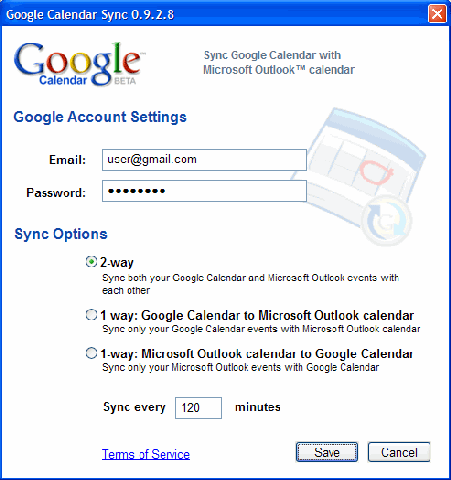
Cal SyncMost of my community work and freebie stuff runs off of Google and I don’t think I’m cutting it short when I say that Google has by far the best calendar/scheduling app on the market today. So this release has definitely brightened up my day, Google announces Google Calendar Sync that does one way or two way sync with Microsoft Outlook, but this also opens up a synchronization from Google Calendar to Windows Mobile.

Leech it today..

Financing for Idiots

IT Business
6 Comments

One of my pet peeves is watching local infomercials in disbelief that there are so many idiots out there, just dying to give me their money. In my next business venture I am picking something far more evil than IT. Consider this brilliant commercial for a brand new car:

Owe more than it’s worth? We’ll pay it off and put you in a brand new Ford car or truck!

What they are really saying is: Are you swimming in debt but are still insecure enough about your standing that you need a brand new car to overcompensate for being a sociopath? Well, tow it in and we’ll give you less than its worth for it, finance the remainder of your loan at a likely higher rate, give you an even bigger car you can’t afford and charge you retail because beggars can’t be hagglers, and your insurance will go up, too! But wait, you will now be in even more debt, owning an asset that will depreciate far faster than your older car!

Just how fucking stupid do you have to be to bite that?

The sad truth is, not that stupid. Most people happen to be that dumb, regardless of their technical abilities they are totally unfit to run a business or advise another for that matter. That, dear reader who didn’t have the balls to post a comment but emailed me instead, is the reason I have dedicated more of my time writing business articles than taking pretty screenshots on how to install an Exchange patch and read the release notes. Most of the audience here is selling technology one way or another (internal to the boss, external to the client) and if you are going to be talking technology business you might want to be more aware of the actual business concepts when dealing with someone that has actually built one with more than 1.5 employees in it.

So ring the bell, schools in sucker. Comments are open for a reason.

In Defense of Microsoft

Microsoft
1 Comment

One of the things you eventually have to come to terms with is that business is not always fair. Not everyone gets compensated the same, not everyone gets the treatment they deserve, not everyone gets their fair share of the pie. Sometimes in business, as in life, you have to make difficult decisions that you know will upset the other stakeholders in order to survive and thrive as a business. It’s a business, not a Miss Congeniality contest.

The other day one of the Microsoft Partners got a call from his client asking him whether they should update their contact information with Microsoft. This, in his opinion, constituted an inappropriate contact with the customer meant to cut him out of the trusted relationship with the client to supposedly sell services to the client directly. Here is the content of his response to the big cheese of SMB Australia (wtf? Robbie is not running that thing yet?):

Inese,

I am a Microsoft Partner in Melbourne and just was shown your mail out to Volume Licensing customers sent last week.  This e-mail is being copied to the Melbourne SBS Users group Yahoo list in an effort to rally other MS partners to voice their opinions on this.

I am utterly appalled by Microsoft blatantly trying to gather end customer information in what can only be seen as a conscious effort to cut out your “partners” and directly sell product to the end customer.

On one hand you have your fellow team members telling us Microsoft would never do such a thing and then we see irrefutable evidence to the contrary.  It is imperative that Microsoft immediately cease this attempt to poach sales from the channel and ideally send a letter of apology to those customers who have been contacted for doing so.

From my own experience, the “small” end of the market prefers to work with their IT Providers and the vast majority of my clients have become engaged my services due to being disillusioned with larger providers.  The larger organisations are unable to provide the personalised service that they desire and that they also pride themselves on providing to their own client base.

It is my opinion that this marketing effort is truly misguided and may in the long term damage Microsoft’s reputation with the SMB market.  You have an enormous army working for you with your Partners, regardless of the level.  We may gripe about things such as licensing complexity and such, but they are far less of an issue than what have to deal with LOB application vendors and the likes of HP, Lenovo and other hardware vendors.  You have succeeded in one marketing campaign to raise Microsoft to the very top of the heap of vendors to be wary of.

If this is how you are going to reward your partners for selling Volume Licensing to our client base, I for one will be hesitant to offer this option in future quotes.  Other vendors have tried this type of approach to hijack customers, some have fared better than others.  I hope Microsoft fails miserably with this one.

I would be happy to discuss this further with your organisation if you should so desire to receive input from one of you most important sales sources you have.

Inese, responded (I’ve boldfaced the significant text):

Dear Concerned in Syndey,

Thank you very much for your email raising your concerns with respect to one of our recent marketing initiatives.  And thank you for taking the time to speak with me this morning to help me understand how you came to perceive the communication as an effort to ‘cut out’ partners from the sales process.

For the benefit of the Melbourne SBS User Group copied on your email (and this one in response), I will restate that the intention of the communication you refer to is absolutely in no way a means of enabling direct selling and  by-passing the Partner channel.  In fact quite the contrary.

As a regular part of our sales and marketing programs, Microsoft, like any other vendor, wishes to engage its existing and prospective customers in a meaningful, timely and relevant fashion.  The foundation for being able to do this is the quality of our customer data including some basic details such as correct contact details, number of PCs and the industry the customer operates within.

The communication you refer to below aims to do just this – to update the profiles of these customers to enable a more relevant engagement.

The reason I say that our intention is actually contrary to your assertion that we are aiming to circumvent the Partner channel is that when we are able to market more effectively to our collective customers, we achieve a much better response which in turn drives a higher volume and quality of sales leads to our Partners.

David, as you correctly point out below, our Partners are a strategic asset for Microsoft and we cannot succeed without you!  This initiative will actually benefit our Partners.  This is truly intended as a positive outcome for the Customer, Partner and Microsoft.  We all win with a solid foundation of customer insight.

Thanks again for the feedback.  I hope I was able to allay your concerns and those any others on this email may have.

Best regards.

inese kingsmill l smb director l microsoft australia


Ok, so I have to say, Microsoft is right here and I have to say they are entitled to take the action they just took. I would even suggest it is fair. They did not take this information and pass it to another vendor, they did not take your lead and try to close the deal themselves, they did not act like the email was a mistake and an isolated incident, all of which they have done repetitively in the past, they simply tried to open a direct channel of communication with their customer.

Now, I know its going to be a hard fact to swallow that this is their customer, that this company has a direct contract with Microsoft, that they agreed to be in contact with Microsoft.. but those are the brakes. The VAR community cannot expect Microsoft to create, finance and support all these programs meant to educate, grow and manage SMB partners, finance their deals, offer bundles and discounts, and be a completely unrelated and uninterested third party. You cannot have it both ways. If you want it that way, go buy everything as a full packaged product and Microsoft will not know a thing about them.

Truth is, Microsoft signed a contract with your customer and in the eyes of law and god and the flying spaghetti monster this is Microsoft’s client. Microsoft will market to them, invite them to events, offer specials, offer training, offer helpful tips and yes, offer services that directly bypass you.

So Microsoft did the right thing. What you should be more concerned about is the blog post that I wrote the other day and more than 100,000 of you read so far – about how Microsoft is building services to be sold directly to the customer. The services I talked about can still be bought from a partner though, but what about Office Web Workplace, which can only be obtained from Microsoft? Are you programming in corporate firewalls to drop connections to that?

Let me level with you folks, because I’ve been warning you about this for years, participation is not optional. Conferences are important, direct engagement is important and trust is important. You choose to go to Riff Raff festivals and vendor hugfests and you miss out on Steven Ballmer jumping around the stage a mile high and nearly passing while saying that they will compete – as a slide after slide keeps on reinforcing the fact that VARs are irrelevant. Partners are important, but if your primary function is that of a reseller, your days are numbered. If you are not a part of development of that Software + Service you are no longer a partner, you are competition.

Microsoft did not descent from heaven as an angel and won 90%+ of the market by producing excellent products that customers just flocked to. Microsoft did so by ruthlessly competing, sometimes illegally, and designing the software in an all-encompassing way to address all problems, on all scales, for all customers.

We exist, as a business, due to that success. My sincerest hope, as a CEO of a software and services company, is that we are mature and professional enough to compete with Microsoft and use our SWOT to provide better solutions to the client base.

What Microsoft did was just a first step, and if you were wise enough to attend WWPC, you know what steps 2, 3, 4 and 10 are going to be too. Microsoft is turning into a more customer-friendly organization, they are going to serve their customer and just because you were the necessity to get them where they are now, it does not mean your business can survive as the big blue tries to steer its ship in the direction of user-managed computing free of IT complexities. It will be a better, more powerful, more aware company and those that survive to compete and complement those solutions will be sustained businesses of the future. So check the big picture, work on yourself, be aware of where Microsoft is going and adjust.

Oh, or you can get upset and try to fight $30 billion a quarter profit company in its quest to reach your joint customer base until they manage to move them to the web.

What is a rollup? Exchange 2007 SP1 Rollup 1

Exchange, Microsoft
Comments Off on What is a rollup? Exchange 2007 SP1 Rollup 1

One of the more frequent questions about Exchange 2007 is the new update technology, the rollup:

Rollup is a collection of hotfixes and Exchange system updates that apply to the entire product. While in the past, Exchange hotfixes included updates for the affected binaries/libraries only, they did not update the product as a whole. The new “rollups” do just that, they provide all the hotfixes affecting Exchange 2007 deployment. Much like service packs, the rollups contain all the hotfixes and patches Microsoft has published and bring the Exchange deployment to an identifiable state (ie, tell me the rollup not a list of all the hotfixes you installed). The schedule is also pretty reliable, every 6-8 weeks.

And speaking of the devil, the first rollup for Exchange 2007 SP1 is out and it fixes the issue of store.exe allocating 100% of CPU. This is a common thing in the 2007 world, there are never enough resources so if you don’t choose to throttle it the Exchange 2007 will allocate so many resources that you’ll hardly be able to launch the management console without snapins timing out.

So, in review: Exchange 2007 SP1 Rollup 1, Exchange 2007 RTM Rollup 6.

Microsoft Software + Services – Partners = The Future

Microsoft
5 Comments

My favorite cat killer is right, I don’t like where Microsoft is going with it’s Software+Services strategy. What I specifically don’t like about it is the PR way in which they are trying to crush their partners in order to compete with Google. In a way, this is no different from what Google is offering, but Google is at least openly waving a middle finger to its resellers and cutting straight to the end user.

Microsoft is trying to dance the line. “Oh, you can buy it from a ton of our partners, or you can buy it directly from us.” Sorry, no go. You’re either comitted to your partner base, or you’re directly competing for their customers business. There is no middle ground, absolutely zero.

How can S+S be a victory for the Microsoft partners? Maybe if Microsoft follows its tradition of dismal product offerings combined with terrible support that was the downfall of bCentral and is currently leaving live.com far behind? I have a little too much faith in Microsoft to believe this will happen, as this is pretty much their last shot at Web 2.0–ish application delivery.

Moves like this make me realize that I am no longer in a partnership with Microsoft but just sending them money so they can crush me faster. Microsoft got to where it’s at by working with partners, but now their “giving more choices to the customers” means “getting more ways to work with the end user directly without the middleman.”

No, thanks. In a way though, this is inevitable. Software is becoming easy to use, end users can manage themselves faster and better, be more productive without IT overseeing all activities and given a sufficiently open company with sufficiently loyal privacy-minded employees, it’s a huge win for the customer. Microsoft is trading the partner loyalty in order to battle Google for the segment of the IT consumers that feel IT services are worthless. Not a business I’d want to target, and sadly, no longer the company I want to recommend because their focus is clearly elsewhere.

We have been very successful as a hybrid company delivering direct services and partner-powered solutions, but we’ve been able to make it work because we’re a service organization. Microsoft is a product company that looks at service as an alacarte addon, and support as an expense. Will they be able to compete with OWN? Doubt that. Will they burn the goodwill and send us looking elsewhere? At WWPC, they’ve done so already.

White Trash Micro (yet another one of my posts you should read but probably won’t)

IT Business
5 Comments

Ok, it’s time again for me to pretend I didn’t waste 6 years in college getting my degrees. Economics time: Why is it that the government is playing white trash economics?

Case and point, State of Florida. Republican governor campaigns on the traditional flawed concept that the people should be given tax cuts in order to stimulate economy. As explained here before, broke people make horrible budget decisions and giving them tax cuts starves the community infrastructure and social programs (the only hope they have to make it out of their predicament) and transfers the wealth to electronics makers (foreign) and fuels conglomerates that only offer low wage jobs (walmart, mcdonalds). The trick here is that the tax cuts only benefit the richest people, who tend to be rich because they can manage their finances. You can have a Ph.D in economics and not balance $260 a week right.

So what happened in Florida?

Charlie Christ campaigned on a platform to cut taxes and reduce insurance rates. This appeals to everyone: “Fuck the man, I want my money.” which sounds great in theory, horrible in implementation when you realize that everything you take for granted from school systems to roads to police to fire departments is funded by those taxes.

The debit/credit system is pretty easy. You start out with a pile of money. You start paying your bills (police, fire departments, etc). The pile gets smaller. You collect taxes, the pile gets bigger. You start spending the entire pile, it goes down to nothing. You have no pile. You got bills. Now you go into debt, start offering municipal bonds. Now you not only have a no pile, but you also have a hole in the table. Then you decide to take less and less money from the people that rely on the infrastructure, and you tell them to go spend it to stimulate the economy. When you buy retail, you buy from a minimum wager. No ifs, thens or buts about it. They need more people, so they start hiring.

With me so far? Looks good, doesn’t it? Bills are being paid, people are happy they got more cash in the pocket, everywhere you go there are lines.. you feel good! What’s not to love?

Well, after a little while the bonds stop selling. People stop investing. Revenue to the state goes down, and the municipalities which got rid of the “high taxes” now can’t pay the police departments, schools, fire departments, roads, etc. People start bitching.

So then Charlie Christ turns onto the corporations, likely the ones that didn’t contribute to his campaign, and says the insurance rates are too high. People can’t afford insurance. (makes you think what they spent their refund checks on then). So they decide to start imposing limits on the corporations that have free will and decision making abilities outside of the governments influence.

Government tells the corporation it will have a roof (rate limit) it can charge. The corporation sticks its middle finger in the air and yells “Kiss my black ass” and tells the state it will not insure any new policies in the State of Florida.

So let’s try to sum this up, we got $200 a year back in taxes but our cities now cannot staff fire departments, police, etc. I am sure it will be of little comfort to know that you have a 42″ plasma when you get shot and paramedics take an hour to come scrape your ass off the sidewalk.

This is as white trash as it gets. Your only hope as a private citizen of getting out of the hole (that you have dug yourself by overspending, underinvesting, undersaving and then having the balls to ask for a refund) is to hope that a) your insurance doesn’t get cancelled, b) that your house is not appraised revealing a far lower valuie, c) a huge category 5 hurricane flattens your house so you can cash out and move to a country with some fiscal responsibility. Or Tennessee.

So what happened in Washington?

Federal Reserve, a private non-government entity, under Greenspan’s leadership pitched teaser rates to stimulate economic growth. They then proceeded to raise those rates 17 times. Now, they are in a panic mode trying to cut the interest rates so they can lend more and create a more liquid money system for an economy that is basically trying to pay off its Visa bill. Where is the crisis?

What federal reserve actually does is create a pool of money for banks to borrow from to keep their markets liquid. All your deposits do not sit in the banks vault, actually, a very tiny portion of it does. The reason the bank begs for your deposits is because it can then take that money and lend it out through mortgages and get a far higher interest rate than it is paying you. The bank is investing in its customers using the money you used to invest in it. So you go to the bank and drop a $100 bill. They take $90 of that bill and lend it out. Assume only one other customer, in order for the bank to have cash on hand it can borrow money from other banks OR from the federal reserve.

Now… the banks are acutely aware of just how screwed our economy is, how many people are not paying their credit card bills, how many are due for a forclosure, etc. So when another bank comes over to ask for money.. well, the bank says no way. But the bank thats begging for money needs to give its cash to their clients. After all, it’s their money!

So the bank goes to the Federal Reserve, and borrows at a higher rate.

Every time “the Fed lowers interest rates” it basically says that it will lend money to the banks at a lower and lower rate. To sum it up:

Banks know their customers. Banks are unwilling to lend one another money because they are all aware that everyone is holding a giant pile of poo (commercial paper) that will be written off the books (lost) and the Federal Reserve is doing all it can to keep on lending the money to the banks to pass them over and hope for another strong consumer cycle that pays off some of the enormous debt the banks have gotten their customers in because eeeeeeveryone from the customer to the bank to the fed to the, yes, white house.. got too greedy.

And now we enter white trash economics, the concept of endless debt shifting in the hope that it never catches up with us. While we do this, however, that debt keeps on raising and prices keep on going up and foreign interests are buying up our country and we will all (99.1%) soon be slaves to our own excesses.

Who gives a shit?

Your infrastructure is soon going to start to suffer. Roads, services, conveniences, construction.

Jobs are going to suffer too, followed by retail. The less jobs there are, the more higher paying jobs go to lower paying jobs and people have far less to spend.

Inability to spend accelerates into inability to meet debt repayments.

Banking system collapses. Dollar all but has already.

Game plan: stay liquid, invest only into items with short term payoff, business-wise bet on failure and take the low interest rates – trade your cash for nothing. Diversify the cash into different currencies, precious metals, items of true value (not vapor value: stocks)

This is a self-fulfilling prophecy: when people get scared and stop spending they accelerate the problem of slow economic growth. The system collapses because people believe it will collapse while they sit on their hands. The alternative is called the greater fool theory – the idea that we can spend ourselves out of the problem of overindulgence and nobody will eventually get stuck with the bill. Truth is, in a system with finite resources someone ALWAYS get stuck with the bucket of crap at the end of the day, and it might as well not be me. Who will it be? The folks that traded in their prosperity for a $200 tax credit.

But what do I know, Go Gators!

It’s Good Enough, Reincarnated

Google, Microsoft
3 Comments

For the past decade IT shops and IT departments have had to fight the “it’s good enough” mantra of cheap CPAs that were in charge of the company budgets. Going even smaller, “it’s good enough” brought you the world of NT4 and $4,000 DST patch, Windows 98 used in production in 2005 and beyond, etc. In the past few years as other options became available (more affordable and powerful computers, less expensive/financed licensing) customers became somewhat more strategic in their IT spending because they finally had someone that was shelling advice without per-hour pricing. We were in a renaissance, for about a year, and then Apple & Google came back and fucked it all up. If there is anything  you do, I hope you read the following article by my friend and one time SBS Show cohost Sarah Perez:

Google Sites the Next SharePoint? Maybe Not.. Why Google Apps Could Lose the Enterprise Market.

Let me give you a quick summary of the IT market in SMB over the past ten years: ’98: It’s too expensive, it keeps on crashing, fix it. ’00: It’s too expensive, it keeps on crashing, fix it. ’04: It’s getting cheaper, It seems to work. ’05: No surprise bills, eh? Ok. Sign me up. ’07: We want a Blackberry, Google Gmail and a Mac. ’08: Why are we paying for all this when we can get it for free?

Not a day passes by that I don’t talk to someone that lost a deal because their customer went the path of “It just works and its cheaper” and ended up with a Mac, no server, file server and a Blackberry. And for what its worth, you don’t meet a lot of people that hate any of the above – those that use them, love them. Sarah’s points out that users love it because they do not have to interact with the bureaucracy of the IT departments, they can just do their work.

Suddenly, good enough is back. Yes, Google retains the right to open up your files, do whatever it wants with them, offers zip in terms of SLA and no support beyond a FAQ and an email they may or may not respond to. But the premise is that you’ll never need to use those. Customer buys a Mac because its cool and because the premise is that the Mac will never crash, that it has no viruses or malware, and that the 50% – 100% premium is not that big compared to all the cost related to what you’d pay for a PC with similar applications.

So here, in 2008, we have a comeback of “it’s good enough” in that people are again comfortable not taking their IT as a strategic asset and instead focus on their core business and little else.

Microsoft seems to to agree. They are rumored to be building dozens of data centers with half a million sq ft, to build their consumer-business targeted empire of online applications…

… more on this a bit later.