Hi, I want a pink Ford Model T, NOW!

IT Business
1 Comment

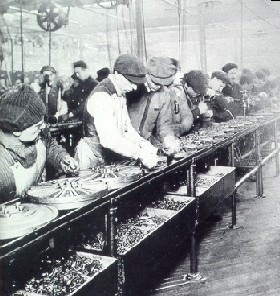
Ford_assembly_line_-_1913 Henry Ford, father of the 20th century corporate slave model and racist, once said that “customer can have any color he wants so long as it’s black” and some 100 years later we still put our process over service because it keeps us from making new mistakes and our costs are predictable.

This is one of the most fundamental concepts in economics and business and everyone adheres to it, even the ones who make themselves to seem like a blatant exception to it. Enzo Ferrari, Donald Trump, solid gold toilet manufacturers and guys that build cell phone towers in the middle of an Arabian desert for Prince Al-Waheed all work on the same principle of a single price for a single service/product and then extra cost for any wild thing you can dream up. Again, nothing new here.

There are many people just being handed their pinkslips right now that are entering the business market and clearly separating themselves from anyone with actual business training or experience. How? They want the pink Model T. They also want it at the same price of a black one. When told that it is something we don’t do, they try to phrase the same thing in another way, as if they are going to trick you into saying something else. It’s like a four year old trying to outsmart a grownup. To their little mind it just does not make sense how an organization has set a deliverable, a process, a support structure, a pricing model, a marketing message, a roadmap… and uweeee, they need to change it. They want their Model T.

This is where I generally hang up and wish them best of luck on Monster.com because that kind of attitude will not get them any business.

But truth is, we all meet clients with exceptional demands that have exceptional needs. I will sell you a gold toilet with an Exchange mailbox, I promise. It will just cost you more than you are prepared to part with.

The worst thing you can say to someone is that you just don’t do X. Sure we do X. We do X and we like it. You just can’t afford it, but I’ll let you figure that out yourself, I won’t be the one to spell it out.

We all are challenged by customers with unreasonable expectations, but if we behave in a way that points out their own inadequacies to them instead of us picking on them, we still might win. Who knows, they may just be completely insane with money to burn. Who am I not to take your money?

Fundamentals of whoring: Set your service, set your price, and be willing to do anything and everything their bank account can support. Now go on ho, make me some green.

What can I get for $10? An Exchange 2007 mailbox with 1GB of storage and a copy of Outlook 2007. Oh, I need UM, too. If you got the money honey, we got your disease….

Walmart Chopper: Day 1 Q&A

IT Business
4 Comments

The last few posts really started burning the vlad@vladville.com inbox so here are some of the points I thought I should discuss in public. I always like hearing from people, please drop me a note if you’ve got something on your mind.

Vana: Am I next?
Yes, thank you for saving me an email and a phone call.

No, of course not. Really, out of the 20 people I talked to, not one of them was surprised. They knew things were not working out and for the most part we all agreed that parting ways was in the best interest of both organizations. Some relationships work, some don’t. Try to understand the nature of a problematic client. They are likely always on your radar or something is always demanding your attention. You are burning time trying to make them happy and getting nowhere.

As I said, 90% or more of our relationships are just perfect. People approach us or we approach them, we find a profitable relationship, stuff breaks, we fix it, they tell us what their clients need and we provide it, everyone in the equation makes more money, the conversations are pleasant (actually, the conversations are the BEST part of this business, I LOVE talking to my partners)

Dan: Are you afraid of the retribution?
I have to be honest, yes, I am. Whenever you upset people you have to be prepared for some blood in the streets to make you look like the devil.

However, the business case for a service termination is not an emotional fear of you missing out on some potential business down the road, the business case is optimizing the company so you are no longer demotivating your workforce and losing money. If you have to do this, don’t let the fear overcome you: It’s like saying you don’t want to go to the hospital for a cut because they might use painful stitches, so you sit on your ass until you bleed to death.

The negativity of having an unhappy client is far worse than the retribution after you’ve parted ways. What is worse, to have a few of your partners badmouth you on the forums all the time, or to just part ways and have them say you’re not friendly to ___ people?

Allen: What the heck is Walmart Chopper?
We come up with entertaining names that make us laugh about the stuff we are doing that are vague enough to be brought up in a conversation and don’t make anyone take themselves too seriously to lose perspective. I know this sounds amateurish but stick with me, I’m about to let you in on a big secret to motivating a cynical workforce. I could have called this “Vlad takes ten days to clear out ten years of mistakes by forcing us to focus on accounts regardless of if they are losing money” which just screams bad leadership. Or I could have titled it “Succession planning, strategic customer base realignment” which is what any “real” company would have done. But here is what happens when you put a serious title in front of people who try to be serious – they start providing “input” which is just another word for unwanted advice: “Well, if we are working out a succession plan should we not also do ___” and you spend more time in meetings deciding what you’re about to do than actually doing it. This is why most meetings end in a stalemate and agreement to meet about it again – I choose to set the agenda and spend more time measuring the actions because thats where you find the faults in what you are about to do, not brainstorming all the possible things you could do.

We make a decision, set the parameters, do, measure, do, measure, do, measure and then if something needs to be changed we’ll look at it when we’re done. Works for us.

Eric: Why is this not a daily/weekly/monthly/yearly chore?
As I tried to explain, this is a seriously draining exercise and your client base should not be dismissed on a whim, or the second their P/L dips below 1.0, or their credit card is declined. If you do that you are clearly all about money and you will have 0 loyalty from your partner base if you behave in such a way. Works for monopolies, cable companies, etc. But for a rapidly growing company, in a high tech market, with a ton of substitutes you need to show a bit of leniency.

I am not saying that one should be careless and just let things slide, but imagine what message you are sending if you’re just randomly kicking people out because you don’t like them or they aren’t profitable at this moment? People are difficult. Making money takes hard work. Getting clients and partners is tough business. Keeping your existing client base happy, or turning an unprofitable client to a profitable client is possible. Just don’t rush.

What I am saying is that you need to have a pattern. You need to have tried to fix/salvage the operation. Only when you’ve failed at that, when you feel that both organizations would be better off do you move to part ways.

Dan: Should this not be done from the start of problems?
Yes, if I had a crystal ball and knew every lead personally, checked their credit, got brought into their board meeting (or sat in their car while they called their Visa to check the balance) or… you get the picture.

Some clients you can tell from the moment you talk to them that they are not going to work out. I have not had a problem with that, I happen to be brutally honest (those that have met me will vouch for that) about all the options so I know that the people that choose to work with us know the very worst of what may happen. I believe my job as the CEO of this company is to explain my business model to my partners, understand theirs, and find profitable opportunities. It is not to cram stuff down their throat and sell them the dream, I want my partners to be around for a while, not sign a perpetual payoff contract for 1,000 seats or invest $18,000 in my software and vanish.

But, over the course of business, things change. Business objectives change and the partner stops training their people, floods us with support calls and makes training of their staff our problem. Management changes, and you get to deal with someone that you really can’t work with and make a positive relationship. Budget allocations shift, people cannot afford all the services they subscribed to and require for their business operation and they complain to you about the software not meeting their needs. The list goes on.

Natural part of business is change, those who embrace it are called leaders, those that sit back and hope for the best are called employees. You do not have 100% vision of the future and at times you need to react after the fact.

Bob: I assume you are clearing shop for something, is it more Shockey Monkey?
No, the primary objective behind this was to make sure that when I take my leave we are not left with the same problems that overwhelm me today. We happen to have some room for a few weeks before things really ramp up for the summer and I made a decision to optimize the business now instead to act on a whim later.

This was not tied to a particular product, plan or anything else.

Day 1? What happens on day 2?
Vlad creates the sky 🙂

Operation: Wallmart Chopper: Day 1

IT Business
2 Comments

The other day I wrote a rather emotional recount of getting rid of a large number of clients. Thank you for the feedback, it was overwhelmingly positive from some of the successful shops that I work with, and the only negativity came from the people who wanted the clients themselves. Quite a few “Dude, why did you dump them, I would of taken them” messages and believe me, no, you would not. I know the revenue number looks nice, but the cost of service provided was far above it. The 20 or so companies we chose to stop working with were not done on the whim or out of spite or without lots of data. Which brings us to a point:

When do you decide that a client shouldn’t be one anymore?

This is likely a 200 page book, but really there are only two reasons:

    1. When they are no longer profitable
    2. When they are no longer respectful

An account can be unprofitable for a number of reasons, they can be rude for a number of reasons too. However, in order to continue to exist in the professional world you don’t just take out the axe and look for blood, you carefully find the problems that cannot be overcome, and if they can’t be fixed you send them to your competitors as the last possible alternative. How do I decide? Monitoring, go figure..

Step 1: Which do we provide?

Are we a service organization or are we a support organization? Most companies in the SMB IT solution provider space are support organizations, they trade time for money and the only thing that matters is that the job gets done when its requested and that the invoice gets paid. Service organizations (like mine) are a little different in a way that when we burn time, we burn profits. Service organizations are designed around a service level (SLA) and whenever we go against our SLA we are losing reputation (and money) and whenever our clients challenge our SLA, we lose money.

Step 2: How do we lose money?

For example, ExchangeDefender is generally sold at $1.50 per mailbox. Part of that fee is a set of antivirus engine, operating system, database, content licenses. Part is bandwidth. Part is infrastructure and infrastructure support. Tiny part of it is marketing, presale support, ongoing maintenance support and so on. The less support we provide for the product, the more money we make, and that is our only variable. There is a built-in incentive for us not to suck because when we suck, we don’t get paid. That’s my challenge when I run the organization.

However, what happens when the problems are external? What happens when the support skyrockets because the user doesn’t read the documentation? What happens when the user never troubleshoots on his own but instead opens up a ticket? What happens when the user never checks their systems but instead calls from a cell while he is driving to a client site and “just want to check if anything is broken”

Those things cost money. The more stupidity we put up with, the more money we lose.

Unfortunately for all of our clients, the shit cascades from there. There are a fixed number of man hours that can be applied towards support and a limited amount of issues a single support tech can handle. So as we have to cut and paste something for the 1000th time from www.ownwebnow.com/help or www.exchangedefender.com/support.php the service to people who have actual problems, who experience true issues with our products goes down.

Step 3: Measure, Measure, Measure

Every time a support request ticket is closed we track the issue. Here are our “Resolution Status” codes stamped on each ticket as it’s closed:

RTFM

Software bug – ongoing

Software bug – fixed

Hardware Event

Network Event

Onetime Event

Information Request

Reassigned

The top case is the most common one for us, followed by Network Event and Software bug – ongoing. On the face value this means that our support sucks, our network is trash and we might as well all go get jobs as professional developers because we can’t code to save our lives.

The numbers tell a different story. If we indeed sucked as bad as our statistics indicate, we would long be out of business. When we plot our companies on X and their support count on Y, we see what seems to be a vertical asymptote around X = 40.

If you’re not into math, what I’m trying to say is that around 40 companies contribute close to 90% of our support cases while the remainder of the distribution produces close to nothing. When normalized for the client count, about 20 companies created more support cases per $ earned than any other client. We aren’t talking a few tickets a month, or a few tickets a week. We are talking hundreds of tickets a month, mostly for the events that have already been explained. Most of these people could have had their own dedicated Own Web Now Corp employee but were bringing in $150/month.

Step 4: We’re not DMV

Some partners make a mistake of thinking that we are a government operation and that we will sit and take their abuse continuously. No, we sell services and partnerships, and if the partner is not looking to buy that they have to go elsewhere.

To me, partners are gold. I take their feedback to create products, I design software they can turn around and make money, I do whatever I can to make sure they get their deal, even when I am the tiniest fraction of their transaction. Why me and not some monkey off the street? Because I know how the business world works, and when you can show alliance with the management of the company you can get the people to sign off on your proposals. I do it, Ballmer does it, it’s just good business.

When my partners take their clients side, and try to shift blame instead of working with us on solving the problem, I generally loose the leash a little and get things working. Then I let go of it completely, because someone that wild does not have our partnership interest in mind and only their own. This is perfectly normal and natural, however, successful people tend to know that long lasting partnerships continue to make tons of money for both sides and clients come and go. So when someone treats us without respect, does not want to work with us, and is just looking out for their currently-golden-egg, there is no partnership there.

Limited time and limited resources. With my limited time and limited resources I choose to go after growing companies that are striving to work harder and do more for more businesses that depend on technology. My mission, my message, to staff, to customers, to partners, to the bank. It’s OK.

Step 5: …. and the horse you rode in on!

Ending partnerships, or any client relationship for that matter, needs to be done professionally and at your expense. See point 6. No matter how much you hate the account and want to inflict them as much damage as humanly possible within the bounds of your agreements, hold off on the legal team jumping in just yet.

Step back.

Why are you terminating relationship? Because they aren’t profitable.

How will a lawsuit, immediate termination, phone calls and paperwork make you more profitable?

They won’t. So let go of your emotional need for retribution, step back, treat the customer in as good of an attitude as you had when you first got them. Can’t get a smile on your face about someone who cost you $5K in support this month but only brought in $150 while cursing you out? Here is my tip: Think about how much this client sucks. Now, pick up your closest competitor. Let this nightmare ride on their books and cripple them, all the while smiling. It’s the equivalent of an SMB IT Services Trojan Horse: “Dear Postini, I got a lead for you,” – you are making your competitor that much weaker by sending them a profitability parasite.

Step 6: Courtesy, Courtesy, Courtesy..

Remember that you are a business professional and that you have a reputation to uphold and that you are not just representing yourself but your partners, your other clients, your staff, organizations you sponsor, etc. Nobody wants to be associated with a knife throwing maniac that runs around and yells you’re fired to complete strangers.

Moreover, it suits you to be as courteous because you are not terminating the relationship out of spite, you are terminating it because it is no longer in the mutual interest of the two organizations to work together. The real reason you are doing this, or at least should be doing this, is so you can free up your resources for your actual business and I honestly believe that every partner we’ve let go would be happier elsewhere.

Step 7: At our own dime…

When people leave us, or when we ask them to leave, the last month is always on us. The labor is always on us. Why? We want the transition to be smooth and easy.

Also, we want the transition to come out of our pocket. This way the partner can go their own way without feeling like they are being penalized for leaving, like they are paying to quit. Here is a little secret: when clients cancel and move they have to cover the month. If you are terminating the relationship because they cannot pay their bills the last thing you want to do is throw yet another invoice their way. Sometimes there is just a little bit of courtesy and white glove service that needs to be extended. You never know. I certainly don’t so it is our policy to cash customers out on our dime.

Secrets aside, people appreciate good service. Even if they felt that we were a terrible provider because they just did not read the documentation, there may be a time in the future when they will need you and will think of you first. We do a lot of things, people move around a lot, etc.

We do not terminate relationships with individuals, we terminate relationships with organizations. In a serious organization you have a number of personalities and decision makers, some that will like you, some that won’t. Part of life and business is working with difficult people. There is no reason to put up with and work with difficult organizations. Most of the relationship problems do not come as a result of a guy being difficult, but because of an organization taking a turn or being run in a way that devalues the relationship, service and what is provided.

Step 8: Got nothing bad to say…

Much like employees who have left the office by setting it on fire and a Texas standoff style shootout but still put you on their reference sheet, do not badmouth the people that you kick out. This is something that is lost on the people in the SMB segment because they probably never had a pleasure of a multimillion dollar company coming after them with a lawyer assault team, but you could just say something stupid at a wrong time that might get back to the person whose relationship you just terminated.

Businesses are not a happy little family. They are fortresses armed with lawyers, debts and bored attorneys just loaded into the cannon and looking for a match. Realize how small the world is, and how quickly the news will travel if you don’t do the right thing. Consider the backlash you are about to bring onto yourself.

Step 9: Process, process, process..

You got to this point by determining which relationships to terminate based on the measurable criteria and you should deal with disconnections with the same courtesy as you did coming to that decision.

Process:

Email

Voicemail

Written letter of cancellation

30 day notice

Transition assistance (recommendation, service documentation preparation)

First, email the person you are about to terminate. You do not want to call them out of the blue and blindsight them. Next, call them or leave a voicemail. This isn’t your girlfriend you are breaking up with, this is a business relationship that went bad on a documented (hopefully) stream of events. Note them, apologize, it’s not you it’s me..

Send a 30 day written notice of cancellation, get it notarized if possible. If you cut someone off at the knees, even if it is in your TOS and AUP, they can come after you for lost wages because there is no written notice of them being cancelled.

Offer assistance in making a transition. Whatever you feel about your partner and their company, your service is provided to an unrelated party that is just struggling to make a buck – just like you are – so being difficult here is just bad karma, you will only be inconveniencing someone that likely had nothing to do with the whole episode. Keep that in mind and smile as you go.

Step 10: Malibu Maccaw, Mojito & DD’s.

This step depends on your personal preferences, so far I have not found much that rum and boobs can’t fix.

I am in this business to help people do what they dream up. The company that exists for the purpose of letting me fulfil that hope is driven by investment, payroll, royalties, licensing and relationships. In order for me to be successful in helping other people be successful, I choose to surround myself with the people that help me accomplish bigger and better things. If thats not you, I am really sorry, the big picture is that there are thousands of companies that are and we will do whatever we can to make them happy. If you don’t already use OWN web hosting, email, offsite backups, virtual servers, dedicated servers, colocation, ExchangeDefender spam filtering, virus filtering, archiving and LiveArchive, Shockey Monkey… well, I hope you consider it.

IMG_4709

Above is my mission, it’s how I roll, pushing my partners towards greatness. Literally!

In defense of the SBSer flag!

SMB
Comments Off on In defense of the SBSer flag!

Poor Mark, his last post is going to get him crucified, burned, pissed on and then some ugly weed will grow on top of it. At the last check of comments, nobody has yet called him unprofessional, bad leader or a hater of all small IT businesses, everywhere. God help him if he doesn’t write anything like that about SPF Nation or the rocks will really start flying, though mostly from people that are paid to speak there.

Here is the truth about conferences – they are a business. You pay for the speakers that you believe can drive the content that will convince people to sign up and pay for attendance. You then take your attendance count to the vendors and try to sell the crowd to them. In the end, you hope that what you paid for the venue and speakers is less than what you earned from the conference sponsors and paid attendees. The rest is just a balancing act between a conference being one large infomercial and making your sponsors look like they just burned a ton of money for nothing but a party. Everyone has their take, so long as conference organizer gets money, conference attendees learn something and the content presenters get paid, you’re good.

What a lot (lot, lot, lot) of people don’t seem to comprehend is that it’s just business. Whether you are a speaker, a sponsor, a vendor, an organizer, etc, you are going to a conference for a defined business purpose and a defined return/benefit. You do not go to a conference for a social benefit or to hang out with your friends.. you know what its called when you have to pay to have friends or pay for a good time, right?

The better question to ask…

One of the Microsoft employees asked me this question last week:

Someone will have to explain to me why there are 4 SBS/SMB conferences each year..

Truth of the matter is, all SBS / SMB conferences suck because they are too short because SMB business owners are not willing to take money out of their busy billable time to figure out how to better run their business or become better engineers. Why those people should only go to the highest profile conferences in this space (TechEd, WWPC) is a whole different rant that I am going to get attacked about some other time. Conference organizers know that your riffraff can’t get its head above its shoulders for more than a weekend or one weekday at best so they create focus conferences – pick a painful topic and keep on pressing that fear until they cut the check. Ergo, four conferences and there will be more and more as the businesses mature and realize they need to work on specific problems they face.

Disclosure: I spoke at the SMBTN Summit conference last year at my own expense (hotel, flight, speaking fee) and it would have been one of the conferences I would have attended this year had my wife been any less than 9 months pregnant. Ditto for the New Orleans SBS ITPRO conference.

SBSers and Reading

Gaypile
5 Comments

One of the best parts of the MVP summit is getting together with project managers who bring you all the Microsoft software and seeing exactly how they collect the feedback and how we all end up with the software that we use.

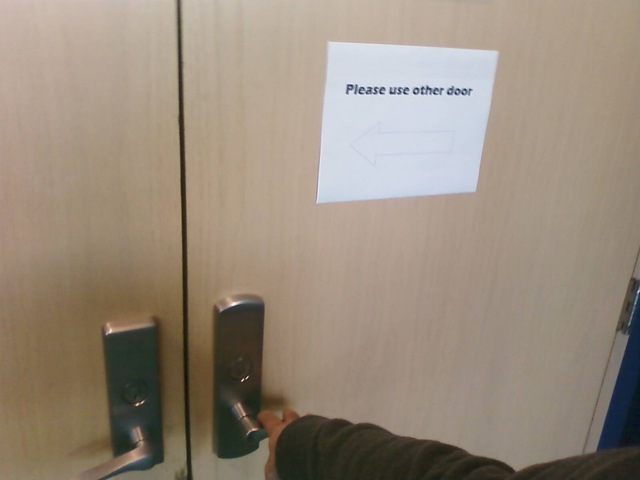
The picture below is of the entrance to the SBS MVP meeting room, where some of the most knowledgeable SBS experts got together with Microsoft SBS team to share feedback, direction, opinions and why wizards are so neccessary because people can’t read the damn documentation.

Here is the picture of the conference room door:

PIC-0012

If you are having trouble reading, the door on the right has a sign on it right at the eye level that says, in English, “Please use other door” and an arrow pointing to, well, the other door:

PIC-0015

The number of SBS MVPs grabbing or the locked door was just amazing. What was incredible though was that Chris and I were standing outside of the conference room looking and laughing at the whole thing.

Two MVPs went up to the door, could not open it, turned around and asked us if we knew if the conference door was locked. Chris said: “Use the other door” and the guys started to walk the other way in the hallway to try and find the other door.. “No, that door, the one on the left” like the sign says.

I decided to start taping the entrance but for some reason nobody wanted to walk in front of the camera 🙂

Hot Jenn

Friends
1 Comment

Earlier tonight we went to Hooters for dinner and we just couldn’t get over our waitress. Is your last name Wakefield? Do you know Jen Wakefield?

PIC-0023

Since I couldn’t get Jen on the cell phone I am just convinced she got a night gig and didn’t want to fess up to it. Here is a pic of her when she is not wearing orange shorts:

n612247487_178459_4487

Oh, and the hot Jenn is a Gator, friend Jen is a nole 🙂

Work in progress indeed…

Microsoft
1 Comment

So Ballmer was joking about Vista and while I wholeheartedly wish the details of that discussion were kept private, in the real world it is a joke that is not very funny to any of us that make a living supporting/managing Vista solutions. I think the OS is great, I bought a new system when I rolled it out at home, with the exception of one device that needed an x64 driver (my fault and vendors fault, not Microsoft’s) it has been very good.

Where the Vista (and Mobility) and Microsoft tend to fall apart is consistency. The products do not consistently perform in a way that one would expect them, here is my own XPerience over the weekend:

Got home after being out for a week. Windows had applied the newest security patches and shut my system off (instead of reboot). Upon powering on Vista my network card was dead, apparently whichever driver Windows installed disconnected my system from the Internet. OK, reinstall drivers. Upon reboot, I found out that my Outlook OST was corrupted (how did that happen?) and instead of repairing, it told me to run scanpst which is not in the run path but under 3 layers of user-unfriendly Microsoft-centric hiarchies (\Program Files (x86)\Common Files\System\MSMAPI\1033) and oh, it just might run for a few hours.

That is not the kind of an experience you want to give your user base in 2008.

For their share, both Mac OS X systems in the office (secretary’s and my desk) were up and running, smugly.

The New View

Microsoft, OwnWebNow, SMB
8 Comments

Today was a rough day, I am knees and elbows deep in fertilizer working on the rose garden that is Own Web Now and what it represents. This is pretty difficult for me to write so please take it with a grain of salt, in all sincerity, this is the first post that I hope nobody is offended by. In order for any rose to continue to grow and bloom, some big branches have to be cut down, blooms removed right after they are the most beautiful and soil planted, replanted and refurbished from time to time.

OWN, in the eyes of many of our customers, is Vlad(tm). Truth is, there are so many people, partners, vendors and organizations that make this possible. I had never envisioned going into a business as some dark overlord of IT with the Exchange superpowers, I always thought that OWN could and would grow into being an organization that benefits businesses, big and small, new and old, and that we worked on the organization that would serve the clients, not a company that would have to put up with things, deal with politics, cut deals and agreements just to make a buck. But fast forward a few years and here I sit on my throne, looking at the incoming CID LCD and wondering if I really want the hassle. Here is how I came to my answer:

Last weeks MVP summit was a huge eye opener because I had no big agenda, I had no hunger, I had really just wanted to enjoy the company of some of the smartest people in this business, buy a few drinks and meals and hopefully learn something new. What I learned is that the opportunity to serve is far bigger than the opportunity to try and change peoples perceptions and set ways.

What I mean by that is that I got to see what Microsoft thinks is the future, I got to see my peers across all markets, I got to see the value delivery that is provided across all segments of the business – IT, services, development, infrastructure, sysadmin. Clue: it’s all the same. In every sector, there are 10% of people who are hungry, dying to have you come in and solve their problem. Then there are 90% of the others, which cause problems for you. Who in their right mind wastes their time on the 90% of the problem cases just because they demand attention instead on nurturing the 10% and making sure that the 10% are the future of your company?

Friday Massacre

OWN was a company built on partnerships, but partnerships are a double edged sword. They are great when they work, they are awful when they have to be broken. Unfortunately, today I had to go through my list and break quite a few of them. For years I have tried to be a good guy and give people the benefit of the doubt, to work with people when they are being difficult, to go that extra mile even when I know I am losing an account. No, it does not make sense financially, but I wanted to know that people didn’t hate me and my company even if we had disappointed them to the point that they virtually had to look elsewhere. I put up with a lot – deadbeats, assholes, gurus, power users, knowitalls… because my reputation was on the line whenever the company reputation was on the line.

But at this point, in 2008, as I am about to go on a leave, this company is about a lot more than me. This company is about the people that work with it, some around the clock, to make sure we and our partners can take the clients businesses to the next level. I have to, ethically, balance the equation of pleasing the partners and creating an environment that is not stress-oriented and driven by the whims of difficult people.

The primary question is – is this fair to the customer, is it fair to the partner, is it fair to OWN employees and is it fair at all?

In 2007, we solved the issue of unreliable SMB email with LiveArchive, nothing else on the market does quite the same thing with so little effort. In 2008, we aim to arm our partners up with the tools and skills they need to flourish. We look towards creating a scalable two-factor authentication offering that can be acquired and managed on demand, from one employee to thousands. We look to help the community of professionals around OWN so we can help serve more people where they are. We look to give advantages to the partners in the countries that have traditionally been overlooked.

So is it fair? Is it fair that the small group of people ruin everyone’s support experience because they crank out tickets instead of reading the documentation? Is it fair that partners cannot behave ethically, and cause us to restrict and limit the functionality of the product that could help those that need those features the most? Is it fair that partners can behave like dickheads and ruin the day of the individual that is trying to help them, so that the next person doesn’t get the spectacular support they deserve? Is it fair that my partners don’t get the kind of attention they deserve because it is being eaten up by people who are in trouble because they didn’t do their job and tried to pin it on us? Is it fair that we are spending time, money, resources and effort on dead ends instead of being open and welcoming and actually building instead of trying to find ways around stuff?

No, it’s not fair and it’s not fair to anyone involved which makes today a particularly tough day. It is hard to say goodbye to people that would rather stay and pain it through, even if we both know they would be happier elsewhere. So we’ve opened the door.

Not all business calls are easy, not all business transactions are fair. Thats life, thats entreprenurial spirit, that is the reality of any organization that looks to do better things for more people. If we have done that, and if I have to sacrifice some short term happiness to make sure we are posed to do that in the future, I will sleep very easy at night indeed.

I’d rather feed the hungry and empower the ambitious than beat myself down trying to change the minds of those marching towards their doom. In fact, that is our mission statement.

So today, I got rid of 20 service providers we used to work with, because we were no longer working together, we were working against one another. If you recall, this was the negative sentiment towards Microsoft that I took to Redmond as well. Truth is, these 20 partners accounted for majority of the support nightmares and demotivating events for my staff, and I would like to publicly thank Mark Crall from TechCare Team who took the time to help me come to this decision back in November when I first turned to him for advice, and for my homies in Karl Palachuk, Erick Simpson and Dave Sobel who always have my back and beat me up when I’m going in the wrong direction. Thank you guys.

On a brighter side, if you were looking for an asshole duel, today is a great day.

P.S. Life is too f’n short and Chris had it right when he talked about ego’s – some people really make themselves out to be 90% of the problem, even if they only represent 0.0001% of the solution. No great business gets built on trying to please that. Despite what opinion some of you may have of me, businesswise, I think we’d be a lot better off if I hired an evil sidekick that was just a complete ass. I’ve been too damn nice to far too many people and I apologize to my staff, my partners and our collective client base for having misprioritized our attention. I am trying to fix it.

So I guess NDA means nothing anymore? Ok, I’m going to break mine too.

Microsoft
5 Comments

Geez, I guess NDA’s mean absolutely nothing anymore. Check out this assclown, that posted verbatum, out of context, commentary from a private Microsoft event to a room full of people that signed a stack of NDAs. So yes, Ballmer said:

“Vista, work in progress.”

He also happened to do it in a joking mood, to a favorable crowd, to a (fanatical) audience, in a response to a very tough question from enthusiasts who shared the pain of trying to help people that got onto the new OS. Should we just crucify the guy for making a bad joke? (the line, not the OS)

Whether fair or not, Microsoft will get beaten up in public about this just because the head cheese has a sense of humor. Cause he isn’t human or anything like that. God forbid we try to laugh a little about our mistakes and pretend they never happened. Nah, that would be wrong, just put the blinders on and keep on pretending everything is ok, right?

Wrong! I like the fact that Microsoft’s leader cracked up a little about the mistakes and is working to overcome them. Microsoft needs more of them, Microsoft needs to defend their turf and bitchslap the Apple ads with that dirty little punk. If they could just hold back just short of abusing their monopoly, crushing their partners, being anticompetitive and pushing closed, royalty-ridden substitutes for standards approval… I think we would all be a little better off.

Best part of the day, Indian MVP asked Ballmer if he had a Shockey Monkey! Now that was friggin classic:

You are a CEO of the biggest software company, 80,000 people, 200 countries.. You must work all the time, how do you sleep at night? Do you have a monkey with shockey stick that hit you when you are trying to sleep? Ok, so I added that last part in but it knocked me out of my chair 🙂

Oh, and as for the NDA material. Microsoft Lolcatdrop, it’s a codename for the new smallbiz solution below SBS specifically targeted at euthanasia clinics. I think Dave Overton is heading that one.

I earned my MVP wings today

Vladville
5 Comments

Earlier today, I made a class-A jackass of myself, with a full on rant about the return of IT projects and the end of IT nightmares of just keeping it all organized and operational.

That at least is the crack we smoke at Own Web Now, the same crack I probably should have had before I decided to open my mouth.

But one benefit of MVPdom is that on Tuesday I was with Exchange MVPs, folks with big enterprise jobs working for HP, Coke, EMC, Quest. Today, I spent with the guys from Down Home Computers, Correct SOLUTIONS, Calvert, Black Warrior. Think all these guys are scared about losing their jobs/companies as Microsoft, Amazon, Google, etc, go to the cloud?

Nope.

Truth is, there is a consulting company for every shop. Users will always need advice, a signoff, a confidence that they are making the correct decision for their shop. One of my sales guys was working a new lead that didn’t know the difference between POP3 and Exchange hosting, he’ll be serving one man and startups, DIYers that just need an extra pair of eyes. My SBS compadres will be serving the small businesses that want strategic technology. Larger businesses will still serve the mess of middleware.

I aim to be in the middle of it because I believe I can beat Microsoft and the garden variety of ultrabig providers that have never been service companies and failed in every attempt to do it. So I am not giving up.

And I don’t want my fellow ITPROs to give up too. Listen, this game is far too big and it is evolving. Managed services is just a little fad stopgap of providing reliable services in the upper small business and higher, small business in the future will be going to something far more affordable and reliable…. but don’t think that because you aren’t selling an SMB thousands of dollars of infrastructure you are going to lose out on thousands of dollars of income – quite the opposite – you just will not deal with thousands of dollars of trying to make Microsoft stuff work, someone else will do that.

But where will the thousands of dollars end up going?

Into your pocket, for the services that only IT professionals can render. Development, business information flow. Your job will evolve from keeping stuff together and running into getting the stuff arranged in a way that it makes more money for the company.

I know you doubt that, but I can share thousands of stories with you of people who discovered a ton more money in their business thanks to Shockey Monkey (and alternatives) that simply organized their business and got it together. You can deliver the same promise to your customers.

Whether you’re one guy.

Whether you’re ten guys.

Whether you’re like me.

The future looks good, what we do is evolving.

Evolve with it, or die.

As for my rant today, it was brought to you by the makers of Nyquil.